
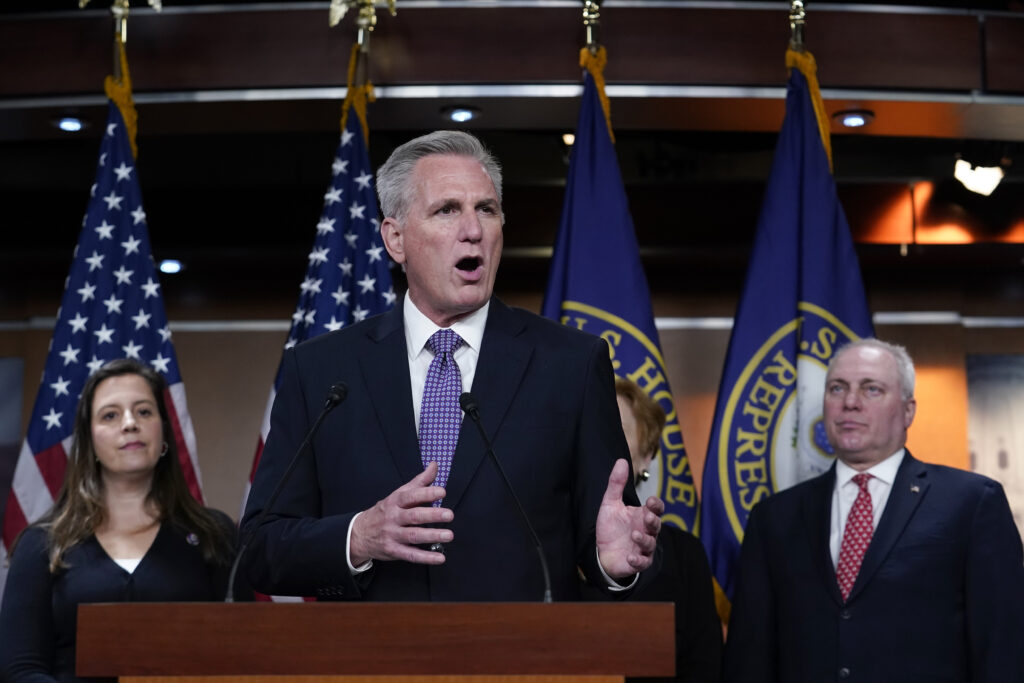
In recent months, Republican leadership in Congress has expressed their desire to make cuts to popular safety net programs like Social Security and Medicare. Most notably, probable Speaker of the House Kevin McCarthy and Senate Minority Whip John Thune both openly laid out their plans to make cuts to Social Security benefits.
Social Security is a program put in place by President Franklin Roosevelt’s administration as part of several pieces of economic legislation passed to help Americans after the Great Depression. Its main function is acting as an earned retirement plan, where part of an employee’s paycheck is put into a fund while the employer matches up to a certain percentage. The fund can then be accessed after the individual retires. Social Security usually ends up being the main source of income for retired individuals, and millions of people in the United States would be in poverty without it. The program also offers disability and survivor benefits.
Despite the immense popularity of this program, the current Republican agenda is to reduce its benefits. This plan involves Republicans refusing to vote on increasing the debt limit unless Democrats agree to make cuts to Social Security. McCarthy has said in the past that he will not rule out making cuts to social programs during upcoming debt ceiling negotiations. In an effort to get more votes in the speaker election, McCarthy is rumored to be planning on appointing members of the far-right Freedom Caucus to key committee assignments in anticipation of debt ceiling negotiations.
The U.S. government is set to reach the debt limit in the first half of 2023. Increasing the debt limit is something Congress must pass for the economy of not only the United States, but also the world to keep functioning as it does. Maria Freese, an expert from the National Committee to Preserve Social Security and Medicare, says withholding this legislation is dangerous.
“The debt limit is the authority to pay bills that Congress has already authorized,” Freese said. “Congress has already approved the spending. All the debt limit does is it gives the government the ability to borrow the money that’s necessary to pay for the spending that Congress has already approved.”
Should Congress fail to increase the debt limit in time, the United States would default on its debts. This could result in one of the worst financial crises ever, with spiking interest rates and stock crashes likely. With the country trying to recover from the effects of the COVID-19 shutdowns, an economic blow like this could have detrimental consequences for many years. Despite these risks, Republicans seem content to dangle the debt limit over the Democrats so they can get their cuts to welfare programs passed.
Democrats could have avoided this debt ceiling struggle by voting on it while they still had control of both chambers of Congress. But they failed to get a vote on the debt ceiling before the 117th Congress expired on Tuesday. Now, it is uncertain whether Social Security benefits will be protected.
The president of Social Security Works, Nancy Altman, pointed out that this plan does not have support from most Republican voters, and that Republicans use misleading language to disguise their efforts.
“As polarized as the American people are, poll after poll shows that we are very united on Social Security,” Altman said. “Whether you’re a MAGA Republican or you are a union member, you see Social Security as vitally important. You want to see it expanded, and certainly not cut.”
Not only is Social Security one of the most popular programs in the United States, but more Americans want to see its benefits expanded, not diminished. Despite the data, Republicans want to make changes that would diminish Social Security’s benefits, such as raising the retirement age to 70 years old.
“Ideologically, it really puts the lie that government is the problem because Social Security is superior to private security alternatives,” Altman said about the effectiveness of the program. “It’s more efficient, it spends less than a penny on every dollar of administrative costs, it’s very fair in distribution and it’s universal. Their [Republican] donors don’t want to pay the cost of Social Security because they’re wealthy enough to self-insure.”
Wisconsin Sen. Ron Johnson (R) has suggested recategorizing the funds for Social Security and Medicare to discretionary spending. Social Security currently falls under mandatory spending, meaning the funds cannot be touched and are automatically distributed yearly. Changing this would allow Congress to make cuts to Social Security on a yearly basis.
“What Social Security is, is a pension plan,” Altman continued. “If you’re in your thirties and contributing to it, how can you rely on it if every year if it may not get reauthorized? It is mandatory spending for a reason. It’s the only way it can work; it’s a guarantee.”
For benefits to continue in full, expansion of Social Security is in fact needed at some point in the near future.
“There is a long-term financial issue relating to Social Security,” Freese outlined. “In that the revenue from payroll taxes will get to a point where it won’t be enough to cover all the benefits that are due to people throughout the program. The best estimates we have right now is that will happen sometime in 2033.”
Democrats have repeatedly put forth bills in Congress to expand the benefits of Social Security, but they haven’t been able to surpass the 60-vote filibuster threshold to get the policies through a divided Senate. One of the latest attempts was the Social Security Expansion Act, which was introduced in June by then-Rep. Peter DeFazio (D-Ore.) and Sen. Bernie Sanders (I-Vt.). With the Republicans now in control of the U.S. House of Representatives, there is less of a chance that this bill will pass in its current form. And they are willing to risk a world economic collapse if it means getting what they want.