
Abortion
Wisconsin’s Supreme Court election could drastically change the state
On Feb. 21, Wisconsin will hold an election to fill an opening seat on the state Supreme Court. Republicans currently hold a 4-3 ideological advantage on the court, but retiring Justice Patience Roggensack will leave the court’s majority up to the election results.
Four judges are running to fill the vacancy including two liberals, Dane County Judge Everett Mitchell and Milwaukee County Judge Janet Protasiewicz. Waukesha County Judge Jennifer Dorow and Daniel Kelly are the two conservative justices filling out the ballot. The two candidates with the most votes will advance to a general election on April 4.
The four candidates appeared in a forum hosted by WisPolitics on Monday.
Kelly previously served on Wisconsin’s Supreme Court and was appointed by former Gov. Scott Walker (R) in 2016. He lost his election for a full term in 2020 to Jill Karofsky.
Roggensack, who was the chief justice when Kelly was on the court, recently endorsed Dorow for the vacancy. Dorow recently finished presiding over the trial of Waukesha Christmas parade attacker Darrell Brooks.
The outcome of this election could influence the future of Wisconsin in terms of abortion rights, voting rights and the drawing of congressional districts. When the U.S. Supreme Court overturned Roe v. Wade last summer, an anti-abortion law from 1849 was automatically reinstated in Wisconsin. Despite the efforts of Gov. Tony Evers (D), the Republican-controlled state legislature has refused to change this law. If liberals regain the majority on the Wisconsin Supreme Court, it could open the door for the right to safe and legal abortion returning to Wisconsin.
During the forum, abortion rights were a main topic for the candidates.
“I can think of no other greater impact that I have seen with the overturning of the Roe decision,” Mitchell answered when asked to name the worst court ruling he has seen. “I think the overturning of the Roe decision really put at jeopardy the idea of privacy that we were founded in the 14th amendment as a critical place of infrastructure as how we understood the law. It was one of the first times I can remember in my own history that a right was reached into the lives of people and taken away.”
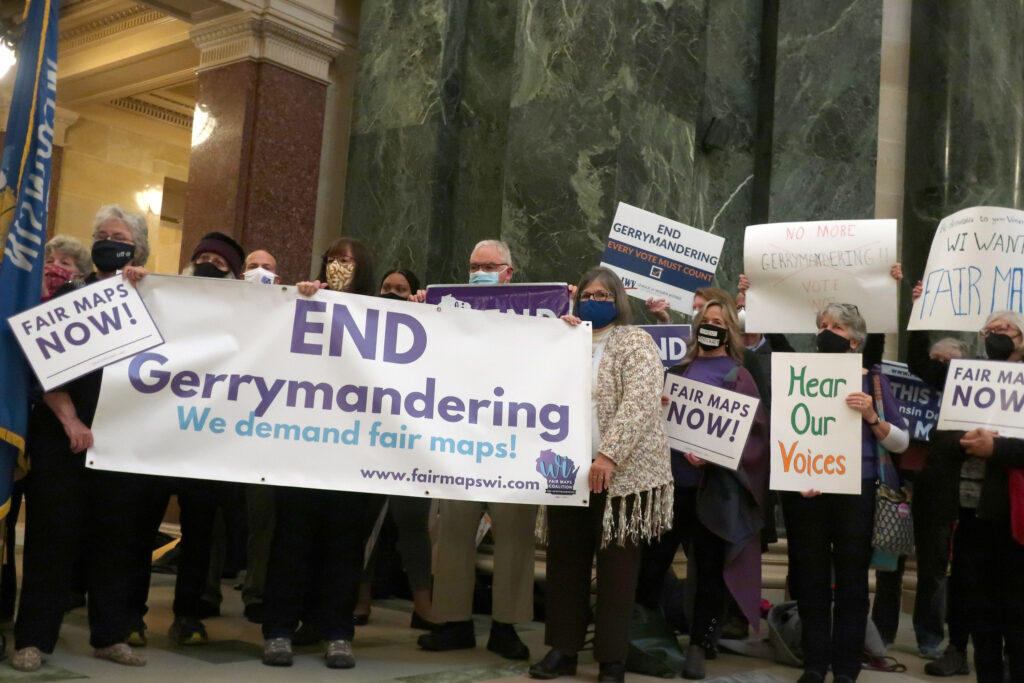
In addition to abortion, Wisconsin has seen heavy Republican gerrymandering in the past decade which spawned a U.S. Supreme Court case that the high court punted in 2018. A later ruling in 2019 saw the U.S. Supreme Court effectively uphold partisan gerrymandering by giving the power to individual states to police the practice. This kept the heavily partisan maps in Wisconsin that allows for misrepresentation in elections.
“Let’s be clear here: The maps are rigged, bottom line,” said Protasiewicz in the forum. “They do not reflect the people in this state. They do not reflect accurately representation in neither the state assembly or the state senate. They are rigged, period.”