
Biden
OPINION: Is The New York Times pro-Trump and anti-Biden? Recent coverage raises some serious questions.
Everyone agrees that the 2024 presidential campaign is historically important. Everyone also agrees that The New York Times occupies a special position as the paper of record and one of the largest media organizations in the world. Its news content decisions, from headlines to story angles, dictate news coverage everywhere else. Its opinion columns, columnists and editorial board positions steer policy makers and policy itself. Because the stakes are so high, we need to call out the biases that have colored the Times’ coverage of the campaign thus far and demand that they do better.
I know, claims of media bias are as old as the media itself. If you don’t like a news story, it’s easy to question the motivations of the specific reporter or the news organization. Conspiracy theories are frequently built on a false contention that the media is intentionally burying the truth about something. Trump himself built his political career bloviating about so-called “fake news.” He’s not the only politician who uses the media as a punching bag. Entire media organizations — like Fox — have been launched with the mission of pushing back against perceived media bias. It’s working. Research suggests that your political viewpoint influences which media you find trustworthy or not. My concerns are of a different sort.
And I want to be clear that the Times is an organization built on solid journalism values. Unlike the propaganda networks, the Times acknowledges and corrects any errors they make.
They publish their values and try to live by them:
“Over a hundred years ago, The Times pledged ’to give the news impartially, without fear or favor, regardless of party, sect, or interests involved.’ That commitment remains true today: We follow the truth, wherever it leads.”
It is precisely because of the respected position the Times has earned in the world of journalism that we all need to call them out for what must be described as dangerous biases impacting their campaign coverage decisions.
How do the editors explain the disparate coverage of recent primary season victories by the two candidates? Just look at the way the Times covered Biden’s win in South Carolina and Trump’s in Iowa. These are the facts:
- Biden wins South Carolina with 96% and 126,350 votes. The Associated Press calls the win at 7:23 p.m.
- Trump wins the Iowa caucuses with 51% and 56,260 votes. AP calls it at 7:31 p.m.
Now ask whether the subsequent coverage is informed by those facts or something else. The headlines about those two elections say Trump got a “big victory” while Biden got a “win.” Deeper in the stories, the language choices stray even further from the underlying facts.
The Trump story says:
- crucial first step
- record-breaking triumph
- important win
- largest victory ever
- striking
- race called after “only 31 minutes.”
- remarkable resurrection
- position him for a blowout on Super Tuesday
Compare that to the way the Times reporters describe the Biden win:
- uncertain measure of wider enthusiasm
- emphatic result
- race called “shortly after polls closed.”
- overwhelming majority
- not much drama
- important contest
Now consider story placement. In the print edition from last Sunday, the Biden South Carolina win was on page 20, while the main featured story on the front page was about a bullfight. The website that day placed the Biden story beneath two Nikki Haley features. By late Sunday afternoon, that Biden story was pushed off the homepage by a Trump story.

The New York Times home page on Sunday, Feb. 4 after the Biden election story was bumped by a Trump story. The screen shot is from 4 p.m.
Contrast that to the prestige placement of the Trump Iowa win. In the print edition of the newspaper, there is a large color photo of Trump accompanying the page one story. I think we can also surmise that the website that day featured Trump’s win prominently.
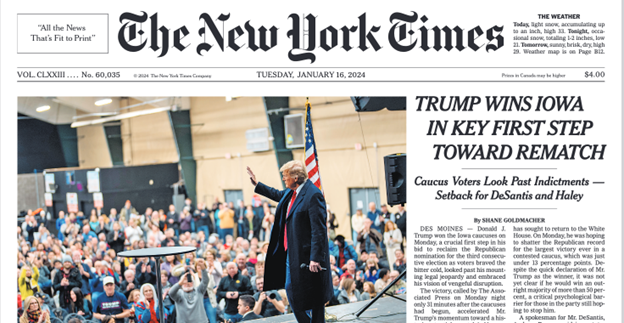
The top half of The New York Times print edition front page from Tuesday, Jan. 16, the day after the Iowa caucuses.
The headlines, the language and the placement all indicate a bias.
Okay, I hear you thinking. It was a one-time thing. Well, it is not. As I wrote last month, much of the mainstream media — including The New York Times — has an obvious bias against reporting stories about Biden voters. Google “Biden voters” to see what I mean.
Within The New York Times website, I found one story with an interview with one Biden voter and an opinion piece with a split Biden/Trump focus group. Contrast that to the years of Trump voter stories. Just since January, I have counted at least 12 Trump voter news stories and opinion columns. Add to that at least two editorials about Trump voters.
Why the chasm in coverage? It’s not like Biden voters are hard to find. At the last count, Biden had 82 million of them, 7 million more than voted for Mr. Trump. The bias against covering Biden voters leaves the impression that there aren’t any, the Times doesn’t care about them or both.
The Times’ coverage of the economy also seems biased against Biden. As we see a stunning economic turn-around, remarkable jobs reports and a stock market that’s breaking record after record, the Times coverage is suspect. Times columnist Paul Krugman recently told journalist Greg Sargent that he actually gets push back from Times editors when he writes a positive economic story.
That helps explain the flurry of headlines that report the positive economic news but also include what journalist Brian Beutler describes as “but fear looms” framing. Two of the worst examples are “The U.S. seems to be dodging a recession. What could still go wrong?” and “The market has had a fabulous run, but this peak doesn’t really matter.” Both of those ran on the very same day, Jan. 20.
I think it’s become obvious enough that the Times is making very different coverage decisions when it comes to Biden and Trump. Whatever their reason for this may be, the impact is dangerous and indistinguishable from bias.
Those of us who value good journalism must demand they do better.
Jennifer Schulze is a former Chicago journalist who talks media every month on WCPT 820AM on “Live, Local & Progressive with Joan Esposito” with former Chicago Tribune editor Mark Jacob. You can follow her on Threads @jenniferschulzechi or Twitter/X @NewsJennifer.