Abortion
WCPT’S Richard Chew interviews Illinois Lt. Gov. Juliana Stratton
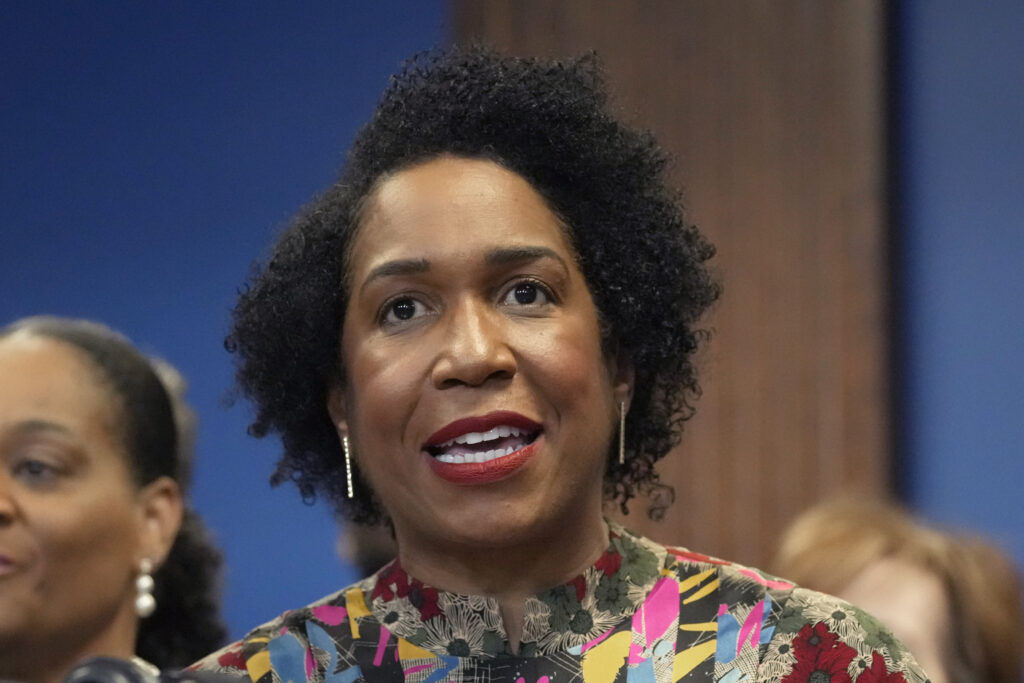
On Tuesday, Illinois Lt. Gov. Juliana Stratton (D) joined WCPT’s Richard Chew and talked about the work that she and Gov. J.B. Pritzker (D) have done to protect and promote reproductive freedom in the state.
She also touched on her work as chair of the Illinois Council on Women and Girls, which helps further her goal of “making Illinois the best state in the nation for women and girls,” and she talked about her historic role as the first Black lieutenant governor of Illinois and the “awesome responsibility” that it entails.
In the interview, the lieutenant governor called Pritzker “the greatest Illinois governor in my lifetime, and I believe he’s the best governor in the United States of America right now.” She and Pritzker came together, she said, “with a real focus on wanting to uplift communities across our state and we rolled up our sleeves and got to work, and that’s what we’ve been able to do, from raising the minimum wage to protecting reproductive freedoms to making sure that we protect LGBTQ+ rights, and also create, you know, fiscal stability in our state — you know, six consecutive balanced budgets, nine credit rating upgrades, paying off our bill backlog, all of those things that are so important to be able to do the work that we set out to do, the progressive values that we wanted to see carried out. So it’s been a real honor and joy to serve the people of Illinois.”
Below is the transcript of their conversation:
Richard Chew: I will not delay the direction we’re going right now and introduce to you guys the one and only, our lieutenant governor, Juliana Stratton from the great state of Illinois.
Good morning, Madam Lieutenant Governor. How are you today?
Lt. Gov. Juliana Stratton: I am doing great, Richard. Good morning to you and to everyone. How long have we been talking about doing this?
Richard Chew: Way too long, but we got it done. (Laughs.)
Lt. Gov. Juliana Stratton: (Laughs.) But we are here today and I’m so glad to be here. Thanks for having me.
Richard Chew: Thank you for being on the show. We met back in 2018 when you and Governor Pritzker were running for office and won, and then we had a chance to re-see each other back in March, when we were at the McHenry County Dems event–
Lt. Gov. Juliana Stratton: That’s right.
Richard Chew: — and you gave that lightning bolt speech. And my wife said, “I knew she was something else, but wow!” (Laughs.)
Lt. Gov. Juliana Stratton: (Laughs.) Well, that was a great event. And I always love traveling to the various counties, all 102 I’m trying to make sure I get to across the state of Illinois. And it was great seeing you there.
Richard Chew: Absolutely. Well, listen, our conversations have been — always been about substance and I appreciate what you’ve been doing for the state. And so many people that I’ve talked to and told that I’ve had the opportunity to meet you and talk with you, everybody just affirmatively smiles and affirmatively head-nods.
And I say this — and I’ve said this to you personally, one-on-one, and I say it on the air: You are doing a phenomenal job. You and Gov. Pritzker are. But you are — if there’s a prototype of a lieutenant governor in the country, I would say that that’s certainly who you are. And I appreciate your leadership, and I think you know that.
Lt. Gov. Juliana Stratton: Well, you do say that, and I appreciate that. And, you know, I love the state of Illinois, but I really just love the people of Illinois. And it’s an honor to serve alongside Governor J.B. Pritzker, someone that I believe has been the greatest Illinois governor of my lifetime, and I believe he’s the best governor in the United States of America right now.
But it’s — you know, we kind of came together with a real focus on wanting to uplift communities across our state and we rolled up our sleeves and got to work, and that’s what we’ve been able to do, from raising the minimum wage to protecting reproductive freedoms to making sure that we protect LGBTQ+ rights, and also create, you know, fiscal stability in our state — you know, six consecutive balanced budgets, you know, nine credit rating upgrades, paying off our bill backlog, all of those things that are so important to be able to do the work that we set out to do, the progressive values that we wanted to see carried out. So it’s been a real honor and joy to serve the people of Illinois.
Richard Chew: You know what’s been great? You talked about the — some of the care issues, as I’ll package it. You guys made it — you made Illinois a place for folks to come to when they were told that you can’t do certain things. You know what I’m talking about in terms of women’s reproductive rights. You said, wait a minute, this is your second home. You come here, we got you. We’re going to make sure that humanity reigns from our administration. And I’m telling you, lieutenant governor, there are so many people that I know in different states that were like, wow, you guys in Illinois are getting it done. And that’s something that you get to hold your head very, very high on in that space.
Lt. Gov. Juliana Stratton: Well, it’s something — you know, think about it. I mean, we — before the Dobbs decision, we here in Illinois were proactive. We passed the Reproductive Health Act even before the Dobbs decision because we trust women and we were listening to women, especially those on the ground, saying, “This is going to happen.” Like, these rights, you know. We know we had the Roe v. Wade decision, but trust me, they are working day and night to try to take away reproductive freedom. And so we were proactive, got the Reproductive Health Act passed here in Illinois, signed into law.
And then we went from there because we knew that after the Dobbs decision there would be women all across the country who would need to make sure that they could access safe reproductive care, full spectrum of reproductive care. But here’s the thing that I always have to remind everyone, Richard, is that while we have become an oasis, and while that is so important, and I’m proud of the work that we’ve done here in Illinois, to be an oasis for those who are in need of care, just think about how many can’t get here. Think about those that don’t have money for transportation, who don’t have money for hotels, who can’t take off work. Because unlike Illinois, they don’t have paid leave for all workers, they don’t have child care for the children that they have, and so they can’t come to Illinois. And trust me, they are coming from all over the country, not just neighboring states.
And so, you know, that’s why this election, come November, is so important because — there’s lots of reasons why it is but one of the ones that motivates me is reproductive freedom, and we know that Vice President Kamala Harris and Gov. Tim Walz, as a team, are the only ones who have made it clear at the top of this ticket that they are going to make sure that they want to restore the protections of Roe, that if she were ever to get a national abortion ban, total abortion ban on her desk, Vice President Harris said she would veto it as president. I mean, we have to remember, this is not just about what’s happening now; it’s for the generations to come after us, and that’s why this election is so consequential.
Richard Chew: It’s so well put. One of the things that I’ve been pushing men to do is to recognize that the reproductive rights isn’t just a women’s issue. Women’s health care issue isn’t just a women’s issue. It is a family issue. It is important that men lean into this and recognize that this impacts our lives, up and down the gender scale, and I’m fingers-crossed and fist-clenched that men recognize this isn’t just about women; this is about us as guys and as families.
Lt. Gov. Juliana Stratton: Absolutely. And thank you for making sure that that message continues to be put out because, think about it: The decisions that you make — let’s just start with the fact that people are also thinking about their own daughters, about their own partners, about their own family members. But even more so, based upon what you’ve said, these are family decisions.
If and when you decide to become parents, what is the economic outlook for your family and what you can afford to do, thinking about child care and all of those other decisions that have to be made. And I just think that that message, that this is a family issue, it’s not just a women’s issue, it’s a family issue is something that continues to be amplified because it’s so very true.
Richard Chew: You’ve got a couple of initiatives that I think are just amazing in terms of the Women and Girls Council and your agricultural initiatives. Second term now, how are those going? What’s your score for yourself in terms of those two initiatives?
Lt. Gov. Juliana Stratton: Well, I don’t know what the score is. I never quite think about it in that way. What I think about is, how can I use my bully pulpit and the influence of the Office of the Lieutenant Governor to continue to uplift our state? And honestly, the governor and I have a role of making Illinois the best state in the nation for women and girls.
So, I am the chair of the Illinois Council on Women and Girls. There are a few things that we are doing. One of them is an initiative that I’ve launched this year called We Thrive, and it’s really focused on women’s economic health and wellness. We know — in fact, I just read an article today, and every day I’m reading articles about how women are still in need of building their confidence because they face so many barriers at every level and spectrum of our lifetimes, starting with as young girls and thinking about in third grade, having an opportunity to go into STEM and how by third grade girls start to lose confidence around math and science. And there’s some systemic reasons for that. Or thinking about women and their student loan debt. And thinking about women who want to start businesses and getting only, you know, less than 1 or 2% of VC [venture capital] funding or don’t get as much money from banks to start their business. Women who are at the latter part of their lives — only 50% of women say that they are ready for retirement and yet they end up having to make more decisions because of our extended lifespans.
So I am looking at the full spectrum of a woman’s life and thinking about the economic barriers that exist for women and how we can tear those barriers down. Right now, we are listening so I’m doing statewide listening sessions to women from all demographics. I think this month, we’re talking to women with disabilities, for example, and talking about the unique challenges that they might face. We’re talking with Southeast Asian women or South Asian women who can talk about, you know, some of their particular barriers. But I’ve talked to women in labor, we’ve talked to older women who are retirement age, we’ve talked to, you know, Black women and Latinas and just women — rural women, women in agriculture. So our goal is to listen to women and then devise a real plan around how we can remove those barriers.
And then also with the Council on Women and Girls we have a Girls Lead program that’s going to be launched very soon, I believe this month, and this is where girls from fifth grade through 12th grade can shadow other women who are in leadership — me included — to really understand the opportunities that they have. And so this is our second year of that, and it went wonderfully last year. We heard girls say, “I never knew that my voice mattered in Springfield, and now I’m thinking about getting into this field,” so it accomplished exactly what we hoped for.
Richard Chew: That’s fantastic. And then, again, this is one of those “if you can see it, you can believe in it in” representation conversations because, as, you know, we know as two African American folks in the state, when folks see that there’s things that they can do and be and believe in that, then they move in that direction.
And that’s of any community. It’s not just — you know, the African American community doesn’t have the market cornered on that, seeing and believing. We know that we lost James Earl Jones. And I said earlier in the show today about growing up, his influence on me. I never really, you know, desired to be an actor, but the thing that —
Lt. Gov. Juliana Stratton: But you have the voice, Richard. You have the voice.
Richard Chew: (Laughs.) Thank you.
Lt. Gov. Juliana Stratton: You know, James Earl Jones had the voice. God rest his soul. And you have the voice. So it’s exactly what you said. Representation matters. And sometimes you don’t even know what’s possible until you see it. I’m the first Black lieutenant governor of the state of Illinois and there’s so many people who come up to me to talk about — you know, certainly elected officials but also others who just say, I had never seen someone in that role and now I understand what’s possible for me or for my daughters. And it’s an awesome responsibility.
Richard Chew: That’s great. That’s a great way of putting it in terms of responsibility.
So as we wrap up, because I know your day is busy, I wanted to ask you two final questions. The rest of this year — we know we have the election coming up and that’s in face — front for everybody right now. What are your goals, as lieutenant governor, as we get through the rest of this year? And I know that the election is a part of that, but what are some of the things that you and Gov. Pritzker have on your dart board right now?
Lt. Gov. Juliana Stratton: Well, thank you for acknowledging that the election is part of that. Of course, that’s not part of my official duties as lieutenant governor, but it is something that is at the forefront of my mind, making sure that we are successful with electing Vice President Kamala Harris and Gov. Tim Walz, and Democrats up and down the ballot, come Nov. 5. There’s just so much at stake, and many of the things that we are trying to do require partners in Washington D.C., who can make it happen and who will support us and make sure that when we have a vision for our state, that their vision is in alignment for the country so that we can move forward and not go backwards, which would happen, of course, under another Trump presidency.
But in terms of what we’re doing just in my office: As I mentioned, we’re going to continue to lay out the work of our We Thrive initiative. Briefly, I’ll just say that my Ag Connects Us All initiative is focused on how do we continue to build a more diverse pipeline and get more young people to be thinking about agriculture, especially as the industry ages? And in fact, later this month I’ll be hosting my first ag-tech summit, which is really to focus on workforce development and really thinking about building opportunities.
Listen, my family started off — when I think about my ancestors who had been enslaved, who were given a plot of land in Mississippi, now called Stephenville, Miss., named after my family — they were given a plot of land but there were racist policies through the USDA that stripped the land from my family and the wealth that came with it and from so many other Black families. And that story is not unique.
And so, I’m working to make sure that when we think about our state’s number one industry, that we are making it accessible to all and that we are tearing down some of those barriers that have kept too many people from benefiting from the bounty that this industry produces. And one of the ways is to help young people understand, agriculture is no longer just sitting on a combine. It is no longer just, you know, a tractor. It is tech, it is ag law, agrobusiness, it is communication, and if we don’t make sure our young people know about these opportunities, they’ll miss out on some really lucrative careers that can help them change the trajectory of their lives.
Richard Chew: And it’s something that impacts all of us through all demographics is our — the agriculture part of our community and our society at large.
So, Lieutenant Governor, thanks for being with us and a big high five and hug to you for all the work that you’re doing. How can folks — if they don’t already know, how can they find you and how can they get involved in the work that you’re doing as our lieutenant governor?
Lt. Gov. Juliana Stratton: Oh, I would love that. As a restorative justice practitioner, I believe the wisdom is in the room. And so the best policy is made not for people but with people and by people. So if you’re interested, please follow me on social media. You can find me @LtGovStratton; that’s my handle on X, on Instagram, on Facebook, also on LinkedIn. And on the other side, you can find me at @JulianaStratton. And I hope that you’ll follow me, but you can also reach out to my office. Just look for my website. There are lots of opportunities to get engaged, including our councils, some of which I talked about today. And I certainly look forward to seeing you in your communities.
Richard Chew: Thank you, Lieutenant Governor Juliana Stratton. A big smile on my face because I’m just thrilled that you were with us this morning. Thank you for taking the time. We’ve got your back, you know we do, and we hope that you’ll be–
Lt. Gov. Juliana Stratton: Well, thank you.
Richard Chew: We hope that you’ll be able to come back in the future.
Lt. Gov. Juliana Stratton: I hope you’ll have me back, Richard, and have a great rest of the day.
Richard Chew: You, too. Stay safe. We appreciate your work.
Lt. Gov. Juliana Stratton: Bye-bye.