
Harris
WCPT’s Joan Esposito interviews Illinois Attorney General Kwame Raoul
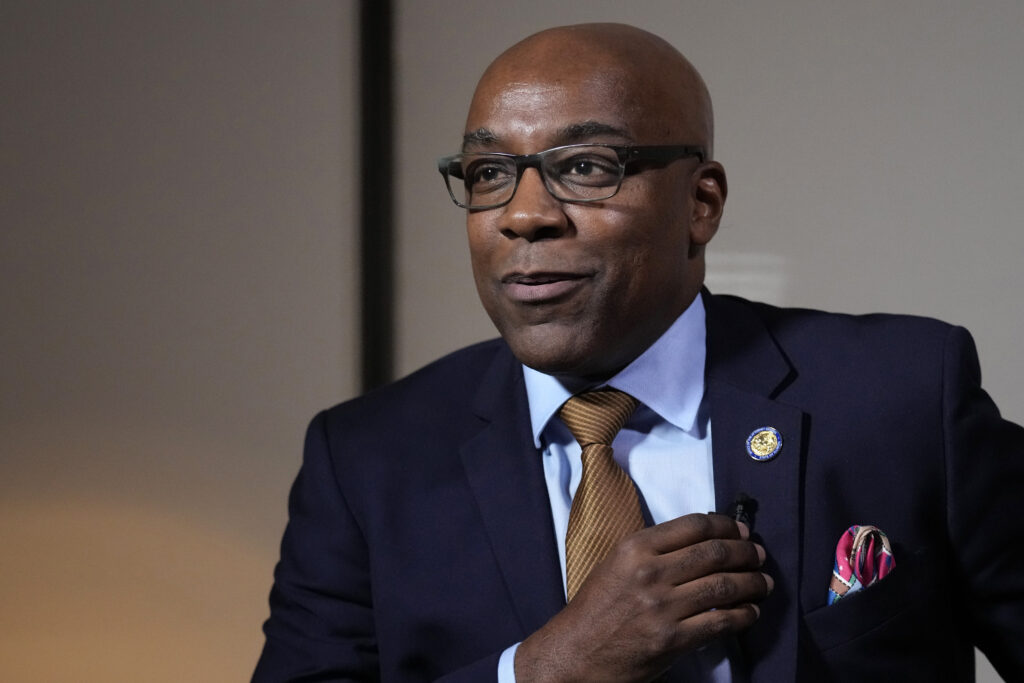
On Tuesday, WCPT’s Joan Esposito talked to Illinois Attorney General Kwame Raoul, who began a second term in office last year after winning reelection in November 2022.
In the interview, Raoul spoke about misogyny where it concerns Vice President Kamala Harris and men who “think that they somehow are compromising their manhood by supporting a woman to be in a position higher than whatever they have achieved and that it’s not displaying strength somehow, it’s somehow displaying a weakness.”
“If you can overcome any insecurity that you have with regards to that, then that displays strength,” he said, expressing sentiments similar to those that he shared with more than 40,000 Black men on a virtual fundraising call for Harris in July.
Raoul also talked about his efforts to protect women in Illinois from the aggressive tactics of state attorneys general like Ken Paxton of Texas, “who longarm into other states, like the state of Illinois” in order to gather medical records related to reproductive health care. Paxton recently sued the Biden administration to block a federal rule that shields such records.
And in the wake of the mass shooting at Apalachee High School in Georgia, Raoul advocated an all-inclusive approach for reducing gun violence. “It’s everything,” he said. “It’s the accessibility of guns, it’s making sure that minors are not in possession of such guns, making sure people with developmental disabilities aren’t in possession of guns, if they’re a threat to themselves or somebody else. It’s making sure that we don’t let trauma go untreated.”
Below is the transcript of their conversation.
Joan Esposito: We’re very proud to welcome to the airwaves our attorney general for the state of Illinois; Kwame Raoul is here.
Kwame, how are you?
Attorney General Kwame Raoul: I’m fine. How are you?
Joan Esposito: I’m wonderful. I have to tell you that I wanted us to reach out to you after I read your quote in Shia Kapos’s Illinois Playbook where you talked about taking part in the Black Men for Harris fundraising call. You talked about misogyny, which I want to talk to you about, but you said, I’m the father of a 24-year-old Black woman who’s in law school, adding that if he didn’t fully support Harris, a former prosecutor, as a Black dad to a young Black woman, “I’m not doing my job.” I thought that was a wonderful, wonderful quote.
Attorney General Kwame Raoul: Oh, thank you. And I often reference my family, my children when I talk about policy or when I talk about politics because, for me, family’s first but it’s the inspiration for what I do and it’s the lens at which I look at what others do in public service. And so to have a daughter who’s aspiring to be a lawyer, who I’m going to say to her, and I have said to her, the sky is the limit for you, there’s no ceiling on what you can do as long as you work hard, and to have her be in law school at a time when we have a woman who has done just that, in Kamala Harris — I have to be critical of others who unfairly change the standards with regards to who is qualified and who is not qualified to be president.
Joan Esposito: With the candidacy of Hillary Clinton, while it certainly wasn’t the only reason, misogyny seemed to play a big role in that election and — as months ago, when Nikki Haley was still in the Republican primary. I know some reporters went out and interviewed Trump voters and they were saying — and sadly, Kwame, it was women as well as men saying, “Oh, well, we just don’t think a woman could be president.” And there were women who said, “Well, you know women are nurturing, and, you know, when it’s that time of the month is she going to be unstable?” And I just couldn’t believe, in this day and age, we were still hearing that kind of misogynistic nonsense.
It must make you crazy, especially when you look at your daughter who’s about to embark on this career and you know that your daughter should absolutely be taken seriously. I don’t know what we do about those sentiments against women. What’s your insight or suggestion?
Attorney General Kwame Raoul: Well, we have to step up, you know, as men who appreciate that — I appreciate — I advocated all the way to the district court in D.C. — to the appeals court in D.C., rather, for the Equal Rights Amendment. Unfortunately, you know, we were successful, not based on an argument on the merits or the amendment itself but on other technicalities. But we have to raise our voices both as men and women for that equality in every form.
If you have somebody who’s put the work in to achieve whatever their position is — I’ve had plenty of women who I’ve had to answer to as a supervisor, as bosses, and they’ve all been qualified to do so and I’ve always been deferential in that context. So equally, as an elected official, if I see somebody who has served as a local prosecutor, served as a state attorney general or served as a U.S. senator and served as vice president, or alternatively, you mentioned Hillary Clinton, somebody who served as secretary of State and engaged with world leaders from around the world, and there are folks who are saying they can’t support them and can’t really articulate a substantive reason as to why they can’t support them, it’s my obligation to speak up, and that’s what I did on the call where we were fundraising for Kamala, a day after she — her candidacy was announced.
Joan Esposito: What exactly — I wasn’t listening in on that particular call. What did you share with the audience?
Attorney General Kwame Raoul: Well, it was a Black Men for Kamala call; it was organized by various individuals and, you know, I said that I wanted to address the elephant in the room, that, you know — it’s not unique to the Black male community; as you mentioned, it’s not unique to Democrats. As you mentioned, it happened with Hillary and it’s happened with others.
You know, sometimes men, in general, think that they somehow are compromising their manhood by not — by supporting a woman to be in a position higher than whatever they have achieved and that it’s not displaying strength somehow, it’s somehow displaying a weakness. And I said it’s the opposite of that. You display strength by not having the insecurity to drive you to withhold your support of somebody who is qualified, simply because they are a woman. If you can overcome any insecurity that you have with regards to that, then that displays strength, not withdrawing from such support.
Joan Esposito: When Trump has tried to get under Kamala Harris’s skin by baiting her with race and, you know, she wasn’t always Black, she used to just be Asian, and she responded, you know, just kind of same old, same old, next question, moving on. That seemed like the best response to me, rather than, you know, something maybe viscerally I might have wanted her say. (Laughs.) He’s an idiot! But, you know, I guess we can’t all have what we want every time. Would you suggest that she continue to just turn the other cheek and take the high road on that?
Attorney General Kwame Raoul: Yeah, I absolutely would. I wasn’t anticipating that type of response, but I thought it was the best response. It probably wouldn’t have been my response. I might have taken the bait.
Joan Esposito: (Laughs.) You and me both.
Attorney General Kwame Raoul: (Laughs.) But, you know, we have to understand that for what it is. It’s what I call the Willie Lynch Syndrome. It’s a concerted effort to divide amongst the Black community, and we can’t fall for it.
You know, who is Donald Trump to judge somebody’s identity as a Black woman? (Laughs.) There’s no such authority to do so. It’s clearly an attempt to divide, and her response is an appropriate one: Nope, don’t even give it the distinction of trying to debate it.
Joan Esposito: I’m joined by Illinois Attorney General Kwame Raoul. On Sept. 8, he issued a statement reflecting on what the attorney of Texas was trying to do; that is Ken Paxton, an all-around completely unsavory human being who is challenging efforts to try to protect women’s medical information. The belief is that these are the kinds of steps that would lead to this idea that women would not be allowed to leave the state to get abortion care, or that their movements would be monitored, if these sorts of Republican entities can get access to this medical information.
Kwame, explain that a little bit better than I just did, please.
Attorney General Kwame Raoul: Yeah. So I just happen to have been in Texas, actually a women’s health clinic, in May, and Texas has a near full ban on abortions. And additionally, they try to criminalize folks who either seek out an abortion or provide the services. So you have providers — the consequence of that, and I heard directly from patients and advocates when I went to Austin, Texas, is that even when women are seeking out — not seeking out an abortion but seeking out miscarriage care, for example, they have trouble having providers put forth the standard care for miscarriage care, for fear of being prosecuted within the state of Texas.
So in April, the Biden administration issued new rules connected with HIPAA, which is a privacy statute — you know, we all know that when you go to the physician you have a right to privacy in your medical records. And that goes for reproductive health care as well, making clear that, you know, you can’t, you know, subpoena such records for a law enforcement purpose.
And so, you know, the Texas AG is trying to longarm into other states, like the state of Illinois, which, you know, respects women and respects women to make their own health care decisions and protects — we actually have a shield law that protects against folks from other states trying to subpoena records for what’s lawful within this state. And so, it’s outrageous and audacious for the Texas AG to try to challenge this rule so that he can prevent women from seeking care in states that respect a woman’s right to choose.
Joan Esposito: I know that Texas is its own entity and sometimes I think some of these politicians are just playing to a Texas audience, because right before an election, where this is a hot-button issue and it is believed that it is going to bring especially young voters out in droves to try to pass some measures to restore some of these rights, it sure does seem like Ken Paxton is absolutely tone deaf, unless you think — is he just playing to a Texas audience that he thinks is going to eat this up?
Attorney General Kwame Raoul: Well, I mean, it’s both. It’s certainly politics but it’s very bad politics. But more importantly, it’s bad public policy. I just want to reiterate: This doesn’t just impact abortion. This impacts other reproductive health care where you have providers within the state of Texas who are fearful of providing the standard care for other reproductive needs and putting people’s lives at risk as a result because of a fear of being prosecuted or investigated by Texas authorities.
And it’s not unique to Texas. You know, we’ve got some surrounding states that are equally as audacious and threatening to patients and providers and advocates who might help them.
Joan Esposito: Before we wrap this up, I also wanted to touch on the shooting at Apalachee High School, which just broke everyone’s heart all over again. You issued a statement about that. I think, regardless of how you feel about women’s reproductive rights, just the idea that Democrats are willing to try to do something, whether it’s red flag laws, whether it’s background checks, whether it’s waiting periods, whether it’s banning assault rifles — Democrats seem to be the only party that are willing to try to rein in guns.
And I swear to you, if I hear one more Republican offering thoughts and prayers, I just don’t know what I’m going to do. Where do you fall on this issue? What do you think would be effective in this area?
Attorney General Kwame Raoul: Well, so gun violence — and I’ve spoken to this in both of my inauguration addresses, back in 2019 and again last year, in 2023, that every public official should seek to make a contribution to fighting gun violence and we should do this in dedication to our children, because gun violence has now outpaced automobile accidents as the number one killer of children in our nation, and everybody should be ashamed about that. And we’ve allowed it to rise to this level, and it’s not just one thing.
So, you know, while we engage in our advocacy, we need to be comprehensive about it. We certainly are in our office. You know, we’ve made sure that we advocated and had the legislature pass a law that fights against those in the gun industry that would market to kids or to other people who are ineligible to possess guns. We’ve sued to have the license of a rogue gun dealer revoked. We’ve partnered with ATF and other authorities to prosecute gun traffickers and straw purchasers. We’ve worked on intervention by embracing and investing in intervention advocacy, such that we can stop people from evolving into shooters.
I often say, and it’s controversial sometimes when I say it, you know, probably the number one thing we could do: get to know the shooter, because I know nobody who came out of the womb with a heart to take — with a gun in their hands and a heart to take their neighbor’s life.
Joan Esposito: Well, and this case is the perfect example of that. You’ve got a very troubled kid coming from a troubled home, a kid who, according to his aunt, repeatedly asked for mental health help that was not given to him, a mother who called the school that morning after getting a text from her son where he was threatening violence at the school, and a call that I don’t know whether it didn’t get through or it certainly seems that it wasn’t taken seriously. It’s just this whole — this whole family was such a mess. And that’s so often the case.
Attorney General Kwame Raoul: Yeah. And that’s — we do a lot of — we partner with Secret Service’s National Threat Assessment Center. Everybody knows Secret Service is in the role to protect the president and other federal officials, but they’ve turned their science in a way to protect against acts of targeted violence. And we’ve done maybe about 15 trainings since I’ve been AG because people need to be aware when those red flags come up and they need to know who to call and who will respond to it, because a lot of these mass shootings can and should be prevented, if people know who to call and what to look out for.
And the other need it does raise is mental health. Now, when I say that, you know, I don’t want to be like a Republican and just say, oh, it’s just all mental health; it’s not guns but it’s mental health. It’s everything. It’s the accessibility of guns, it’s making sure that minors are not in possession of such guns, making sure people with mental — with developmental disabilities don’t — aren’t in possession of guns, if they’re a threat to themselves or somebody else. It’s making sure that we don’t let trauma go untreated. And it’s not just focusing on the person who pulled the trigger; it’s focusing on the person who participates in an industry that is targeted towards trafficking to people who they know will do harm with guns.
Joan Esposito: Yeah. Do you think the idea of allowing gun companies to be sued — as we do with every other company that sells a product that is potentially harmful — would that bring about change?
Attorney General Kwame Raoul: Well, certainly, as we’ve seen in other industries, whether it’s automobile industry or other industries, civil accountability has led to safety measures, for certain, and it’s outrageous, I think, that the gun manufacturing industry is provided with some immunity at the federal level.
That said, you know, there is a window of opening even with that statute that allows existing state laws to call for industry accountability, and that’s what we tried to do with the Firearm Industry Responsibility Act, targeting those who market to kids or market to illegal militia or participate in other deceptive practices.
Joan Esposito: It has been a pleasure talking with you, Kwame. Really appreciate you taking time out for what I know is a very busy day to talk with us.
Attorney General Kwame Raoul: My pleasure. Thanks for having me.
Catch “Joan Esposito: Live, Local and Progressive” weekdays from 2:00 to 5:00 p.m. Central on WCPT (heartlandsignal.com/wcpt820).