
Crime
Wisconsin Supreme Court candidate Susan Crawford talks election, her life story with WCPT’s Patti Vasquez
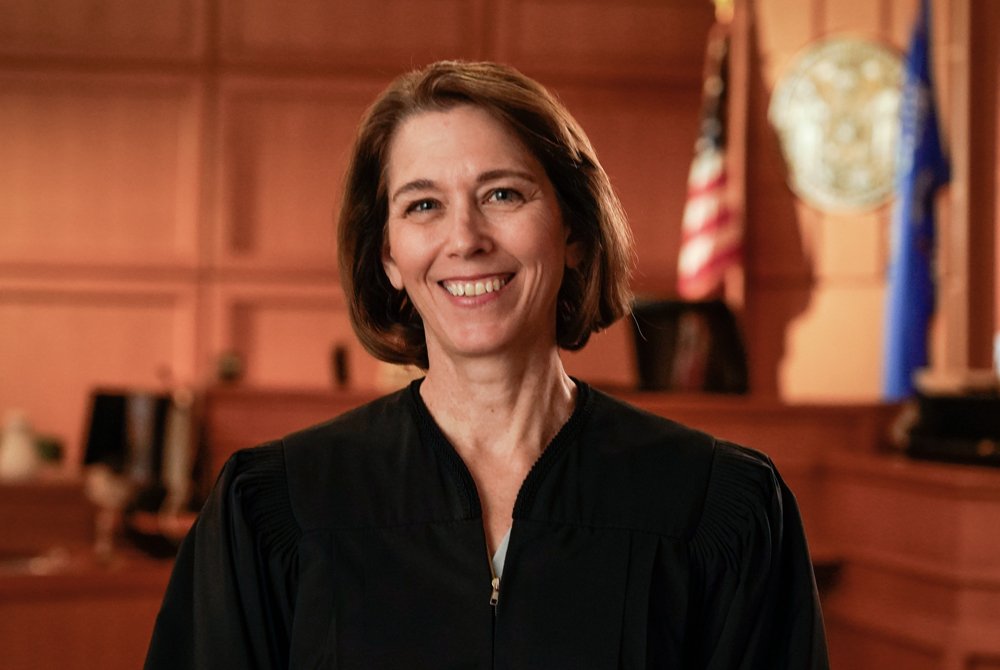
Last Friday, WCPT’s Patti Vasquez spoke with Wisconsin Circuit Court Judge Susan Crawford, a candidate for the Wisconsin Supreme Court race on April 1 that will determine control of the court.
Her opponent in the statewide, nonpartisan race is Brad Schimel, who has been a judge of the Waukesha County Circuit Court since 2019, following a four-year stint as Wisconsin attorney general under Republican Governor Scott Walker.
After earning a law degree from the University of Iowa, Crawford began her career as a prosecutor at the Wisconsin Department of Justice. In the interview, she highlighted her work in healthcare fraud and appellate cases and criticized Schimel’s handling of the state’s sexual assault evidence backlog during his tenure as attorney general.
“I don’t know whether it was incompetence or just deliberate disregard for the priorities of the office,” Crawford told WCPT, “but he didn’t get it done. And we don’t need somebody like that on our Wisconsin Supreme Court. We need people who understand that crime victims need to be protected and offenders need to be held accountable.”
Crawford added: “The thing I mainly want voters in Wisconsin to understand is that I’m running this race to protect them and to protect their rights, and I’ve really pledged to be a fair, impartial justice and to make common-sense decisions that keep in mind that those decisions are about people’s lives.”
Below is the full transcript of the interview. (Please note: The transcript has been edited for clarity.)
Patti Vasquez: Tell us a little about yourself, because you have really had a tremendous career in law. Where did you grow up? What part of Wisconsin did you grow up in?
Judge Susan Crawford: Yeah, thanks, Patti. I grew up in Chippewa Falls; that’s in western Wisconsin. Had a great childhood there, riding my bike all around town and going swimming at the public pool every day. And I went to public schools all the way through elementary school, middle school, high school. Graduated from “Chi-Hi,” which is what we call the Chippewa Falls senior high school there. And yeah, just had a great Wisconsin childhood.
Patti Vasquez: And did you want to be a lawyer or even a judge when you were a kid? Because I wanted to be a lawyer around, like, in high school or so. It didn’t happen. I didn’t pursue that. But when did you know?
Judge Susan Crawford: Being a lawyer was really not on my radar at all as a kid. I didn’t know any lawyers, I didn’t know any judges. So it just wasn’t something I even could have thought about at the time. I really wanted to be a teacher when I was a kid, and I was a big reader and a good student. And so that was really my goal when I was a kid growing up in in high school.
So law came quite a bit later on, after I had graduated from college. And I actually tried out graduate school for a while in English, which is what I majored in in college, and then decided I really wanted to do something where I could help solve problems in our society and just be a lot more actively engaged in the issues that really affect people’s lives. So I started law school, and I went to the University of Iowa for law school, which at the time was the most financially viable option for me. [I] got a great legal education there and eventually found myself at the Wisconsin Department of Justice as a prosecutor, and that’s where I started my legal career in Wisconsin.
Patti Vasquez: When you say you wanted to solve problems — and by the way, folks, a degree in the liberal arts is such a really great starting point for everybody. Unless you want to be a doctor, want to be an engineer — obviously a different direction. But for people like you and me — I have a degree in history, and that’s also a jumping-off point for a lot of lawyers, philosophy, all those things. And when you mentioned you wanted to solve problems, that comes from wanting to read and understand stories. We learn about those problems, don’t we, in society and in relationships, don’t we?
Judge Susan Crawford: Yeah, absolutely. I think some of it was born from experiences that I had growing up. My dad was laid off from his job. He was an engineer, was laid off when I was in high school. My family went through a lot of really difficult times financially. My mom worked as a clerk at an office supply store and for a while. That’s what my family was surviving on. And as a result, I financed my own college education. I was really lucky to go to a college that offered me a lot of financial support and scholarships and things like that.
But going through some of that and seeing the struggles that my family went through, and I also had a younger sister who was born with a lot of medical issues and had some special needs, and seeing my family really struggle to get her the care that she needed. Those are part of my life experiences that really shaped my values and made me want to give back and contribute to our community and make sure that people have what they need to live a good life and achieve the American Dream.
Patti Vasquez: Wow. Well, Susan, I was going to go door-knocking for you regardless, coming up in the next few months. I have a beautiful boy who has significant challenges and has special needs. Knowing that we might be able to elect a justice on the Supreme Court of Wisconsin who gets it, who’s a sibling, because your parents had to have managed — I guess you would say thread that needle of making sure your sister had everything she needed, as well as making sure you were supported in every way possible. And clearly, they did, and you found that way. So it informs everything.
Tell us a little bit about the path from being a prosecutor, working with state agencies, being an attorney and becoming a judge and being on that bench.
Judge Susan Crawford: Thank you, Patti. I’ve always looked for the opportunities during my whole career, where I could use my experience and my skills and my education to make life better for people. And all the time that I’ve been working in Wisconsin to try to protect people’s rights and make sure that the promises that are made to people in our Constitution and in Wisconsin law are actually delivered to people.
So, as I said, I started out as a prosecutor at the Wisconsin Department of Justice. I was handling cases in the trial courts. I worked in health care fraud, prosecuting people who were stealing money from the state Medicaid program, which is intended to provide health care to poor people, and also worked in the appellate court — so that’s the Wisconsin Supreme Court and Court of Appeals — handling felony cases to make sure that people who had harmed the community were held accountable and that crime victims were protected and that our communities were kept safe.
I first argued in front of the Wisconsin Supreme Court in 1998 and, as a prosecutor, I always looked at my job as all those things, protecting our community and protecting crime victims, but also doing justice. And because I was involved at a point in the process that was really all about developing the law and making sure that Supreme Court decisions in criminal cases gave good guidance and direction to prosecutors and defense attorneys and law enforcement, I always had to look at the bigger picture about what was needed to do justice. But then after that, I served in Gov. Jim Doyle’s administration, helping to lead state agencies. I was chief legal counsel in the governor’s office. And then after that, I was in private practice protecting the rights of ordinary Wisconsinites in our courts.
Patti Vasquez: Absolutely remarkable. So, tell us a little bit about the things that you see happening in Wisconsin that you want to make sure that people understand is really so [paramount], as we move forward, in this experiment of democracy.
Judge Susan Crawford: Yeah, well, thanks for that Patti. I’m going to take the long view on this. We’ve seen in Wisconsin, periodically, times when our rights have really been threatened. With the Dobbs decision, for example. After 50 years of women being able to count on their constitutional right to make their own decisions about their health care, about their families, the Supreme Court stripped that away because of a change in the personnel on the U.S. Supreme Court. And as a result, we now have a couple of cases moving through the Wisconsin Supreme Court that will determine whether women are able to make their own choices about their families and about their health care, whether doctors will be able to provide those services to women, or whether we’re going to become another state like Texas, where women are literally bleeding to death on a hospital gurney while their doctors struggle to decide if they’re close enough to dying to get the health care they need. This race is a race that has some really significant consequences. There are literally issues that are life-or-death issues for Wisconsin citizens. That’s just one of them.
Our public safety is obviously always an issue in these races, and that’s why I talk about my career as a prosecutor, work I did at state agencies to protect the public, and work that I’ve done as a judge. I have sentenced people, and when I believed that they need to be put away in a prison to keep our community safe, I have done that.
And I haven’t really talked about my opponent in this race yet, Patti, but-
Patti Vasquez: Please do. (Laughs.)
Judge Susan Crawford: Brad Schimel — his record on public safety is, unfortunately, a really weak one. He served as our state attorney general, top lawyer in the state, had a responsibility at the Wisconsin Department of Justice to make sure that sexual assault kits — that is evidence that is taken from the body of a crime victim. Because when it’s a sexual assault, the scene of the crime is the person’s body, and that evidence is gathered by a nurse and put into a kit for safekeeping so that it can be tested. DNA testing can be done so that the perpetrator can be found and prosecuted. Well, Brad Schimel had a backlog of 6,000 of those cases and failed to get them tested. I don’t know whether it was incompetence or just deliberate disregard for the priorities of the office, but he didn’t get it done. And we don’t need somebody like that on our Wisconsin Supreme Court. We need people who understand that crime victims need to be protected and offenders need to be held accountable. And that’s one of the many reasons that I’m running this race.
Patti Vasquez: I couldn’t be more grateful for your candidacy in this race. Again, we are talking to Judge Susan Crawford, candidate for the Wisconsin Supreme Court. You can go to crawfordforwi.com. And we’re going to have more conversations, when your schedule allows. You have a lot to do. And here’s the thing: Judges can’t tell you they’re campaigning or ask you for money or all those kinds of things, but you know who can? I can! So go to crawfordforwi.com. Right there when you to the page, you can learn more about Judge Susan Crawford, her career, her experiences. And I really am grateful that you’re running. I know you’re on a tight schedule. We’re so grateful for your time. The way Wisconsin goes, folks, is how the country goes, and there’s no getting around that.
And Judge, I can’t thank you enough for your service, for your passion and commitment to our democracy and the safety of everyone and the protection of our rights. So I want to wish you the very best.
Is there anything else you want to make sure folks knew about before I let you go?
Judge Susan Crawford: Well, Patti, I think we covered a lot of great ground here. But the thing I mainly want voters in Wisconsin to understand is that I’m running this race to protect them and to protect their rights, and I’ve really pledged to be a fair, impartial justice and to make common-sense decisions that keep in mind that those decisions are about people’s lives. So that’s why I’m doing this.