
Chicago
Chicago Mayor Brandon Johnson talks about CPS-CTU contract, Trump tariffs with WCPT’s Richard Chew
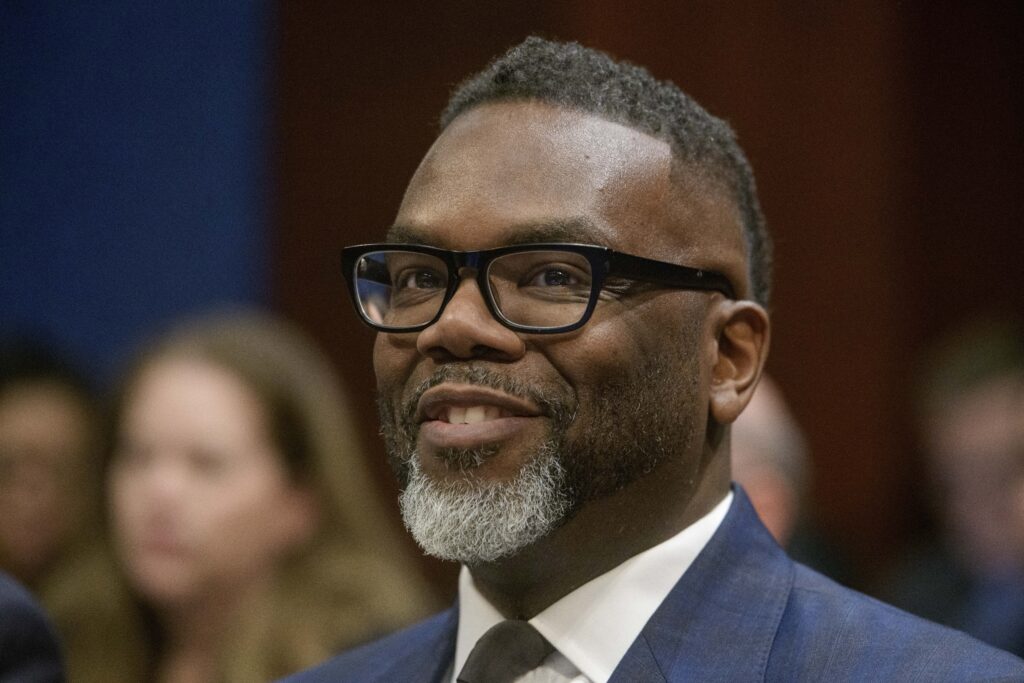
Chicago Mayor Brandon Johnson joined WCPT’s Richard Chew last Friday to comment on his first two years as mayor, negotiations between the Chicago Teachers Union and Chicago Public Schools and President Donald Trump’s sweeping tariffs.
Johnson joined Chew for their monthly “This Month with the Mayor” conversation. (It takes place the first Friday of every month at 7:30 a.m. Central on “Chew’s Views.”)
On the two-year anniversary of his 2023 election as mayor, Johnson highlighted the achievements of his term thus far, pointing to investments in youth employment and mental health services, falling crime rates in Chicago and the recently negotiated, but not yet approved, contract between the Chicago Teachers Union (CTU) and Chicago Public Schools (CPS). The proposed contract includes provisions for smaller class sizes and sustainable community schools, the teaching of Black history and protections for veteran teachers and LGBTQ+ students.
“This is a contract that the people of Chicago hoped for,” Johnson told WCPT. “And about a week before they settled it, I brought the CEO and the president of the Chicago Teachers Union and CEO of public schools into the room and I said, look, we’re not we’re not as far apart as people might think, and provided a pathway for them to close the deal. And they did that — first mayor since Mayor Richard M. Daley to actually have labor peace with our schools.”
The mayor called the sweeping tariffs President Donald Trump imposed on U.S. trading partners last week “a terrible idea” that will have “a devastating impact on working people in Chicago and throughout America.” He added: “[For] the everyday person in the city of Chicago who is focused on affordability — and that means not just rent and their mortgage but the groceries and gas and other basic amenities that we need to just live our day to day — these policies are awful.”
Looking ahead to the second quarter of 2025, Johnson spoke of his priority for advancing what he calls a co-governance model with the people of Chicago, “so that more and more people can be activated and … informed in a way that allows them to make great decisions.” He noted that all city departments will be tasked with participating in the effort.
“I want more and more people to know what’s happening in Chicago,” Johnson said. “If there’s anything that that frustrates me in this role, it’s meeting and coming across people who could have benefited from a service that they didn’t know existed.”
Below is the full transcript of the interview. (Please note: The transcript has been edited for clarity.)
Richard Chew: Hey, progressives, welcome back to “Chew’s Views.” It’s Friday, first Friday of the month, which means that we have the opportunity and the luxury of having our own Mayor Brandon Johnson from the great city of Chicago with us this morning.
Mayor Johnson, welcome to the show, and I want to dive right in because I know time is tight with you this morning and we want to make sure we try to get in as much as possible.
To the extent that you were part of the updates with the Chicago Teachers Union and CPS [Chicago Public Schools], what are your thoughts? What’s happening there? How are we viewing this in the city of Chicago?
Mayor Brandon Johnson: Well, thank you for that question. Over a decade ago, a group of teachers got into a room and had a conversation with parents and other community leaders about a city that works for everyone and particularly a school district that all children deserve. And this contract, quite frankly, reflects that vision that was put forth nearly 15 years ago.
Class sizes that are manageable and much smaller — that’s going to help our kindergartners out tremendously. There is a direct correlation between class size and effectiveness. And so that was a big victory for the people of Chicago. Sustainable community schools — we went from 20 sustainable community schools to 70. I would have preferred, of course, an entire district made up of sustainable community schools, but we’re moving in the right direction. And basically, sustainable community schools really provides local control of that community to partner with non-for-profit organizations, community-based organizations, businesses, faith-based organizations, to add additional resources to help support that school community.
Dyett High School is a good example of that. That was a school that was set for closure. I was a part of a hunger strike that kept it open, and now it’s a sustainable community school and they produce champions — the 2A boys basketball state champions, right there on the South Side of Chicago, a school that was left for dead that we revived.
We also have protections in there for senior veteran teachers. It’s important now, particularly with Donald Trump, who clearly does not value government experience, that there’s real protection there. There’s protection for Black history, protection for LGBTQ+ students. This is a contract that the people of Chicago hoped for. And about a week before they settled it, I brought the CEO and the president of the Chicago Teachers Union and CEO of public schools into the room and I said, we’re not as far apart as people might think, and provided a pathway for them to close the deal. And they did that — first mayor since Mayor Richard M. Daley to actually have labor peace with our schools. I don’t often brag about the connection between Richard M. and I, but there you have it.
Richard Chew: (Laughs.) Well, listen, first of all, I appreciate you saying it that way, because we know the history of Chicago and we’re a political city and what we’re doing in the city of Chicago, the state of Illinois, is resonating in other parts of the country. I can tell you that from people that I’ve talked with. We are representing what I think a lot of people want to see, and that’s working together, coming together, but still fighting for the things that aren’t right and that are going to be harmful to not just the city of Chicago but the country at large. And to that end — and asking you a question about tariffs, these Donald Trump tariffs. These are not government tariffs. These are Donald Trump tariffs. What are you seeing, what is your staff seeing, as it relates to how this is going to, if not already impacting the city of Chicago?
Mayor Brandon Johnson: It’s a terrible idea. It’s very poor policy. And to your point, this hangs directly around the shoulders of President Donald Trump. It is clear that his primary goal is to protect the interests and expand the wealth of the ultra-rich in this country and in this world, and these tariffs are going to have a devastating impact on working people in Chicago and throughout America. Chew, the last time we spoke, we talked about building more affordable homes, and the clip that you just played speaks directly to my commitment to repopulate the city of Chicago with working people. And when you have these type of tariffs, when your exports primarily come in from Canada and Mexico, that’s only going to raise — (audio break) — type of materials, which then makes everything else more expensive. Again, the everyday person in the city of Chicago who is focused on affordability — and that means not just rent and their mortgage but the groceries and gas and other basic amenities that we need to just live our day to day — these policies are awful.
The last thing that I’ll say is I had a press conference yesterday with mayors who represent along the Great Lakes and the St. Lawrence River, and I’ve had a tremendous relationship with the mayor of Montreal, the mayor of Toronto, because there’s a strong reliance upon our neighbors to the north to help grow our economy. And so not only is it going to impact just the price of goods, it’s going to impact the trade relationships between the cities in Canada.
Richard Chew: One of the things that I’ve said, and you’ve said it too and so many other of our leaders have said, is that this is not about improving our relationships with other countries. This is retribution. This is not calculated. And you said it’s foolishness. And so, if it weren’t, the question would have to be asked, so what’s the end look like? Where is this going to actually take us? What’s the point where we can go OK, now we’re in shallow waters and we can see what we’re doing? And there’s nothing at all in these tariffs that is an indicator of when it’s going to stop and what the results and the benefits will be on the back end of it. And I’m sure you see that too.
Mayor Brandon Johnson: Yeah, you’re spot-on. This reminds me of the time — it’s a little vague but during the ’80s, when I was a kid, to see the frustration of my father and my uncles as they were trying to explain to us Reaganomics, that somehow the trickle-down impact would help working people, and we know it was a very devastating time economically. And this just has some — it’s obviously far more potent, but it’s reminiscent. It’s, again, Mark Twain: History doesn’t repeat itself, but it certainly rhymes.
And when you have the oligarch and the ultra-rich who believe that if you take care of us first, we’ll make sure that the peasants and the rest of us working people, lower class, middle class, working class folks, it’ll eventually get to you, but we are your saviors, we are your providers, and you’ve got to look out for us and we’re going to look out for you. That type of economy just has not worked. And so that’s why I’ve put forth a very bold vision around investing $820 [million], $830 million in our infrastructure, because we cannot rely upon the federal government, again, building more affordable homes, creating pathways for our young people to get a quality education and is publicly funded. These are the things that working people think about every single day. Here’s how we’re leading.
And I’m glad you mentioned that. I hope the people of Chicago recognize that we are leading the way. And this notion that somehow, on the back end, that years from now, or months from now, we’re going to reap the benefits of someone who has never had the interests of working class people in his heart, ever, at any moment, at any time in his life, that somehow he has found gospel and is somehow going to — (laughter) — look out for the least of these. That’s not his orientation. That’s not why he ran again. And he is proving to everyone what the people of Chicago have already known that his interests are tied directly to the Elon Musk’s of the world and apparently January 6ers. He moved quicker to release people who stormed the Capitol than he was to release policies that can actually help day to day, the day-to-day experience of working people.
Richard Chew: Yeah. Mayor Johnson, talk about this for a second, in terms of assessing the first quarter of 2025 and let’s talk about the — I won’t say negative. Let’s talk about the areas of improvement first, and then let’s talk about the things that were successful. When you look at this quarter, from a calendar year standpoint, what are some of the things that you sit back and say, in your private moments, I wish I had done that differently, or I wish I had done that better? And don’t take the route that so many politicians try to take and say, “Well, we didn’t do so bad.” You know what I’m asking. What could you — (laughs) — this is you and me and, of course, everybody that’s listening. What is it that you say, man, I should have done that differently, or I could have done that better? And then let’s talk about the things that you did do well that you feel are successes for the city of Chicago.
Mayor Brandon Johnson: Look, I mean, there’s no secret that in Chicago that there are some real entanglements within our government systems, right, and our public schools in the city of Chicago is a perfect example of that. And as the school board becomes its own independent body, I have responsibility and I’m accountable to help the public school system become its own independent body. And what I’m reflecting on in this first quarter is that the payment for workers, for whatever reason — and I don’t know why they did it but, for whatever reason, the payment for pensions for workers of the Chicago Public Schools, someone thought it’d be a good idea for that payment to be paid by the city of Chicago, even though they’re not our workers. And what I’m reflecting on in this first quarter [is] how I could have better engaged the Board of Education to understand what their responsibility is ultimately going to be, and that in order for both of our budgets to work together, we have to have some shared responsibility as we disentangle the reliance of Chicago Public Schools on the city. I know that sounds hyper-technical, but it does have implications for both of our budgets.
And here we are, going into the second quarter, and it’s a matter that we have not entirely solved. It’s solvable. And, again, I’m going to hold myself accountable to make sure that what I inherited that we transform it. And so, it’s one of those things where I have not given up on it, but it’s something that we weren’t able to resolve in this first quarter, and the issue did not go away.
Richard Chew: Got it. All right, so pivot for us to a couple of things that you can say — if you pick two things and said, man, we got that right. What would be the top two things that you say we got right? Because there are others but pick the two that you say we got that right.
Mayor Brandon Johnson: Yeah. And, you know, it’s interesting that you asked that way, because even with your first question, I have an easier time reflecting on what we don’t do well.
Richard Chew: (Laughs.)
Mayor Brandon Johnson: And maybe that’s just human nature versus what we got right, because my wife — she teases me; she’s like, you’re the only person who wakes up with good news and you’re in a bad mood.
Richard Chew: (Laughs.)
Mayor Brandon Johnson: The other day, we got a teacher’s contract for the first time without a strike or a strike authorization, and in my mind, I’m going, why did it take us so long? You know what I mean? Because I’m thinking, like, I got other things I’ve got to get done, but I am very proud of the fact that there is a settlement, a teacher’s contract that reflects the values of working people. I mean, people, I think, underestimated those of us who pushed back against the [Rahm] Emanuel administration, as he was closing schools and defunding our public education system, firing veteran teachers and closing down mental health clinics. That was a very tumultuous time. And it wasn’t ever in our thought or mind, thinking that somehow, that if we push back hard enough, I would become mayor of Chicago. I mean, I think we were thinking, if we pushed back hard enough, we could actually have a contract that reflects the values of working people. And we did get that. We did move significantly in a positive direction.
I believe that there are a lot of things that we got right there: 100 librarians, 400 teachers assistants. I mean, these are going to really help our children succeed. And I think the other point that I made earlier about repopulating the city of Chicago with working people, we broke ground — and we talked more about it, but we broke ground on a number of investments. But the thing that I know that we’ve gotten right in this first quarter: our Department of Planning and Development, we’ve secured almost $8 billion in the first quarter for new development — $8 billion.
Richard Chew: That’s fantastic.
Mayor Brandon Johnson: Here’s the thing: All of last year, we secured $11 billion. So we have already almost surpassed our economic development and planning for housing and other economic development for the city of Chicago. We’ve already almost reached our combined number from last year, which last year, by the way, was $11 billion, and that number was bigger than 2022 and 2023 combined. So the city of Chicago is clearly open for business. The difference is, we’re just not for sale.
Richard Chew: That’s a powerful statement, because here’s the thing: Right now, weather’s changing. We talked about this a little bit last month. Weather’s changing here in Chicago, in the Upper Midwest, and throughout the country, but we know that as we get better weather and folks are out and about, there’s the temptation, the possibility of an increase in violence — the natural increase of activity lends itself to the potential increase, I should say, in violence. You know that’s coming and you know that that’s a reality and it’s a concern of people here in the city of Chicago, particularly with tourism. What are your thoughts there, and how are you preparing for that and being able to navigate that?
Mayor Brandon Johnson: Yeah, first of all, let me just acknowledge that the city of Chicago, for decades, have suffered with unfortunate gun violence. Last year alone, we removed 12,000 guns off the streets of Chicago. That’s essentially 35 or something like that a day. And these guns are not being manufactured in Chicago, so these are coming in from red states, primarily, and too many people are accessing them. And to your point, as the weather gets better, we have to be even more vigilant around how we support our communities.
Now, what I want to just say, as well, I think it’s important for the people of Chicago to know this, that violent crime is down in Chicago period, point blank. And every year since I’ve been in office, it has continued to go down. Just in this first quarter alone, since we’re talking first quarter, we had the lowest number of homicides in a first quarter since 2019.
Now look, one homicide, one shooting is one too many. This is devastating too many of our communities. But violent crime in the city of Chicago is down nearly 23 percent; homicides were down almost 20 percent; shootings, shooting victims. And there’s a lot to be said about how we are investing in young people but also how our police officers are showing up solving crime. We have 200 more detectives that I’ve hired since I’ve been in office. Our clearance rates continue to go up, and you know one of the deterrents of violence in the city of Chicago, or anywhere else, is holding people accountable, and we’re doing just that. And so how we’re preparing is, we’re going to make sure that we make critical investments all over the city.
One of the things that I’m very proud of this year, we have, right now, an open application to hire 29,000 young people for summer jobs. There’s a pilot program that we started last year with Streets and Sanitation, introducing more of our young people, brown and Black, to public sector jobs. Seventy-five people showed up to serve as Streets and Sanitation workers; 55 of them stayed. This year, we have 100 that have signed up. Working with the chancellor of our community colleges, we’re setting up community college fairs, where we’re going to register our seniors right into our city colleges, which the number one registrant right now for our city colleges, right now, are young Black men. So we’re paying attention to the areas of needs.
Between making sure that our police officers have what they need, we’ve expanded our CARE program, Crisis Assistance Response & Engagement program for people who are having mental health crises, and mental health and behavioral health service providers are showing up to those crises, versus police officers. That has freed up law enforcement to concentrate their efforts and to other areas of needs in our community. So there’s a robbery strategy that we have where robberies have gone down 25 [percent], in some places 35%
Look, there’s a lot more work to be done, but as long as we’re working together, investing in young people, investing in mental health, investing in jobs, building more affordable homes, making sure that our officers have what they need and they can actually do their job, that’s why I believe we’re experiencing some level of success.
Richard Chew: Yeah. Mayor Johnson, that’s an answer that a lot of people have been wanting to hear from you in terms of what’s coming these next six months, in terms of our weather and how it impacts folks being out and about on all levels. So I appreciate that.
And right now, I mean, you kind of covered it a little bit, but just take a couple of minutes to talk about your vision for this second quarter, for the city, and why, even with the areas where you feel that you may have missed the mark this first quarter, you have a vision toward things improving and getting better in this second quarter and as we keep going forward.
Mayor Brandon Johnson: Yeah, thank you. I appreciate the way you framed that question, because look — (laughs) — the challenges that we are facing in Chicago are real. And one thing that I do love about Chicago — and other people might find this to be a little frustrating — is that we are resiliently stubborn, is one way I can put it. (Laughter.) It’s like, if something doesn’t quite go our way, even if it’s decent, we’re constantly figuring out how we can do it better. And one of the things that I’m really determined to do going into the second quarter is just really spend more time in our community engagement and co-governance arm of my vision for Chicago.
I’ve said this before, and I think I got away from saying this, that the government that we inherited will be different than the one we pass on. In other words, right now, we are already experiencing that this is not our grandparents’ government, right — (laughter) — where things were done in rooms and behind the scenes and there was a lot more of that type of work that was handled in those backroom settings, if you will.
And I’m not saying that every single door doesn’t ever get closed. Sometimes you might have to fuss or yell some things out. But I actually believe that democracy is stronger when more people are engaged. I actually firmly believe that’s why I think so many people are being misinformed in some of these public spaces, because everyone is throwing their opinion and perspective out, without anything being vetted or fact-checked. And what I’ve instructed my administration to do is my transition report said that we’re going to develop a co-governance model so that more and more people can be activated and cannot just be activated but informed in a way that allows them to make great decisions. And so, we’re going to see a lot more.
The city of Chicago is going to experience a lot more of that co-governance model, and all of our departments are being charged to participate, whether it’s Public Health, whether it’s community safety, whether it’s Department of Family & Support Services, whether it’s our budget team. So we’re going to have more community budget meetings so that the people of Chicago can get an early look into what challenges that we have but the opportunities that will be there as well. I want more and more people to know what’s happening in Chicago. If there’s anything that that frustrates me in this role, it’s meeting and coming across people who could have benefited from a service that they didn’t know existed.
Richard Chew: Yes, absolutely.
I want to say this and ask this question: I always try to end every show with a positive, forward-thinking outlook, and you’re a locally elected official, but you have a national voice. And so for anybody that’s listening to this show, this segment, anywhere in the country, what can you say to them, and what do you want to say to them about the future, not just of Chicago or Illinois, but the country at large?
Mayor Brandon Johnson: Yeah, look, the city of Chicago has a long history of fighting for freedom and liberation for working people. For many people who may not know, but a couple of years ago, I was elected on this day, but this was also the day where Reverend Dr. Martin Luther King Jr. was assassinated, and the freedom movement that came north really began to provoke this country to not just pay closer attention to the failures of our government but to really speak to the opportunities that our government can bring to people. And that opportunity was really centered around housing. And to know that someone like Al Raby, a former social studies teacher like myself on the West Side, invited Dr. King to come to Chicago to fight for housing — so here was a teacher, right, fighting for housing.
This [school] contract, by the way, I should have mentioned, that was settled, provides stronger connections between CPS and the city of Chicago, and connecting families to services, including affordable housing. And just to see the full circle and the manifestation of a generation ago that believed what Dr. King essentially said, that if you can figure it out in Chicago, we can do it anywhere in the world, and that’s what I would say to the nation.
As we build more affordable homes in this city — we’re doing that: almost 4,000 of them within the first 20 months; 1,800 under construction; we’ll have another 4,600 affordable homes within the next 18 months. Our Missing Middle program that is being piloted in the North Lawndale community, where Dr. King stayed, in Englewood, where developers are accessing city-owned land, where they’re building multi-units that they live in, and so not only will they be able to live but they’ll be able to rent and build generational wealth — six developers, five of them who fit within our minority — and women-owned developers, three of which are women of those six.
The affordable housing push that Dr. King came to Chicago to highlight, we’re seeing the manifestation of what he believed a generation ago, and we’re going to continue to do that. As I said, $11 billion just through our planning commission, $8 billion just this year alone, 37,000 construction jobs, so we’re putting them to work. Dr King was in Memphis fighting for working people, our streets and sanitation workers, and we’re growing our Streets and Sanitation Department with young people from the West and Southwest and Northwest Sides of Chicago.
And then, finally, public education. We’ve invested more in public education locally than I think any other city across America, and it’s not even our direct responsibility, but we support our public schools with over a billion dollars just from the city of Chicago. So between education, creating more jobs, and, of course, building more affordable homes — Dr. King was assassinated because he was fighting for working people, and he came to Chicago with that very fight, and he said, if we can do it in Chicago, we can do it anywhere in the world. And guess what. We’re doing it in Chicago. So, world, America, it can be done.
Richard Chew: What a great way to look at this. And on this anniversary, if we want to call it that, kudos to the legend and the history of Dr. King and so many other great leaders.
Mayor Johnson, thanks for being with us, and keep up the great work. We’re going to keep pushing you. And as I say, we’re going to be critical and complimentary at the same time, because I believe in our city, and I believe that we’re going to be able to be that shining light to move this country forward. So thank you so much for being with us today.
Mayor Brandon Johnson: Oh, you’re welcome.