
Ohio kicks off redistricting process, with Republicans looking to further gerrymander maps
On Monday, the Ohio state Legislature held its first public hearings on the state’s redistricting process, where Republicans rejected a map drawn by Democrats that would more evenly split Ohio’s congressional districts.
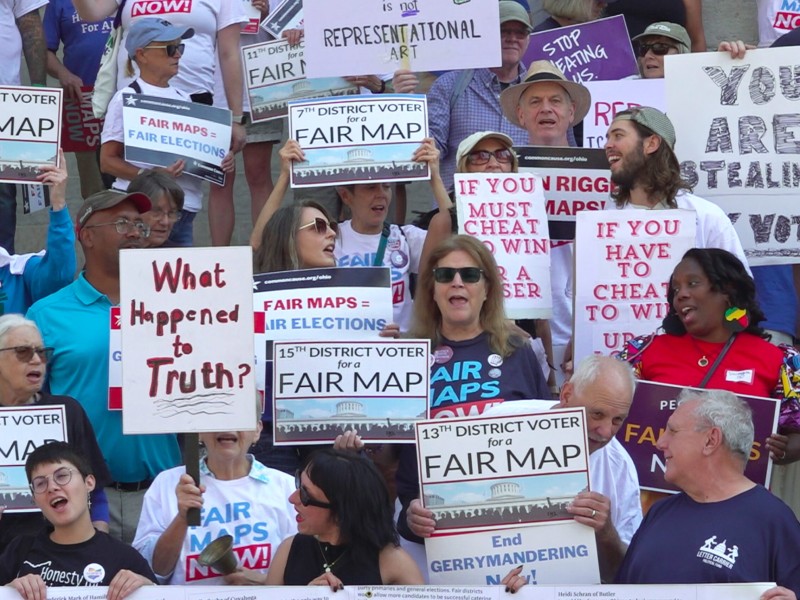
On Monday, the Ohio state Legislature held its first public hearings on the state’s redistricting process, where Republicans rejected a map drawn by Democrats that would more evenly split Ohio’s congressional districts.
Even though the GOP did not offer a map of their own yet, they made it known that the Democrat-drawn map would not move forward. The new map would give Democrats the advantage in seven congressional seats and Republicans the edge in eight, which proponents argue would reflect Ohio’s voting patterns in statewide elections in recent years. (Last year, President Donald Trump won the state in the presidential election over former Vice President Kamala Harris with 55% of the vote compared to Harris’ 44%.)
Stark County Sen. Jane Timken (R-Canton) disagreed.
“In the relevant time period in which we are to consider partisan races, Republicans have won 22 out of the 23 races,” said Timken. “I question their logic as to why it has to be 55–45 when clearly the voters of Ohio have strongly supported Republicans over the last decade.”
Timken is the co-chair of Ohio’s redistricting committee, which is tasked with drawing the new map before Sept. 30. The Republicans, who control the committee, have indicated that they will not pass a map that meets state bipartisanship requirements before the deadline. This will shift the process over from the General Assembly to the redistricting commission, which is also controlled by Republicans.
“It is insulting to the people of Ohio that they have not come up with a proposal,” said House Minority Leader Dani Isaacsohn, a Cincinnati Democrat. “Clearly, they have opinions because they asked very specific questions.”
Isaacsohn has also said that any map short of the 8-7 split is “not fairly representative of the state” and likely would not get any Democrat support, which Republicans ultimately do not need to pass their map.
The seven-member commission will have until Oct. 31 to pass its own bipartisan map, and the commission is comprised of Gov. Mike DeWine (R), Secretary of State Frank LaRose (R), State Auditor Keith Faber (R) and four representatives from the state legislature (two from each party).
As passed by Ohio voters in 2018, the state constitution disincentivizes but doesn’t outlaw partisan maps. If the commission misses the Oct. 31 deadline, the GOP can pass a map which doesn’t “unduly favor or disfavor a political party” using a simple majority vote in the Legislature, but it will only last until 2030. Republicans exploited this in 2022 to pass their current maps, after the state Supreme Court threw out two previous partisan maps.
Repeatedly through Monday’s hearing, Timken and other Republicans on the committee pushed back against citizens that called the process unfair, saying the maps don’t have to be “fair” but rather not “unduly favor” one party.
Last November, voters had an opportunity to remove politicians from the redistricting process and implement a no-partisan commission. However, the measure was voted down after Republicans in the state conducted a massive disinformation campaign which claimed that voting the measure down would end gerrymandering. After the amendment failed, state party Chair Alex Triantafilou openly admitted that confusing voters to preserve gerrymandering was “not such a bad strategy.”
Despite DeWine and LaRose both pledging to end gerrymandering, DeWine condemned the redistricting reform amendment last year, and LaRose intentionally wrote misleading ballot language for the measure. Both men are poised to give the Republicans even more of a rigged advantage for the 2026 midterms.
Heartland Signal encourages news organizations and content creators to use our content. You're welcome to republish this article for free as long as you follow our republishing guidelines.
Related Articles
FACT CHECK: Ads fault Minnesota state senators Hauschild, Kupec on fraud vote they later backed
A GOP-backed ad campaign claims DFL state Sens. Grant Hauschild and Rob Kupec opposed fraud accountability measures. But both senators voted yes on Senate File 856, which created Minnesota’s Office of the Inspector General.

Former elections official accuses Missouri secretary of state of altering results, misleading judge
Nick La Strada, fired in May as director of election integrity, alleges Denny Hoskins also illegally used public funds to influence a St. Louis County election.