
Health care
Plan to put Medicaid work requirements in Missouri state Constitution draws public opposition
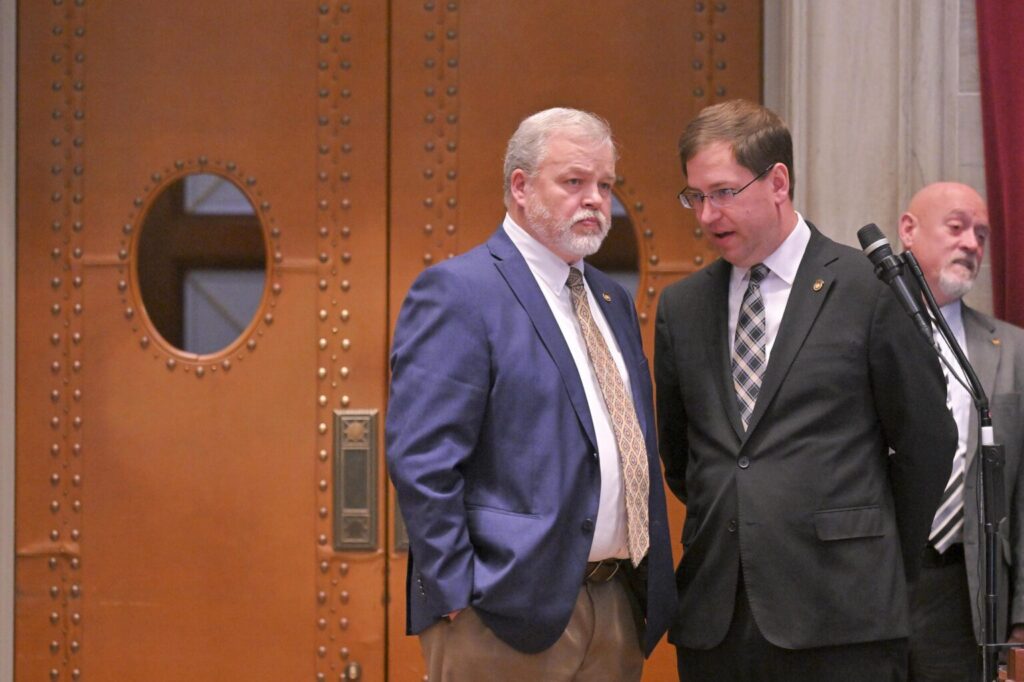
Advocates for cancer patients, people with developmental disabilities and their caregivers urged Missouri lawmakers Wednesday to reject a proposal writing Medicaid work requirements into the state Constitution.
The bill, sponsored by Republican state Rep. Darin Chappell of Rogersville, would put the issue before voters in November.
Starting Jan. 1, 2027, the One Big Beautiful Bill Act passed by Congress last summer will require states to verify that Medicaid expansion enrollees ages 19 to 64 are working, volunteering or attending school for at least 80 hours a month to qualify or keep their coverage. The law also requires states to check enrollees’ eligibility twice a year rather than annually.
Chappell said his proposed constitutional amendment is necessary to ensure Medicaid work requirements continue even if the federal law changes, arguing that savings to the state from the federal law will stabilize funding for services for vulnerable Missourians.
He described his bill’s goal as “making sure that we have the wherewithal and the budgetary flexibility to make sure that those dollars go to those individuals who are the most vulnerable among us.”
But witnesses testifying against the bill on Wednesday said the proposal could lock the Missouri Department of Social Services into a stricter version of work requirements than the federal law mandates while detailed federal guidance on the law is still in flux, leading more Missourians to needlessly lose coverage.
Missouri lawmakers weigh $294M price tag to carry out new federal Medicaid rules
More than 90% of adults under 65 are already working full- or part-time, or not working because of caretaking responsibilities, illness, disability or attending school, according to a 2023 KFF study.
The U.S. Centers for Medicare and Medicaid Services is expected to issue its guidance in June, though the department is already building the systems it will need to implement the federal law.
Several witnesses asked state lawmakers to postpone discussion of Chappell’s proposal until next year to allow the department to focus on meeting federal requirements.
Jay Hardenbrook, advocacy director for AARP Missouri, said he wants state lawmakers to provide oversight once the department starts implementing Medicaid work requirements.
“I want you guys to come back and look at what they’ve done to make sure that it’s right,” Hardenbrook said. “But this is getting the cart way ahead of the horse.”
Chappell’s proposal, critics testified on Wednesday, would tie the department’s hands, preventing it from mitigating the impact of the federal law on vulnerable Missourians.
The federal law allows states to offer short-term hardship exemptions in months when someone has been hospitalized, lived in a county or city with a federally-declared emergency or traveled for an extended period to receive medical treatment. The federal law also specifies mandatory exemptions, including for people who are pregnant, disabled, undergoing treatment for a substance use disorder or “medically frail.”
But current language in Chappell’s proposal would prohibit the department from seeking optional exemptions “unless a [state] general statute law expressly authorizes the implementation of the exemption.”
Depending how the federal government interprets the mandatory exemptions, witnesses said, optional exemptions could be necessary to provide coverage for Missourians who can’t meet work requirements.
Emily Kalmer, Missouri government relations director for the American Cancer Society, said that while she hopes a federally mandated exemption for people who are “medically frail” will cover most cancer patients, the federal government hasn’t finalized its definition of the term.
“After you are technically a survivor but you are still going through a lot of the debilitating effects of your cancer treatment, there’s still potential that you would have issues with meeting the work requirement,” Kalmer said.
It’s unclear whether those people will qualify as “medically frail.” If not, optional short-term hardship exemptions could help them maintain Medicaid coverage.
“We’re asking Missouri to implement this law in a way that tries to minimize the loss of health care coverage for low-income cancer patients and survivors,” Kalmer said.
Hardenbrook said he is concerned that Chappell’s proposal would rule out efforts he and the department are working on to help caregivers of older Missourians maintain coverage.
The federal law includes a mandatory exemption for any “parent, guardian, caretaker relative or family caregiver of a dependent child 13 years of age and under or a disabled individual.”
“We’ve been working with the department to try to make sure that we can gather up all of the different data sources that there are [to show] how somebody is a caregiver,” Hardenbrook said.
Affidavits might be an option, Hardenbrook said, but he’s not sure if Chappell’s proposal would allow them, since it prohibits “self-attestation” of exemptions.
“One thing that we know for sure is, if this resolution passes with the current language, [caregivers] would not be exempt,” Hardenbrook said.
Katie Gamble, representing the Missouri Association of County Developmental Disability Services, said that in addition to uncertainty about exemptions for caregivers, it’s not clear if all Missourians with disabilities will qualify for an exemption.
Chappell told The Independent that he would support an amendment to his bill allowing Missourians to count hours they spend caring for people who are elderly or disabled toward their work requirement.
“I’m open to that,” Chappell said. “I don’t want to put anybody in a bad spot, and I think that would pass the House.”
Republican state Sen. Jill Carter of Granby, chair of the committee that discussed the bill, also said she would support this change.
Carter is sponsoring a bill granting state lawmakers the authority to implement “work and community engagement requirements.” It would not seek to amend the Missouri Constitution.
Opponents of Chappell’s bill said they worry it would increase the paperwork burden for Medicaid enrollees and applicants, causing people to go without coverage and essential medical care.
Democratic state Sen. Patty Lewis of Kansas City, a member of the committee, told The Independent coverage losses for procedural reasons are part of the design of Medicaid work requirements.
“With the paperwork, having to apply twice a year, if you don’t dot your i’s or cross your t’s, you’re at risk for getting kicked off,” Lewis said. “And I think that’s the overall goal: trying to, unfortunately, not give health care to certain members of our state.”
Suzanne Opperman, a psychiatric nurse practitioner who previously worked at the veterans’ hospital in Columbia, said many of her current patients would struggle to complete paperwork to prove that they met work requirements or that they should be exempt.
Applying for Medicaid and navigating the annual renewal process, she said, is already hard enough.
“I worked at the VA for 28 years,” Opperman said. “I know paperwork. And the amount of stuff that people are having to do…. It would be hard enough for somebody who is totally physically able and mentally able to process all this. It’s practically a college degree to be able to manage this stuff.”
Kalmer said that for those who lose coverage, even temporarily, the price can be high.
“That’s where people fall through the cracks,” Kalmer said. “It depends on what cancer diagnosis you have, but some of them move really quickly, and a month without coverage is a month that really impacts your survivability.”
Missouri Independent is part of States Newsroom, a nonprofit news network supported by grants and a coalition of donors as a 501c(3) public charity. Missouri Independent maintains editorial independence. Contact Editor Jason Hancock for questions: info@missouriindependent.com.
This article, “Plan to put Medicaid work requirements in state Constitution draws public opposition,” has been republished from the Missouri Independent under Creative Commons license CC BY-NC-ND 4.0.