
Vivek Ramaswamy promises largest property tax rollback in Ohio history, but big questions remain
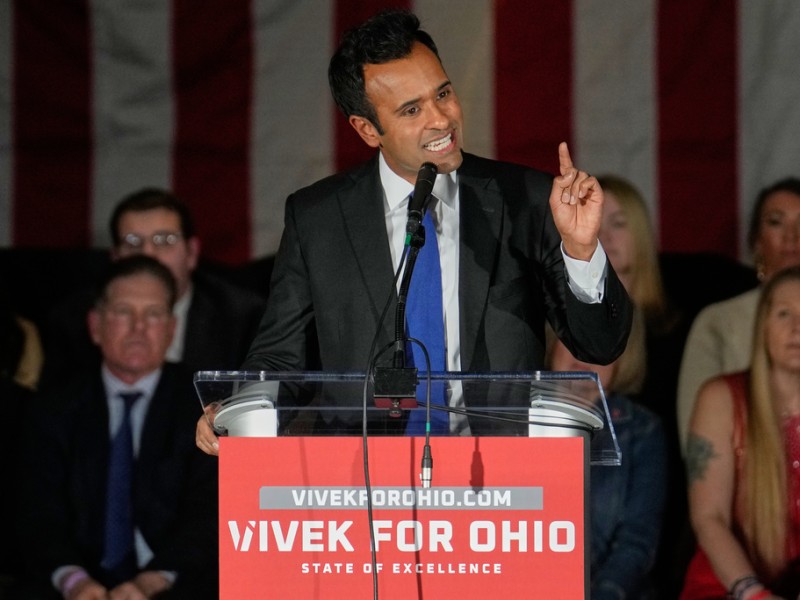
Ohio Republican candidate for governor Vivek Ramaswamy is telling voters he’ll roll property taxes back to “levels where they were before the end of the Covid pandemic.”
But think tank Innovation Ohio contends the idea would be a disaster for local services like schools, public safety, libraries and public health. The group estimates Ramaswamy’s plan would mean $6.6 billion in cuts for those agencies.
“Rolling back the tax base would mean deep, immediate cuts to schools, fire stations, and services in every county,” the report states.
Right now, grassroots organizers around Ohio are working to eliminate property taxes outright. State lawmakers take that effort seriously enough that they’ve passed a raft of major property tax reforms, with even more proposals working through committee.
Last year, a working group made of former lawmakers, school officials, and auditors spent months wrestling over property tax reform. Although they endorsed several of the bills lawmakers later approved, the effort was a showcase for just how difficult it is to balance interests when it comes to cutting property taxes.
If it’s as simple as Ramaswamy portrays it to be, wouldn’t someone have stepped in to untangle the knot already?
Can he do that?
Ramaswamy’s plan is light on specifics, and no governor can wave a magic wand to bring property taxes down. Ohio Capital Journal reached out to Ramaswamy’s campaign for details about his proposal but they didn’t offer any.
Instead, in a written statement, campaign spokesperson Connie Luck said “our campaign doesn’t take policy advice from the Democrat staffers who ran up an $8 billion state budget shortfall and lost 300,000 jobs 15 years ago.”
Howard Fleeter, an economist and school funding expert, was left scratching his head. Property taxes had been climbing for years, even before the pandemic. Does Ramaswamy really want to go back to the middle of the pandemic or does he mean before it? Is he talking about tax rates or the amount homeowners actually pay? Does his plan apply to residential property only or does he include taxes on public utilities’ property?
“I think the burden is on Ramaswamy to show his work here,” he said.
How big a difference will Ohio’s property tax proposals make?
Ramaswamy’s website does little to answer Fleeter’s questions. Instead, it vaguely promises a plan “designed to protect taxpayers while maintaining stability for local communities.” Ramaswamy insists new construction won’t be impacted, existing debts will be honored, and local governments will operate “with greater discipline.”
The website says his plan “builds on recent reforms that limit automatic tax increases.”
Lake County Auditor Chris Galloway said that measure, Ohio House Bill 186, might offer a way to achieve a kind of rollback. Galloway was part of last year’s property tax working group and advocated on behalf of H.B. 186. The measure limits future property tax increases to the rate of inflation. Originally the bill was forward looking, but an amendment pushed the baseline year back to 2023 — ratcheting taxes down further in many parts of the state.
“Can we roll back to pre-COVID levels? Yes,” Galloway said. “It would be an extension of what was accomplished under H.B. 186. Basically, instead of 2023 levels, it’s going back to 2019.”
But he warned there’s no way to cut that deep without making sacrifices.
“Costs for everyone have gone way up since 2019. That includes local governments,” he said. “So, slashing their revenue means slashing services. That can be done, but people are going to have to decide what they want to do without.”
When lawmakers passed H.B. 186, for instance, they decided they didn’t want to do without. Instead, they pulled $360 million from the sales tax holiday fund to keep school districts from losing money.
Ohio House approves bills limiting property tax increases to inflation
And as a practical matter, winding the clock back to 2019 doesn’t return tax bills to 2019 levels — it just changes the starting point for capped increases. Under the H.B. 186 model, property tax bills aren’t supposed to outpace inflation, but there has been a lot of inflation in the last six years.
If Ramaswamy is serious about lowering property taxes, Galloway said, he should take an even more radical approach.
“Want to lower taxes? Get school funding off our property tax bills,” Galloway said.
He made a similar pitch to the property tax working group but got no takers.
Galloway envisions the state completely taking over the education system. Instead of 600-plus local districts Galloway would have less than 100. That would mean dramatic reductions in administrative jobs and potential savings from consolidating transportation, collective bargaining units and school facilities.
“You could save billions of dollars,” Galloway said. “All of that takes political will and heavy lifting, but it is quite doable.”
Totaling the bill
Innovation Ohio’s report sets aside questions of means to focus on the potential consequences of Ramaswamy’s idea.
To get to its $6.6 billion estimate, Innovation Ohio started with recent Ohio Department of Taxation reports detailing millage rates and assessed property values. With that, the group calculated an initial estimate for 2025 and then used the same method for the two previous years — comparing their estimates to actual collections. The estimates came in about 2% high, so they lowered the 2025 calculation to match. Innovation Ohio included utility-owned property in its estimate as well, projecting the prior year’s total forward based on the most recent growth rate.
But that just gets to a figure for 2025. If Ramaswamy wins the election, and embarks on his plan to lower property taxes, it won’t happen until he takes office in 2027. To get to an estimate for 2027, Innovation Ohio took the 2025 figure and applied the three-year average growth rate of 5.1%.
With that math, the group estimates property taxes would amount to $27.2 billion in 2027. In 2021, Ohio collected $20.6 billion in property taxes. Innovation Ohio used that year as its baseline (Ramaswamy didn’t indicate one) because it’s “the last year before pandemic-era property value increases began working through Ohio’s tax system.”
What that would look like
About 60% of Ohio’s property tax dollars go to schools. The Innovation Ohio report notes dialing back to 2021 funding levels right now would mean cutting school funding by $2.4 billion. By the time Ramaswamy could put his plan into action, that figure would be $4 billion, based on Innovation Ohio’s projections.
“School districts would have no choice but to lay off teachers and staff, increase class sizes, and eliminate programs,” the report reads.
Ohio’s governor, lawmakers, and grassroots organizers are all wrestling over property tax reform
Because many districts use voted levies to service debt taken out for capital expenses like school construction, “a rollback would leave those obligations unfunded and could force school closures or indefinite deferral of building repairs.”
The report notes Ohio’s townships in particular would feel the pinch when it comes to public safety services. Unlike cities, townships can’t levy income or sales taxes. So if property taxes get cut, townships can’t turn to some alternative revenue source to replace the lost funding.
“Voters in townships across the state have approved 3,190 levies specifically for police, fire, and EMS services,” the report states.
Libraries get more than half their funding from property taxes. County health, developmental disabilities, and senior services agencies all rely on property taxes to fund basic operations.
And Innovation Ohio contends the harm doesn’t stop with direct cuts. Cutting off a reliable source of revenue source will make it harder for local governments to borrow money and potentially lead to a downgrade in credit ratings. The group warns if local governments are pinched, state bond ratings could suffer, too, “from the cascading instability at the local level.”
“That means higher borrowing costs for years to come,” the report states. “Communities would pay more for less as future infrastructure projects become costlier to finance.”
Follow Ohio Capital Journal Reporter Nick Evans on X or on Bluesky.
Ohio Capital Journal is part of States Newsroom, a nonprofit news network supported by grants and a coalition of donors as a 501c(3) public charity. Ohio Capital Journal maintains editorial independence. Contact Editor David Dewitt for questions: info@ohiocapitaljournal.com.
This article, “Vivek Ramaswamy promises largest property tax rollback in Ohio history, but big questions remain,” has been republished from the Ohio Capital Journal under Creative Commons license CC BY-NC-ND 4.0.
Heartland Signal encourages news organizations and content creators to use our content. You're welcome to republish this article for free as long as you follow our republishing guidelines.
Related Articles

Data centers investments, personal finances take center stage at Michigan governor debate
Michigan gubernatorial candidates Jocelyn Benson and John James faced off over rising living costs, government reform and data center developments. While both candidates agreed on a couple issues, they clashed over transparency and who is best equipped to lead the state.
Access to abortion care is improving in Ohio, but abortion opponents continue efforts against it
As studies show improvements in access to abortion care in Ohio, abortion opponents both in and outside of the state legislature are attempting to bring more regulations against it.

Bill to end Pennsylvania’s closed primary elections passes state House
A bill to allow independent and third-party voters to cast ballots in Pennsylvania primary elections passed Tuesday in the state House.