
Pillen vetoes bill defining snow/ice removal, flood management as ‘emergency management’ duties
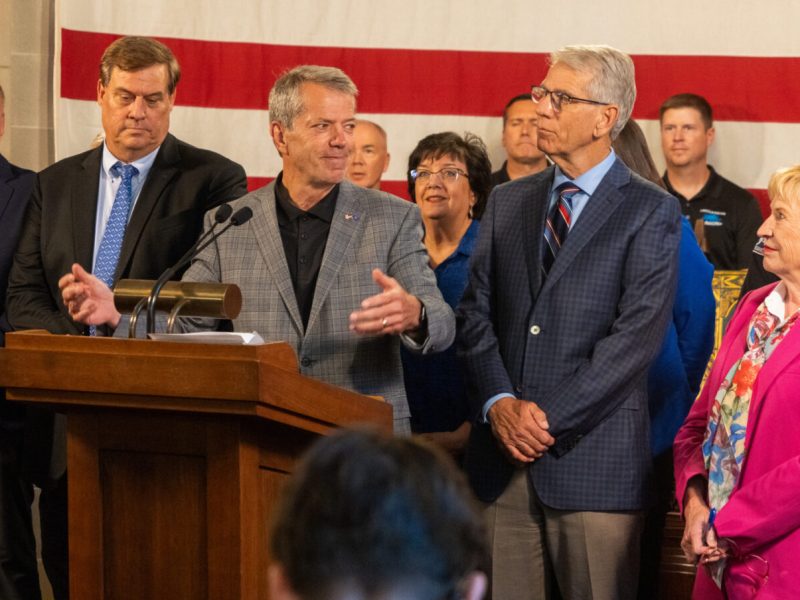
LINCOLN — Citing property tax concerns, Nebraska Gov. Jim Pillen issued his first veto of the year against a bill meant to explicitly include snow and ice removal and flood management as “emergency management” functions in state law.
In a one-page letter returning Legislative Bill 1256, from State Sen. John Cavanaugh of Omaha, Pillen argued counties, cities and villages could under the bill reclassify certain types of services to “circumvent” state property tax caps on local governments that were put in place in 2024 to fight what the governor called “out-of-control property tax increases.”
In 2025, Nebraska property taxpayers were assessed $5.59 billion, an increase of $285.52 million, or 5.39%.
“I cannot in good conscience sign LB 1256 into law, which will increase property taxes, while we are in the middle of a property tax crisis,” Pillen wrote in his veto letter, which his office released Thursday.
Pillen cited an assessment from the Nebraska Department of Revenue, which is under his control, that the six-word law change could cost as much as $40 million more each year, assuming a 2.5% increase in property taxes for snow emergencies.
The governor said those implications were not “properly discussed” in the legislative session.
The Legislature last Friday unanimously passed the bill, 49-0, and it unanimously advanced from the eight-member Government, Military and Veterans Affairs Committee. It had less than a two-minute debate March 30 before advancing, including supportive testimony from Cavanaugh and State Sen. Rita Sanders of Bellevue, the committee chair.
Cavanaugh, in a Thursday text, said the bill is about clarification and doesn’t change the definition of an “emergency” for property tax levy limit purposes.
“Governor Pillen is playing politics with emergency management,” Cavanaugh said. “I will ask the 49 senators who voted for this bill to stand by their vote.”
Cavanaugh has said it would allow workers who perform such duties to be considered “emergency” and not “general maintenance.” These services are often already activated in relevant emergencies, he said.
The Omaha senator said the explicit change could help counties and municipalities “better utilize emergency funds in cases of catastrophic weather events” and potentially get around “certain budgetary constraints” on the use of day-to-day funds.
“It recognizes in law what is already the case for our state and local governments in practice, that making roads safer for travel and protecting communities from flood waters is an important emergency duty,” Cavanaugh said March 30 during floor debate.
State law already defines emergency management services to include “other functions related to civilian protection, together with all other activities necessary or incidental to the preparation for and carrying out of the functions listed in this subdivision.”
Scott Dombeck, a representative of the American Federation of State, County and Municipal Employers Local 251, supported the bill at a Feb. 26 hearing. No one opposed it.
Sanders noted that when the bill was presented at its hearing, it had no estimated state fiscal impact. But she said Pillen’s team has done more research and found it could be an “unfunded mandate” on local governments, an issue which Sanders tried to address this session.
“I think that’s some more work that I’m going to have to get done before tomorrow morning and look at that,” Sanders said, noting that the local cost would give a possible reason to veto.
Said State Sen. Brad von Gillern of the Elkhorn area, chair of the Legislature’s Revenue Committee that deals with tax policy: “If the governor has new information that shows how this is potentially impacting property tax, I’ll consider that in debate tomorrow.”
The Legislature can choose to override Pillen’s veto Friday, the final day of the legislative session. That would require a motion to do so and at least 30 votes.
In 2024, the Legislature limited exceptions for municipalities and counties to increase property taxes with certain exemptions for public safety. Pillen urged the Legislature to sustain his veto and bring the legislation back in some form in 2027 to “deliberate” the property tax implications.
“I refuse to sign a law that end-runs the carefully crafted caps we passed in 2024, which property taxpayers depend on,” Pillen said in a social media post Thursday.
- Editor’s note: This story has been updated with comment from State Sens. John Cavanaugh, Rita Sanders and Brad von Gillern.
Nebraska Examiner is part of States Newsroom, a nonprofit news network supported by grants and a coalition of donors as a 501c(3) public charity. Nebraska Examiner maintains editorial independence. Contact Editor Aaron Sanderford for questions: info@nebraskaexaminer.com.
This article, “Pillen vetoes bill defining snow/ice removal, flood management as ‘emergency management’ duties,” has been republished from the Nebraska Examiner under Creative Commons license CC BY-NC-ND 4.0.
Heartland Signal encourages news organizations and content creators to use our content. You're welcome to republish this article for free as long as you follow our republishing guidelines.
Related Articles

Data centers investments, personal finances take center stage at Michigan governor debate
Michigan gubernatorial candidates Jocelyn Benson and John James faced off over rising living costs, government reform and data center developments. While both candidates agreed on a couple issues, they clashed over transparency and who is best equipped to lead the state.

Access to abortion care is improving in Ohio, but abortion opponents continue efforts against it
As studies show improvements in access to abortion care in Ohio, abortion opponents both in and outside of the state legislature are attempting to bring more regulations against it.

Bill to end Pennsylvania’s closed primary elections passes state House
A bill to allow independent and third-party voters to cast ballots in Pennsylvania primary elections passed Tuesday in the state House.