
A supermajority fractured: Rural Republicans break ranks as Tennessee passes school voucher expansion
Before the Tennessee General Assembly passed a private school scholarship expansion bill this week, an unusual fracture within the GOP supermajorities widened as some rural Republicans voiced concerns over public education funding.
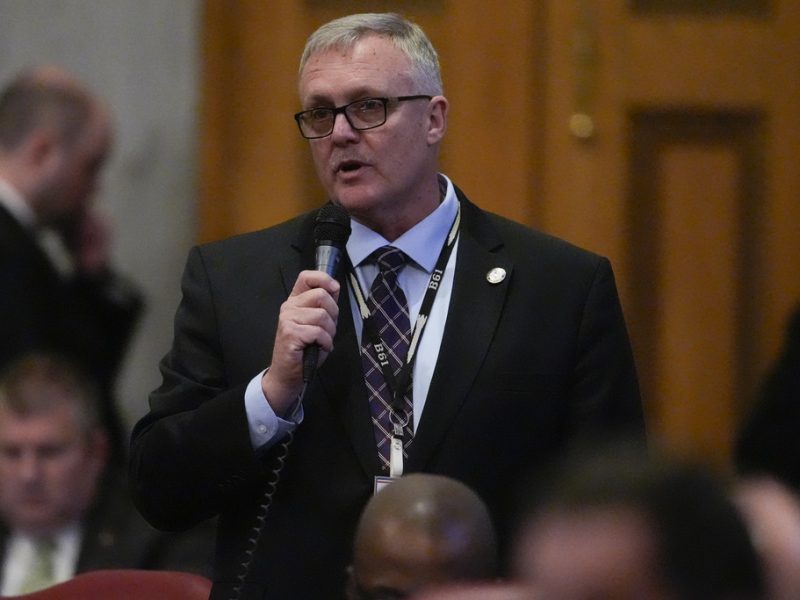
Before the Tennessee General Assembly passed a private school scholarship expansion bill this week, an unusual fracture within the GOP supermajorities widened as some rural Republicans voiced concerns over public education funding.
House Bill 2532 passed in the Tennessee House of Representatives with a 52-43 vote on Monday, with 22 Republicans joining all 21 Democrats in the chamber in voting against. The Tennessee Senate also approved the bill on Thursday with an 18-14 vote, sending the bill to Gov. Bill Lee’s (R) desk for his signature.
Among the dissenters was state Rep. Monty Fritts (R-Kingston), who argued that the bill was unconstitutional and takes money away from rural school districts. The representative and gubernatorial candidate also referenced a recent conversation he had with parents at Claiborne High School in New Tazewell, Tenn., who had to raise money to help pay for toilet paper for the middle school.
Tennessee State Rep. Monty Fritts (R-Kingston) becomes a rare Republican to speak out against a bill to nearly double the amount of charter school scholarships the state gives out.
“I think what we’re doing is unconstitutional … The average Tennessee individual pays between… pic.twitter.com/Lx85NJCPnJ
— Heartland Signal (@HeartlandSignal) April 15, 2026
Fritts joins a growing number of Republicans who are now casting doubts on the benefits and costs of promoting private schools at the expense of public ones. Despite being a pillar of national Republican politics, the issue has become a harder sell in states like Tennessee.
HB 2532 would nearly double the number of voucher school scholarships given by the state to 35,000, up from 20,000. Earlier this year, Lee called for expanding the “Education Freedom” scholarships, and directing $303 million of state dollars to private education. The state is dedicating $7,295 per scholarship for the 2026-27 school year.
HB 2532 also changes the hold-harmless provision passed by the state last year, which guaranteed school districts would maintain their current funding regardless of enrollment decreases. The version of HB 2532 passed on Monday would only allow districts to receive funding for students they can provide a Social Security number for, effectively forcing schools to collect this sensitive data.
Jenny Mills McFerron, the director of Policy and Research at EdTrust-Tennessee, told Chalkbeat Tennessee that the Social Security change is a backdoor attempt to track students’ immigration status.
“Equally troubling is the amendment requiring Social Security number tracking, a backdoor attempt to track students’ immigration status,” Mills McFerron said. “Lawmakers have repeatedly invoked accountability and transparency as core values, but have chosen to wield it selectively to protect the wealthy and target the most vulnerable students in our state.”
Speaking in favor of the bill, Rep. Aron Maberry (R-Clarksville) said the bill empowers Tennessee families with choice.
“Parents, not the government, know what’s best for their child’s needs,” Maberry said on the House floor on Monday. “These scholarships are about empowering families with real choice. And while these scholarships have been made broadly available, their impact has especially been made on lower and middle income families.”
Rep. Gloria Johnson (D-Knoxville) said the public money should be used to improve public schools, since Tennessee ranks 47th in the nation in funding public education.
“Imagine the choice that our public schools could offer if those $300 million were put into our public schools instead of subsidizing private education for wealthy families who never had their kids attend public school in the first place.”
In the Senate debate on Thursday, several Democrats and Republicans spoke against HB 2532, including Sen. Richard Briggs (R-Knoxville). Briggs said the lack of data from the state on who is applying for the scholarships is alarming, and he speculated that many of the applicants include children who are already enrolled in private schools.
Heartland Signal encourages news organizations and content creators to use our content. You're welcome to republish this article for free as long as you follow our republishing guidelines.
Related Articles
Access to abortion care is improving in Ohio, but abortion opponents continue efforts against it
As studies show improvements in access to abortion care in Ohio, abortion opponents both in and outside of the state legislature are attempting to bring more regulations against it.
Bill to end Pennsylvania’s closed primary elections passes state House
A bill to allow independent and third-party voters to cast ballots in Pennsylvania primary elections passed Tuesday in the state House.
Minnesota Truth Council concludes public testimony on Operation Metro Surge
A council tasked with documenting the harms of — and resistance to — the federal government’s immigration crackdown held its final public meeting Tuesday in Rochester.