
Indiana Supreme Court rules Sen. Spencer Deery winner in 3-vote primary
Justices questioned reasons for Recount Commission to disallow ballots cast for Deery that flipped lead to challenger Paula Copenhaver.
This post has been republished from the Indiana Capital Chronicle under Creative Commons license CC BY-NC-ND 4.0
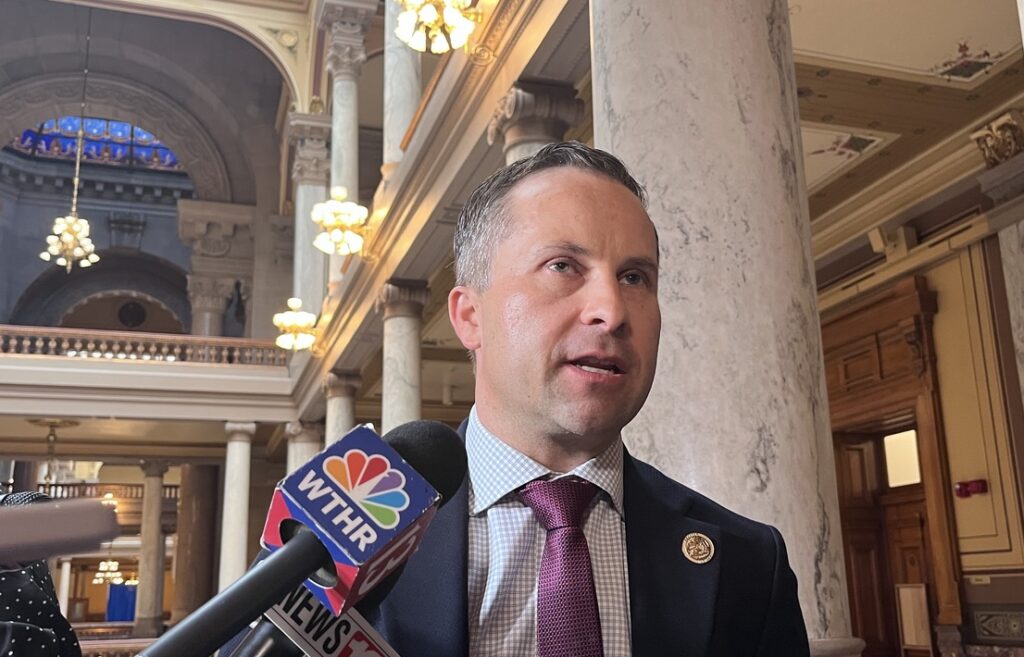
Indiana Supreme Court justices pressed Thursday for reasons to justify tossing out six ballots that will decide the outcome of a razor-tight Republican primary between state Sen. Spencer Deery and challenger Paula Copenhaver.
The justices heard arguments over whether to overturn an Indiana Recount Commission decision rejecting those six ballots — all cast for Deery — in a move that flipped the May primary outcome and gave Copenhaver a three-vote lead.
Deery’s attorneys argued that the commission’s majority abused its discretion to disallow those ballots because missing county clerk seals or signatures were the result of election worker omissions rather than anything the voters did.
Chief Justice Loretta Rush said the justices would be discussing the case “quickly and hopefully we’ll get some type of determination.”
Thursday’s arguments came a little more than a week before the Sept. 19 deadline in state law for county election offices to have started mailing out absentee ballots. Early in-person voting starts Oct. 6.
Justice questions “plot” over six ballots
During the hearing, questions from the five justices included why the six Deery ballots shouldn’t be counted without any evidence of fraud or tampering.
Justice Mark Massa asked one of Copenhaver’s attorneys “how is it the voter’s fault” in knowing that the clerk’s seal was needed.
Justice Derek Molter later said he struggled to understand how there could be some sort of “plot” involving those ballots.
“It’s hard for me to reverse engineer how only six ballots, not 200 or something like that, just six spread across three counties could be something other than a valid indication of how those six people were trying to vote,” Molter said.
Four of the disputed ballots were absentee ballots submitted by mail, with the two others were cast during in-person early voting.
Court halts ballots while it considers recount of 3-vote Indiana Senate primary
Copenhaver attorney William Bock told the justices that the clerk’s seal and the initials of two election officials are valid steps to prevent absentee voter fraud.
“That’s why the seal and signature are on an absentee ballot as authenticators, because the problem can come in any part of the process,” Bock said. “It need not be a voter error.”
Justice Christopher Goff said the law treats ballots without the bipartisan election worker initials differently and those are clearly out. But the six in question involve a missing clerk stamp or signature.
“It just seems to me that we don’t have a reason here statutorily to kick (these) out. The savings clause applies,” he said.
That clause was added by lawmakers in 1986 and says “A ballot that has been marked and cast by a voter in compliance with this title but may otherwise not be counted solely as the result of the act or failure to act of an election officer may nevertheless be counted … unless evidence of fraud, tampering, or misconduct affecting the integrity of the ballot is presented by a party to the proceeding.”
The primary race gained attention as President Donald Trump included Copenhaver, the Fountain County Republican chair and a staffer to Lt. Gov. Micah Beckwith, in his endorsements of challengers to GOP senators who voted last year against redrawing Indiana’s congressional districts.
Right to vote “a paramount interest”
The Recount Commission’s two Republican members — Secretary of State Diego Morales and attorney Paul Mullin — disallowed the six Deery ballots in a series of 2-1 votes last month.
Deery attorney Karen Celestino-Horseman argued Thursday that the commission has not set standards for tossing out ballots.
“Election integrity is one interest, but also the voter has a paramount interest in his right to vote and having that vote count and not having it thrown out due to the neglect of an election official,” said Celestino-Horseman, who is a Democratic member of the Indiana Election Commission.
Molter also quoted the American Law Institute: “A paramount principle of election law upon which there is the greatest degree of consensus is that the rules for counting ballots should be specified without ambiguity insofar as possible before the ballots are count.”
He said an election manual created by the Indiana Election Division makes clear the votes will be counted as long as no wrongdoing is alleged. But he noted that Secretary of State Diego Morales — chair of the recount commission — flipped and voted to toss them after knowing who would benefit.
Little time was spent during the hearing on arguments from Copenhaver’s attorneys that the courts could no longer overturn the Recount Commission’s decision because the Aug. 21 certification deadline for this fall’s election had passed.
Copenhaver, a former Fountain County clerk, told reporters after the hearing she believed the commission was consistent in its decisions on which ballots were valid.
“We have laws in place to authenticate the ballot,” she said. “Do we know that a ballot may have been substituted or may not have been substituted? We didn’t really have that, and that’s the reason and that’s the importance of authenticating the ballots.”
Deery, the senator from West Lafayette, told reporters that he hoped the court did not set a “standard that your vote can be invalidated by government incompetency.”
“There are clear questions here that the precedent needs to be set, and hopefully get clarified, that make it absolutely clear that as long as there’s no fraud or tampering, that your vote should count if you meet all the parameters,” Deery said.
SUBSCRIBE: GET THE MORNING HEADLINES DELIVERED TO YOUR INBOX.
Heartland Signal encourages news organizations and content creators to use our content. You're welcome to republish this article for free as long as you follow our republishing guidelines.
Related Articles
![Michigan gubernatorial candidate Anthony Hudson speaks into a microphone at a city council meeting, wearing a black sweatshirt reading "[illegible] NOT?" and a cap reading "FIX MICHIGAN."](https://d27ejbywo8x2i0.cloudfront.net/wp-content/uploads/2026/09/29164519/jhu-1024x662-1-800x600.png)
Michigan Libertarian Party disavows its own gubernatorial nominee
The Michigan Libertarian Party released a statement Tuesday afternoon disavowing Anthony Hudson, a Genesee County truck driver who is the party’s own gubernatorial candidate.

Minnesota AG candidate’s stock portfolio presents 174 potential conflicts of interest
If Republican Ron Schutz wins the attorney general’s race in November, he will be responsible for enforcing Minnesota’s laws against the country’s biggest and most powerful corporations. His own personal fortune is staked on many of them.

Assembly GOP candidates in competitive seats try to distance themselves from their party
Republicans’ control of the Wisconsin Assembly is up in the air this November, and GOP candidates in competitive districts are taking steps to convince voters to allow them to extend their 16-year streak of leadership, including by distancing themselves from Republican leaders in Washington, D.C. and in Wisconsin.