
Chicago’s Black wards contribute more, receive less funding from Tax Increment Financing, new report finds
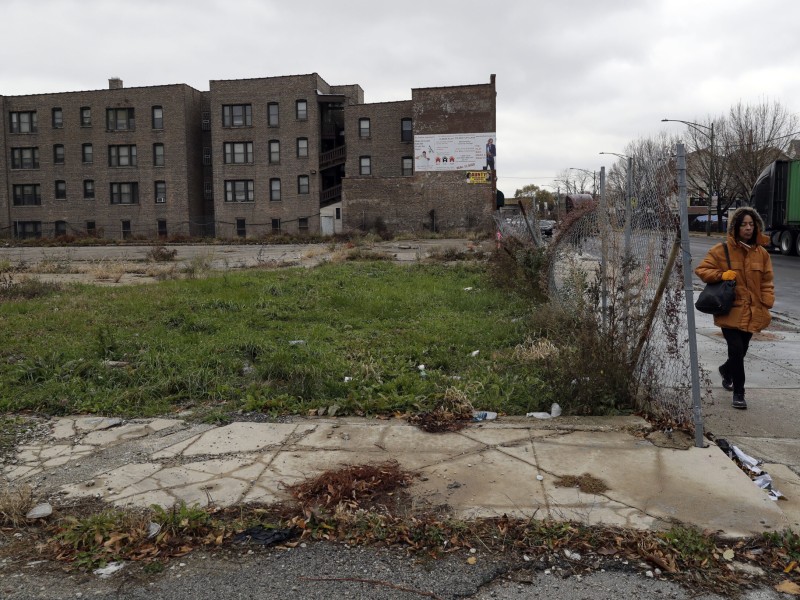
Majority Black wards contributed nearly half of the record-breaking $2.3 billion sitting in Chicago’s Tax Increment Financing (TIF) accounts as of January 2022, a new CivicLab report found. But the city’s 18 Black wards received less TIF funding in 2021 than the city’s 14 majority white wards, which contributed less than a third of that money.
Majority Black wards contributed nearly half of the record-breaking $2.3 billion sitting in Chicago’s Tax Increment Financing (TIF) accounts as of January 2022, a new CivicLab report found. But the city’s 18 Black wards received less TIF funding in 2021 than the city’s 14 majority white wards, which contributed less than a third of that money.
CivicLab’s TIF Illumination Project released a report earlier this month that found Chicago’s 132 TIF districts collected a record high $1.08 billion in property taxes in 2021. But the report also found that TIF account expenditures only totaled $307 million that year, and over a third of that spending went to areas that are at least 50% white.
The best performing TIFs in 2021 were all located in or near the city’s hottest performing real estate, the Loop or Central City, while lower-income TIF districts went ignored.
Chicago is among the 35 U.S. cities with areas designated as TIF districts, meaning a TIF has assigned them a “baseline revenue” for property taxes that go to their city council or local government each year. Then for the next 23 years, any additional tax revenue goes into the TIF, which is made to fund that district’s infrastructure projects and public services.
As successful TIFs develop a district, their property taxes rise and even more money goes toward TIFs. CivicLab COO Tom Tresser explained to Heartland Signal that this creates giant accounts that are “essentially swelling up with money.”
CivicLab’s report found that TIFs have taken approximately $10.3 billion from Chicago property owners since their implementation in 1986.
“There’s a larger message that Chicago is ‘broke’ in the civic atmosphere, that we just don’t have enough for public pensions,” Tresser said. “We’re trying to destroy that narrative.”
Since many areas give up at least half or all of their property taxes to TIFs, these districts’ local governmental units are deprived of nearly $500 million in funding each year, data from the Illinois Department of Revenue show. This money is not necessarily used to improve the neighborhood it came from. CivicLab’s report found that over half of the TIF funds Chicago collected in 2021 were moved out of the area in which they were initially extracted, then distributed in a “secretive and arbitrary matter.”
CivicLab’s report questions why an estimated $1 billion taken from Black wards that is currently sitting in Chicago’s TIF accounts is not being used to fund public health services in communities hit hardest by the pandemic. The Kaiser Family Foundation found that Black people have experienced higher rates of COVID-19 infections and deaths than white people.
The group recently launched a petition to “shut down racist TIF slush funds” that use public money to instead subsidize wealthy real estate developers in white communities “while the heavily TIF’d West Side rots.” The petition calls for all the money in Chicago’s TIF accounts to be released back to local units of government.
This idea has yet to take hold in Chicago’s city government.
“You’re gonna find that this is a radioactive issue,” Tresser said. “A lot of our representatives just represent the real estate industry.”
Tresser said TIFs have essentially become unregulated slush funds that mayors give to wealthy developers who contribute their campaigns.
Two months before losing her bid for reelection last November, Chicago Mayor Lori Lightfoot announced her LaSalle Street Initiative that will use TIF funds to convert partially full office towers in the Financial District into high end residential properties. She declared $336 million in “surplus funds” from TIFs in 2021 to use in her upcoming city budget, something she’s done every year since 2019.
Lightfoot’s team did not respond to a request for comment on the LaSalle Street plan, which CivicLab’s report calls a “cruel joke on Chicago’s long-suffering communities of color.” The group has documented over $848 million in TIF funds used to construct office towers and other commercial properties in Chicago’s Central Business and Financial Districts over the years.
Lightfoot created a new TIF district in 2019 to help fund the Lincoln Yards project, a $6 billion initiative launched by the wealthy real estate company Sterling Bay to build luxury high-rises and retail in the area using a “record amount of TIF funds,” the Chicago Tribune reported.
The Chicago Teachers Union has threatened several strikes over this plan, seeing as public schools are the “#1 user of property taxes,” Tresser explained, and have lost billions of dollars to real estate development, furthering racial disparities. Data from the Illinois State Board of Education show that 80% of Chicago public school students are Black or Latino.
“The plague of TIFs follow in a long line of majority-imposed policies on Black and Brown communities that are designed to keep them down, bleed them, fleece them, and make advancement impossible in America and in Chicago,” CivicLab states in their petition to abolish TIFs, a system which Tresser and his colleagues think cannot be reformed.
Tresser believes this idea will take hold as more people learn to question how public money is being used, by answering questions about how their city is “working or not working for them.”
“How’s the library? What’s the public school like? Does the bus come? People can readily answer those questions.” Tresser said. “The larger issue is, how do folks know how their government works? Basic civic education is how we roll.”
Heartland Signal encourages news organizations and content creators to use our content. You're welcome to republish this article for free as long as you follow our republishing guidelines.
Related Articles

Multiple childcare bills on access, fraud advanced in Ohio House committee
Multiple childcare bills were approved in an Ohio House committee on Monday. Three of the bills deal with increasing access for children, and another is a response to calls for increased vigilance regarding potential childcare fraud.

Chicago Bears say they will ‘advance’ stadium plans for northwest Indiana site
The Chicago Bears gave a boost Friday to the prospects of building the team’s new stadium in northwest Indiana, which top Indiana officials immediately seized as a sign that the multibillion-dollar deal will happen.
Illinois legislature wraps 2026 with $55.9 billion budget, new corporate taxes and rideshare union rights
The Illinois state legislature sent a record-setting $55.9 billion budget to Gov. J.B. Pritzker at the conclusion of the 2026 legislative session.