
FACT CHECK: Mike Rogers mischaracterizes voting process for Michiganders without photo IDs
While on Newsmax last week, Michigan Republican Senate nominee Mike Rogers mischaracterized how voters in the state can cast their ballots without a photo ID, failing to note it involves a legally binding affidavit.
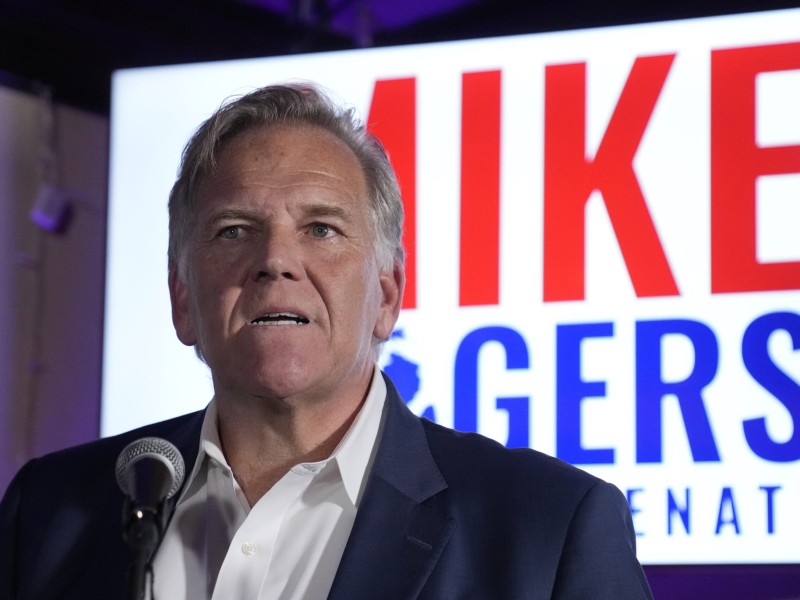
While on Newsmax last week, Michigan Republican Senate nominee Mike Rogers mischaracterized how voters in the state can cast their ballots without a photo ID, failing to note it involves a legally binding affidavit.
During an Aug. 21 appearance on “Carl Higbie Frontline,” Rogers discussed a lawsuit from the Republican National Committee against Michigan Secretary of State Jocelyn Benson over voter roll maintenance when he pivoted to the state’s voter ID laws.
“And by the way, what they tell you is if you don’t show up with an ID, you can sign a piece of paper that said, ‘No, gee whiz, I really am ‘fill in the blank,”” Rogers said. “It should make you feel a lot better about how that’s handled in the state of Michigan. So it is concerning.”
On Newsmax, Michigan GOP Senate nominee Mike Rogers mischaracterizes the state’s voting process, saying those without photo IDs “can sign a piece of paper that said, ‘No, gee whiz, I really am ‘fill in the blank.””
Those voters have to sign a legally binding affidavit in order… pic.twitter.com/XHSgp7uuFW
— Heartland Signal (@HeartlandSignal) August 26, 2024
Rogers also pledged that “ballot integrity people” were being recruited.
This characterization of how voting without a photo ID works in Michigan does not bring up precautions and legal steps taken in validating votes. While the state’s Department of State encourages people to bring photo IDs to polling places if they have them, it is not required. However, in order to cast a ballot without a photo ID, the prospective voter must sign a legally binding affidavit affirming who they are and where they live.
According to the affidavit itself, making any false statement on it is perjury, a felony in Michigan that is “punishable by a fine up to $1,000.00 or imprisonment for up to 5 years, or both.”
This has been the law in Michigan since 2007, with the Department of State holding dozens of uncontested elections since then. The law was originally a Republican idea to push towards photo ID requirements at polling places, according to Outlier Media’s Alex Klaus. Rogers himself won three elections for Congress under that photo ID rule.
Rogers’ pivot towards premature election skepticism is an almost complete reversal to where the former congressman’s position was just a handful of years ago. In May, the Washington Post’s Patrick Marley profiled Rogers’ stance changing from being outspoken that the 2020 election was legitimate to either casting doubt on it or avoiding the issue altogether.
“Rogers had previously declared the election ‘free and fair’ and compared Trump to a ‘gangster’ for pressing Georgia election officials to find more votes for him,” Marley wrote. “Now running for Senate with Trump’s endorsement, Rogers has tried to quickly move on when asked about those views in media interviews.”
Marley noted that this all coincided with an endorsement from former President Donald Trump, the country’s most prominent election denier.
“With Rogers facing a GOP primary in August, he sought and won Trump’s endorsement in March,” Marley wrote. “Since then, Rogers has not always been as direct as he was in the past about his views on the 2020 election.”
The article mentions Rogers anticipating Democratic cheating in a Detroit News op-ed from January as well as him dodging the question during a WJR 760AM radio interview in April, where he said he “answered that a hundred times.”
The Michigan Democratic Party condemned Rogers’ Newsmax comments in an Aug. 23 statement.
“If you can’t beat ‘em, spread conspiracy theories about elections…?” the party asked. “Rogers (once again) embraces dangerous election conspiracy theories and casts doubt on the integrity of our election system, saying it’s ‘really very concerning for us.’”
Heartland Signal encourages news organizations and content creators to use our content. You're welcome to republish this article for free as long as you follow our republishing guidelines.
Related Articles
With Coleman absent, Kessler presses affordability and health card at Minnesota forum
Minnesota Senate District 48 DFL candidate Dan Kessler says health care is the one cost Minnesota can actually bring down. He made his case at a forum his opponent, Sen. Julia Coleman, didn’t attend.
Huizenga campaign spending at center of McCann’s MI-04 challenge
Democrat Sean McCann is making Rep. Bill Huizenga’s campaign spending, including $400,000 paid to his half-brother’s firm, the core of the MI-04 race.
2026 midterm debates: Why candidates are skipping or stalling them
Election debate scheduling has become increasingly contentious across several midterm races this year. Candidates across the Midwest have had disputes over debate participation, logistics and host selection, with some candidates declining to debate altogether.