
Chicago Teachers Union’s Stacy Davis Gates talks CPS CEO Pedro Martinez with WCPT’s Richard Chew
In a Monday interview with WCPT’s Richard Chew, Chicago Teachers Union President Stacy Davis Gates expressed her frustration with the state of contract negotiations with Chicago Public Schools and the role CPS CEO Pedro Martinez is playing in that process.
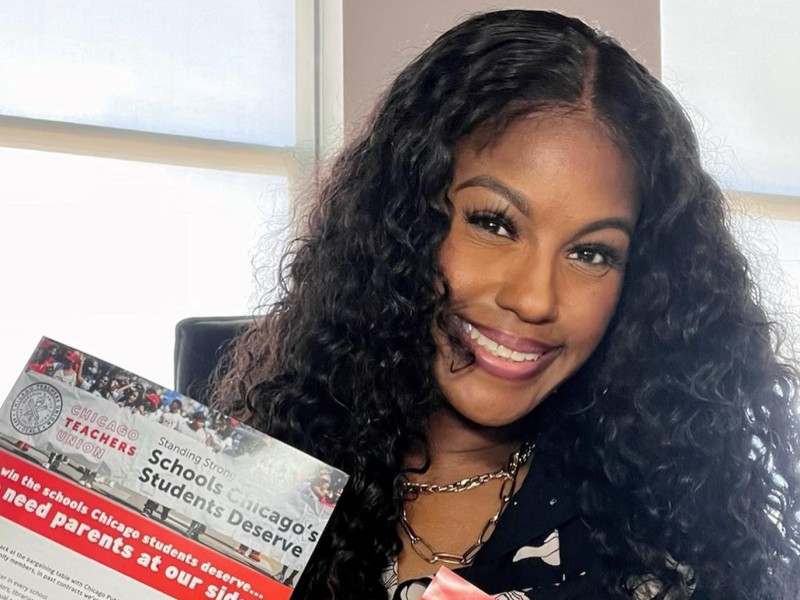
In a Monday interview with WCPT’s Richard Chew, Chicago Teachers Union President Stacy Davis Gates expressed her frustration with the state of contract negotiations with Chicago Public Schools and the role CPS CEO Pedro Martinez is playing in that process.
“We are deeply disappointed in CEO Pedro Martinez because he has an opportunity to be legendary,” Gates said. “And he has chosen to take our work, turn it in as his own, and then tell everyone he can’t afford to implement any of it. It just feels so cynical and disconnected for the type of partnership coalition that we’ll need to actually resource and transform our school district.”
Last week, the union’s House of Delegates issued a unanimous no-confidence vote for Martinez “in light of his failures to urgently address the needs confronting the district and embark on the transformation of our schools for which the people of Chicago voted,” according to a CTU press release issued Monday. The release went on to explain that the vote was spurred by “disclosures that Martinez has been considering another round of school closures, co-locations and cuts to balance the district’s budget.”
“Our union wants a teammate,” Gates told Chew. “We want a teammate because we want to implement the strategic plan. We want to implement [Mayor Brandon Johnson’s] vision, and we want to sign a contract that codifies all of those things so we can move our district ahead. We’re not going back to the times where we closed schools. We’re not going back to the time where we’re just fighting incessantly. We’re moving forward in coalition.”
Below is a transcript of the interview.
Richard Chew: I know you’ve got some stuff to bring to us about what’s happening with local schools, specifically here in Chicago. And I know a lot’s happening, and I want to definitely, you know, get your thoughts and what you are working on, and some of the things that are in front of you these next few weeks.
Stacy Davis Gates: Well, you know, we are trying to land a contract that we can negotiate at the table. The conditions changed for the Chicago Teachers Union in the last, you know, couple of years. Since 1995, our district has been under mayoral control and our bargaining rights were narrowed to only negotiate over wages and benefits, so the labor actions that folks saw in ’12 and in ’19 and almost in 2016 were necessary to get the Board of Education, the Chicago Public Schools to actually negotiate with us. And so we did, and some great things have come out of that. In 2012, we were able to win air conditioning.
So, like, in Philadelphia this past beginning of the school year, they were sending kids home. We didn’t have to do that in Chicago because our collective bargaining agreement forces the district to deal with its facilities. In 2016, on the brink of a labor action, we were able to win sustainable community schools. These are schools that received more resources than not. And then, in 2019, we were able to get social workers, we were able to get nurses in schools. These are the things that the CEO and CPS are, you know, touting as tremendous achievements, but those things came through struggle.
And so now we are, you know, reviewing the district’s five-year strategic plan that was voted on unanimously by the Board of Education, and we are finding all of our contract proposals embedded in this strategic plan. Coupled with that, the mayor’s transition plan for public education — all three of these things, the mayor’s transition plan, the Chicago Public Schools’ five-year strategic plan, our proposals in this latest contract struggle, are basically mirror images of each other. The frustration is setting in with our membership about why we don’t have a contract. And so last week, our house of delegates, which is our highest governing body in our union, took a unanimous vote, a very intense vote, to push back on Pedro and vote a no confidence in his leadership.
Richard Chew: So where is that going to lead us, then? I say “us,” but yes, where is that going to lead you? Where is that going to lead us?
Stacy Davis Gates: Well, I’ll start with us at the Chicago Teachers Union first.
What families who, you know, send their children to Chicago Public Schools should be aware of is that our members are going to be reaching out to unpack, you know, the latest of what’s happening, to clarify what’s necessary in order to land this contract. Number two, we’ll have an open bargaining session about sustainable community schools tomorrow. And then, number three, we’re going to be rallying for more funding at the end of this month, when our federal COVID funds run out. So CTU is beginning to organize and mobilize itself to take care of itself.
We are deeply disappointed in CEO Pedro Martinez because he has an opportunity to be legendary. And he has chosen to take our work, turn it in as his own, and then tell everyone he can’t afford to implement any of it. It just feels so cynical and disconnected for the type of partnership coalition that we’ll need to actually resource and transform our school district.
Richard Chew: And he’s been running away, basically, from the responsibility. I mean, kudos to you for holding his feet to the fire and this no confidence voting. I just think it’s amazing that someone that has that kind of power and leverage would run away from doing the things that the charter demands, which is to represent the teachers, to represent school systems, and, most importantly, to represent our children. And it just seems like he just keeps running away from it. And I didn’t even realize this until you just said it, Stacy, but taking credit for the work that you guys are actually doing.
Stacy Davis Gates: Well, it goes to show you that this is going to have to be a coalition and a partnership in order to get it done. Look, for many, many years, mayors of Chicago have directed CEOs to close 50 schools. They’ve directed them to close hundreds of schools. They’ve directed them to erect “Willis Wagons” to maintain segregation. They’ve directed them to privatize schools, especially those schools on the West Side. Listen, we finally get a mayor who gets public education because he’s a public educator. And then we get Pedro playing a different role. It’s like, my god, can we get any of this right? It’s like, dude, you’re reading from the wrong script. We’re all working together this time. We’re not going on strike. We’re trying to figure this out together. We have teachers everywhere.
I mean, the CEO is a graduate of the Chicago Public Schools. He is the first-generation graduate of Chicago Public Schools from an immigrant family. He should know, beyond any measure, the type of resources we need for our bilingual students and our newcomer students, and yet they’re not there. He should know, as a student, what it means to attend, you know, a school that doesn’t have the staffing or the faculty vacancy filled. He should know that, and yet he ignores that and obfuscates his, you know, responsibility to be a team player.
Look, we want a teammate. Our union wants a teammate. We want a teammate because we want to implement the strategic plan. We want to implement the mayor’s vision, and we want to sign a contract that codifies all of those things so we can move our district ahead. We’re not going back to the times where we closed schools. We’re not going back to the time where we’re just fighting incessantly. We’re moving forward in coalition.
Richard Chew: Well, it’s interesting. I’m going to throw a couple things at you but try to get to the real meat of this real quickly. He has used the word obfuscate, which is great, because it’s hypocrisy, to your point. When you were describing that, I thought, this is hypocrisy. This is a guy that pulled the ladder up after he got to where he needed to get to, from the culture that he’s from, and from the greater community of students here in the city of Chicago, irrespective of culture. But he’s a product of CPS and pulled up the ladder, and that’s — you guys made it clear, that’s unacceptable, and then to commission this study to evaluate — (laughs) — closing more schools is completely off the rails. I mean, that’s just craziness. So I’m proud of you, again. (Laughs.)
I’ve said this before, and people may laugh at me, but I’m really proud of your standing in the void, and I use that phrase a lot, to make sure that this stuff doesn’t happen. What’s going to be next, though? Now that this this vote has come through, what will happen next?
Stacy Davis Gates: Well, what will happen next is that we’re going to continue to mobilize and hope that our CEO will either do the right thing and become a partner or decide that this isn’t, you know, the type of, you know, mission he wants to be on anymore.
Look, the Chicago Teachers Union is a union full of people who live right next door to you right now. We’re neighbors. We’re your family members. The Chicago Public Schools is one of the largest employers in the state of Illinois, and so you know a Chicago Public Schools employee. We want to stabilize this district. The district educates the vast majority of our children in this city, and educating the vast majority of children in our city will require a coalition and a partnership. Again, he said that he wanted to be a part of this coalition until it came time for him to hand in his part of the group project.
Pedro is supposed to present a vision that he can make sure that the governor, our state legislature, our president, Congress can get behind. He’s yet to do that. The only thing Pedro’s done successfully is tell, you know, the world that he cannot afford even the vision that the Board of Education voted for unanimously. That’s not acceptable. If he doesn’t want to do the job of helping to transform, making sure that, you know, Black and brown kids have a neighborhood school to walk to that have sports in the fall, the winter and the spring, if he doesn’t want to make sure that we have fine arts in our school, you know, system, that we also have children, you know, being able to get to school — we have less children getting to school on buses this year than we even did last year. He’s yet to solve that dilemma or even–
Richard Chew: That’s crazy.
Stacy Davis Gates: Yeah, it is crazy. And these are special education students, our most vulnerable students, and many of their parents are still scrambling to get them there. In fact, many of them are already working in a deficit as it relates to what they need. We have oversized classrooms. He laid off teacher assistants last year. He laid off bilingual teacher assistants, and these are people who are in short supply as it is.
Richard Chew: So — (laughs) — yeah, that’s just crazy. But I know you heard me say that. I didn’t want to interrupt you, but it slipped out. (Laughs.)
So I’m going to ask you this tough question, and this is probably the toughest one I’ve asked you in our interviews and our conversations. If there came a day where you could be in that role, would you do it? And what does that look like?
Stacy Davis Gates: I actually think that there are other people who could do that role better than me, to be honest with you. I appreciate the role that I have currently as, you know, president of the Chicago Teachers Union, and what I want to do is be a part of a team of people who are going to do their part. It is important for, you know, our paraprofessionals, our clinicians and our teachers to have advocacy that sees their total humanity, as well as advocacy who doesn’t believe that that is in contrast to what students and families need.
I think that our leadership of public education, our advocacy of what it needs is special, and I want to continue that. And I also want to work with, you know, stakeholders in this and figure out how we get the type of leadership that’s going to love Chicago Public Schools enough to go to the mat for it. Our members love their work. They love the people that they work with. They love the opportunities that they have to offer a transformative educational experience. They have just been begging for a partner. They don’t want the incessant fighting.
You know what they want to fight about? They want to fight about how you put together a schedule that gives young people the opportunity to take Mandarin, to take a world — you know, to take a world language and a fine art and play on a sports team after school. They want to talk about that. They don’t want to talk about whether or not the CEO should or shouldn’t go. You know, do the job or don’t. You know, he’s negotiating his contract. Negotiate our contract.
Richard Chew: So, two things I have to tell you: one, when you answered the question, Henry, who is our board engineer, his head nodded, like, wow, what a great answer. And then I have to compliment you because that’s what leaders do, guys, who are listening to our program today. That’s what leaders do. They recognize who they’re around, who they’re working with, who they’re representing.
And Stacy just said it: There are people that would do it better than I would. And in the role that you are in, you recognize the influence that you have, and you want to leverage that as best possible. That’s what leaders do, guys, and that’s why I always appreciate having Stacy on with us, because she speaks from the heart, but she also speaks from the heart of the people that she’s representing. So it’s always a pleasure to have you on, and I’m glad we were able to kind of put this together this morning.
Catch “Chew’s Views with Richard Chew” weekdays from 6-8 a.m. CST on WCPT (heartlandsignal.com/wcpt820).
Heartland Signal encourages news organizations and content creators to use our content. You're welcome to republish this article for free as long as you follow our republishing guidelines.
Related Articles

GOP Wisconsin legislator Zimmerman missed 225 votes last session, some to attend AI summit
Reps. Tip McGuire and Shannon Zimmerman were both booked on the same Milwaukee AI panel on June 24, 2025. McGuire withdrew so he could finish voting on the Assembly floor. Zimmerman made the panel, and votes kept being recorded in his name after he left his seat.
Ohio’s Ramaswamy and McColley have long backed near-total abortion bans
Even after Ohio voters overwhelmingly passed a 2023 constitutional amendment protecting abortion rights, GOP gubernatorial nominee Vivek Ramaswamy and state Senate President Rob McColley remain committed anti-abortion advocates. Audio from a recent rally shows McColley framing the constitutional defeat not as a setback, but as a shift in strategy.
Ryan Mackenzie’s stance on data centers collides with his policy record
Rep. Ryan Mackenzie says data centers should pay their fair share. His record includes a 2021 tax exemption vote and support for limits on local oversight.