How Trump’s ‘Big Beautiful Bill’ will gut the middle class even more
The House of Representatives has passed President Donald Trump’s 1,100-page budget bill, which is set up to give financial breaks to the country’s richest people, while middle- and working-class Americans will again foot the bill.

The House of Representatives has passed President Donald Trump’s 1,100-page budget bill, which is set up to give financial breaks to the country’s richest people, while middle- and working-class Americans will again foot the bill.
After weeks of amendments and tweaks, Republicans passed the bill in the House last Thursday with a 215-214 vote. Several Republican holdouts flipped their votes after meeting with Trump in the White House, where he likely pressured them with primary challenges if they continued to resist. Reps. Thomas Massie (R-KY) and Warren Davidson (R-OH) were the only nay votes cast by Republicans, and both argued that the bill is not serious about cutting spending since it is projected to increase the federal deficit by as much as $4 trillion over the next decade.
The crux of the legislation is to make the tax cuts passed by Republicans during Trump’s first term permanent. Most of the benefits of those 2017 tax cuts went to the wealthiest individuals in the country, and the new legislation passed in the House this week is no different.
According to the nonpartisan Congressional Budget Office (CBO), the new bill will likely decrease the amount of resources for households in the bottom tenth of income distribution, thanks to the bill slashing social safety net programs to pay for the tax cuts.
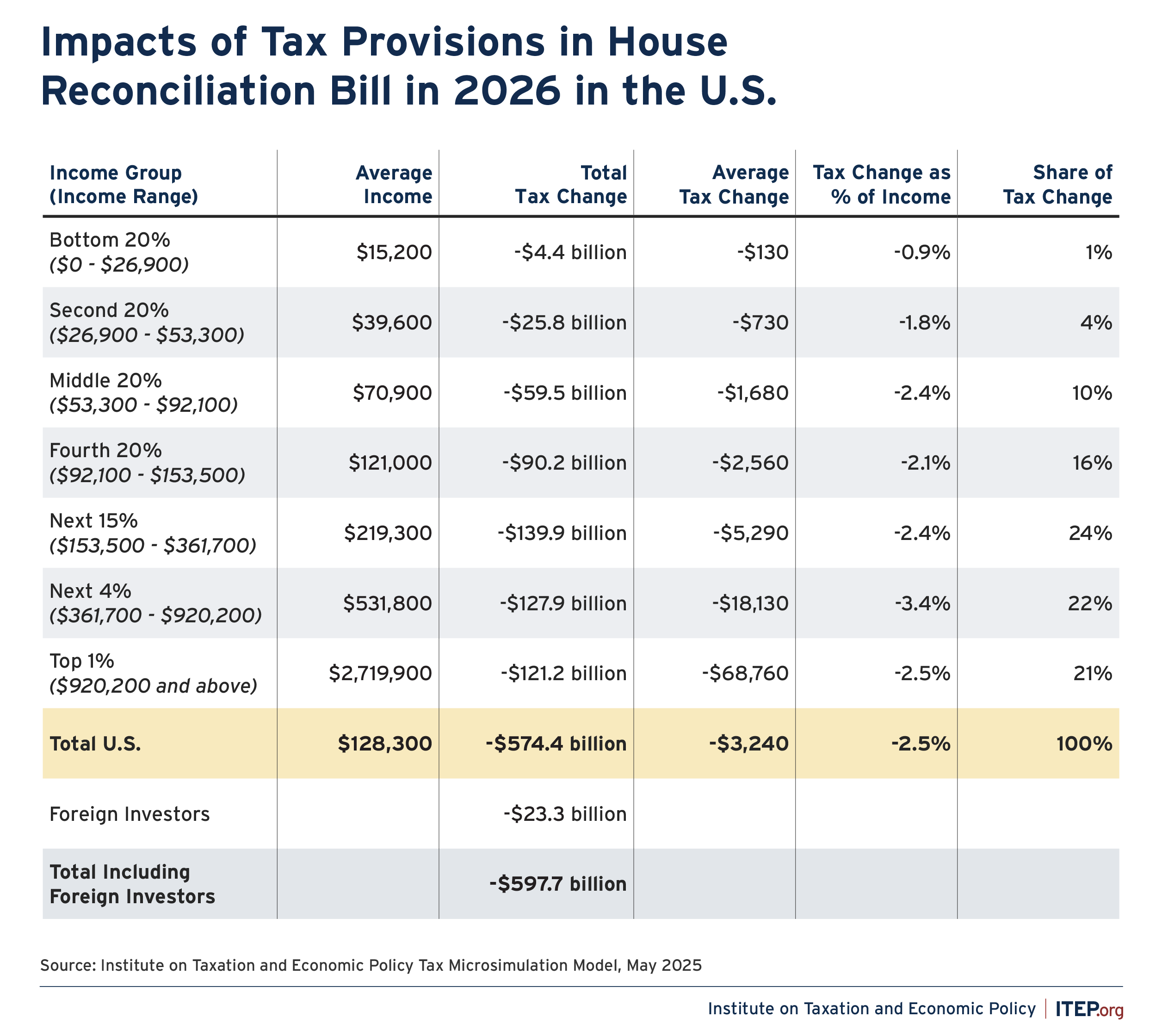
The Institute on Taxation and Economic Policy estimates that people making an average income of $39,600 will only see a $730 annual reduction in their taxes. The top 1%, those earning $920,200 or more, will see the largest reduction at $68,760.
The contents of the bill are not set in stone, as the U.S. Senate will spend the coming weeks making its own changes before final passage, which is supposed to come before a deadline on the Fourth of July. Many Senate Republicans have voiced their concerns with the bill, mainly that the tax cuts could increase the deficit.
Sen. Ron Johnson (R-WI) was quoted last week as saying he will not support the increased spending and that Trump can’t threaten him with a primary challenger for his seat.
“I know everybody wants to go to Disney World, but we just can’t afford it,” Johnson said. “Listen, in the House, President Trump can threaten to primary, and those guys want to keep their seats. I understand the pressure. Can’t pressure me that way.”
Sen. Rand Paul (R-KY) expressed a similar sentiment, indicating that he doesn’t want Republicans tied to a bill that makes the deficit worse. Sen. Lisa Murkowski (R-AK) has reportedly pushed back on the cuts to Medicaid as well.
Senate Majority Leader John Thune (R-SD) will need at least 50 senators to vote for the bill after the Senate makes its changes to it, meaning he can only afford three Republican defections in a floor vote.
The Senate is set to return on June 2 after an off week for Memorial Day. These are some of the provisions currently in the bill passed by the House.
Millions will lose health care coverage
To offset the cost of the tax cuts, Republicans are calling for sweeping changes to Medicaid, a program that provides health insurance coverage to more than 78 million Americans. But under the current provisions in the bill, at least 9.7 million people are projected to lose health insurance coverage over the next decade. These changes include tying the program to work requirements, which would start by the end of 2026, and implementing more barriers for enrollees to obtain and keep coverage.
Decreased funding could lead to hospital closures, which would disproportionately affect rural parts of the country and put even more financial strain on citizens.
Medicare is also set to see as much as $500 billion in reduced spending by the end of 2034.
The bill would also prohibit Medicaid from funding clinics that perform abortions, like Planned Parenthood. In a statement, Planned Parenthood Action Fund President Alexis McGill Johnson said as many as 200 Planned Parenthood centers, which also provide cancer screenings, STI testing, pregnancy testing and a variety of other medical care services in addition to abortion, could close down and deprive millions of immediate access to care.
“‘Defunding’ Planned Parenthood is as unpopular as it is dangerous, but House Republicans don’t care about what the American people want or their ability to get basic health services,” Johnson said. “We know what ‘defunding’ will mean: Nearly 200 Planned Parenthood health centers could be forced to shutter, and more than 1.1 million patients could lose access to care. Cancers will go undetected, STIs will go untreated, and birth control will be harder to get — all while charging the taxpayers nearly $300 million to do it.”
Food stamps take a massive cut
As much as $300 billion for the Supplemental Nutrition and Assistance Program (SNAP), also known as food stamps, will be cut over the next ten years under the current text. States will be tasked with taking on 5% of the benefit costs for SNAP as well, which is projected to put massive financial constraints on state budgets that will likely lead to more people losing benefits.
Republicans have also increased the age of work requirements for SNAP, with older adults without dependents needing to work until 64 years old instead of 54 under the bill. While some House Republicans in the Midwest like Reps. Derrick Van Orden (R-WI) claimed to want to protect food stamps, he and the GOP members of the House Agriculture Committee approved the SNAP cuts and ultimately voted for the larger bill.
Clean energy credits are gone
The bill also eliminates clean energy tax credits passed during the Biden administration. Clean energy companies saw shares plummet after the vote as the bill could derail a boom of infrastructure projects made possible by Biden’s Inflation Reduction Act.
“If Congress does not change course, this legislation will upend an economic boom in this country that has delivered an historic American manufacturing renaissance, lower electric bills, hundreds of thousands of good-paying jobs, and tens of billions of dollars of investments primarily to states that voted for President Trump,” Abigail Ross Hopper, president of the Solar Energy Industries Association, said in a statement.
Increased military and deportation spending
While seniors and the poor will see their social safety nets slashed, Trump’s bill calls for increased funding for the Pentagon, which already sees $900 billion annually. Despite Republicans constantly saying Medicaid and SNAP cuts will only remove waste, fraud and abuse, they seemingly have no problem calling for more than $1 trillion in annual defense spending despite the Pentagon consistently failing to account for its own dollars.
The current budget bill shows that $175 billion would be dedicated to Trump’s “Golden Dome” plan, a controversial missile defense system that has been deemed impossible to implement and would likely make defense contractors tons of money. Democrats have called for an investigation into the system, with concerns over national security and a potential conflict of interest if Elon Musk gets the Golden Dome contract. Studies show that nearly half of the Pentagon’s money already goes to weapons manufacturers in the United States, effectively transferring even more wealth to the richest entities in the country.
The reconciliation bill also directs more money for Trump’s deportation efforts, with increased funding for a border wall, detention centers, deportation capacity and Immigration and Customs Enforcement (ICE) agents.
Another provision would deregulate silencers for firearms and scrap a $200 transfer excise tax. The bill also modifies the National Firearms Act to exclude silencers from registration requirements, which would make them significantly easier to obtain and own. Although silencers do not completely eliminate the noise of a gunshot, they can reportedly reduce the sound by 20-35 decibels. Silencers are illegal in eight states and Washington D.C.
Heartland Signal encourages news organizations and content creators to use our content. You're welcome to republish this article for free as long as you follow our republishing guidelines.
Related Articles

Bill to end Pennsylvania’s closed primary elections passes state House
A bill to allow independent and third-party voters to cast ballots in Pennsylvania primary elections passed Tuesday in the state House.
Minnesota Truth Council concludes public testimony on Operation Metro Surge
A council tasked with documenting the harms of — and resistance to — the federal government’s immigration crackdown held its final public meeting Tuesday in Rochester.

Missouri education board declines to seek $300 million increase in school aid
After a stalemate, the board voted to keep its foundation formula request flat despite rising costs under state law.