
ANALYSIS: Ohio Democrats show when a bad map is a good deal
Aaron Kleinman writes, “Ohio Democrats just gave up a congressional district to Republicans. Good on them.”

Today, Democrats on the Ohio Redistricting Commission agreed to a new congressional map that seems likely to end the political career of longtime Rep. Marcy Kaptur (D-OH) and makes Rep. Greg Landsman’s (D-OH) seat much harder to defend. So people like former state Democratic Party head David Pepper and a coalition of liberal advocacy groups are saying that it’s a lousy deal.
But if you take a close look at the political trends and redistricting process in Ohio, you’d see that the map was a reasonable bet to prevent a total washout in the state’s congressional delegation, and the votes for it were justified. And notably, nothing in the deal precludes Ohioans from trying to implement a fairer process ahead of the 2028 elections.
The process
Ohio has the most convoluted redistricting process of any state. The state constitution requires Ohio politicians to redraw the map they passed ahead of the 2022 elections before the 2026 elections because those maps did not have bipartisan support. The constitution also requires that districts not be drawn for partisan gain, but a nakedly partisan Republican state supreme court has gutted those requirements.
The first body that gets a crack at redrawing districts is a commission with five Republican members and two Democratic members. If a majority of the commission can agree to a map with votes from members of each party before Oct. 31 it gets put in place for the rest of the decade. If not, then the legislature has until Nov. 30 to pass a map by a majority vote. That map would be subject to a veto referendum (similar to the ongoing effort in Missouri) unless it was passed with a supermajority.
How it’s played out
Ohio’s current map has 11 seats that went for Trump and four that went for Harris, but Democrats hold five seats because longtime Rep. Marcy Kaptur has both significant crossover appeal and lucked into some lousy opponents. But Republicans could feasibly draw a map that would leave the state with only two seats that Democrats could win and 13 that they would be virtually assured of absent a red wave.
So with that background, Democrats on the commission had a choice:
- Agree to a map that’s worse than the current one but still gives them a chance of winning four seats
- Let the legislature draw the map and bet everything on a veto referendum overturning a map where they can only win two seats.
They chose the former. Here’s how the three endangered Democratic incumbents’ seats have changed:
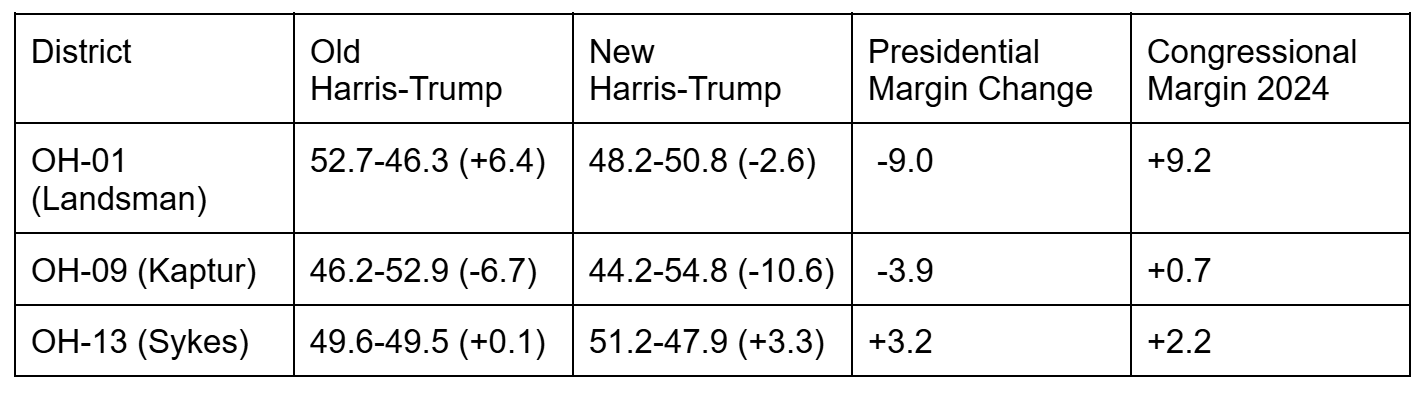
So while this map would’ve likely doomed Kaptur in 2024, Landsman might’ve survived (though he too faced a subpar opponent), and Rep. Emilia Sykes (D-OH) would’ve had an easier time. Also of note: The two Republican-held seats most endangered under the current map (OH-10 and OH-15) each get about a point more Republican.
Ultimately, I would have taken this deal if I were in the Democrats’ shoes. Here’s why.
The veto referendum process was no sure thing
There are a number of hurdles to the veto referendum process that gave Democrats an imperative to cut a deal. The first is that a new law isn’t subject to a veto referendum if it is passed with a supermajority. Republicans have a supermajority in the Ohio Senate and are only one seat away from one in the Ohio House. We have seen them break supermajorities on redistricting votes in other states by peeling off members of minority caucuses.
But ensuring every Democrat voted against the map would only remove one hurdle. The signature-gathering campaign would take place in the 90 days following final passage (likely in early November). Collecting 250,000 signatures from at least 5% of the voters in 44 counties during the coldest part of the year in Ohio (not to mention the Thanksgiving, Christmas and New Years travel periods) is no small feat.
And Attorney General Dave Yost and Secretary of State Frank LaRose, both Republicans, could make it even harder by using their discretionary power to reject the ballot description and initial 1000 signatures submitted by organizers. The 90-day signature gathering period clock keeps going even if this initial petition gets rejected and the time it takes to resubmit or try to litigate the issue through the partisan state courts will similarly take valuable time. Moreover, LaRose could reject the signatures as insufficient. That would have to get litigated as well, with no sure outcome.
Moreover, you may be wondering why Ohio voters didn’t do away with this convoluted process and pass an initiative to implement an actually impartial redistricting commission. They did try to last year, but LaRose couched it with misleading ballot language that their state supreme court upheld. Republicans also ran a misinformation campaign against it, which party Chair Alex Triantafilou happily admitted to. There’s no guarantee that they wouldn’t try to do the same with a veto referendum, but it certainly bodes ill for any process that relies on Yost, LaRose and the courts to not use their power to squelch the referendum.
This map is a bet on current political trends
Under the new map Ohio will likely have a similar congressional delegation by the end of the decade as it would have under the old map. Just look at the trends in the presidential vote for the counties that’d be the population centers of any seat in their area. First, let’s take a look at Kaptur’s home county — Lucas County, home to Toledo. It’s getting a lot less Democratic than it used to be.
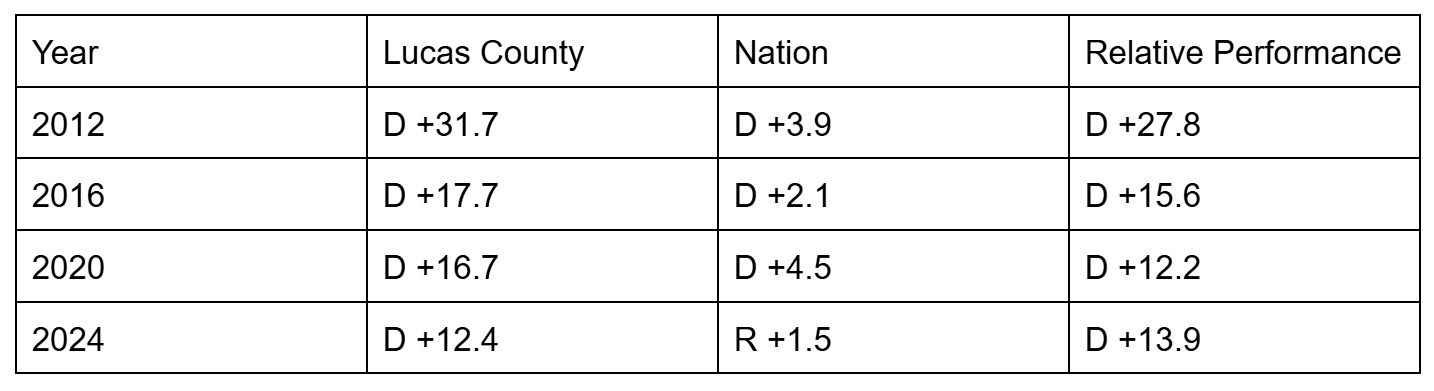
Under the new map Ohio will likely have a similar congressional delegation by the end of the decade as it would have under the old map. Just look at the trends in the presidential vote for the counties that’d be the population centers of any seat in their area. First, let’s take a look at Kaptur’s home county — Lucas County, home to Toledo. It’s getting a lot less Democratic than it used to be.
While there was a slight improvement relative to the rest of the country in 2024 overall, the trend is that Democrats are in a freefall there. Lucas County has a lot of non-college educated voters, and there is a secular trend against Democrats with them. Kaptur barely won in 2024 against a flawed opponent; a replacement-level Republican could have knocked her off in 2026 under the current map.
Moreover, when she was first elected in 1982, the heavily blue county was big enough to be more than 90% of a congressional district. Today, it doesn’t even have enough people to be more than 55% of one. With the outlying areas trending Republican as well, it is getting harder and harder for a shrinking county to counteract them with Democratic votes. Kaptur might potentially pull another rabbit out of her hat in a good year, but it’s hard to see her (or another Democrat, she’s 79) holding onto the seat for the entire decade.
Meanwhile, let’s look at Hamilton and Warren Counties, where the bulk of Landsman’s district is located.
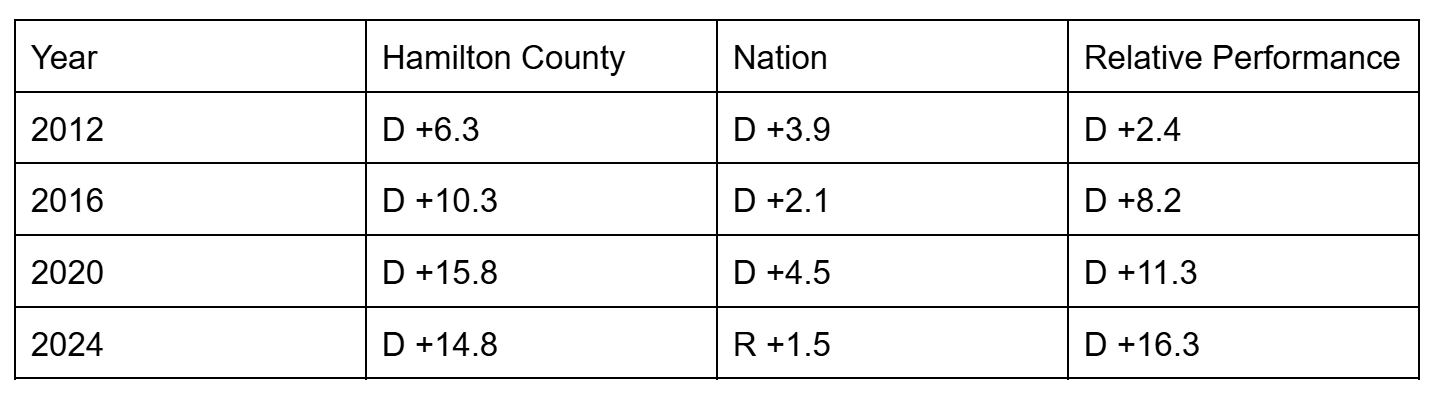
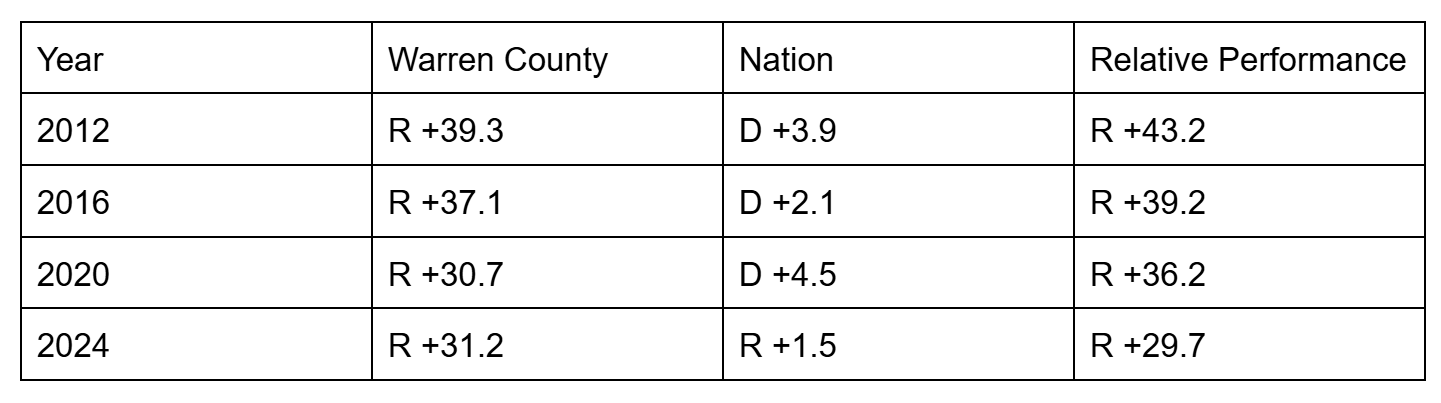
Remarkably, Harris barely lost any ground in this area relative to Biden even as she was doing six points worse nationally. If Democrats are looking for places where they could bounce back in 2026, Southwest Ohio is high on the list.
So putting Landsman in a more marginal seat is a decent bet to make. Even if Trump won his seat by 2%, there’s a good chance a Democrat carries it in 2028 (while the GOP nominee looks like it’ll be JD Vance, he didn’t seem to help them here in 2024. And just ask his half-brother how their local brand is doing.)
So, if Republicans gave you the choice to 1) somewhat shore up an incumbent in a very close seat, 2) likely hasten the retirement of a 42-year incumbent who’ll probably be the last Democrat to represent the seat and 3) put another incumbent in a purple seat that still has trends in his favor instead of making all three seats unwinnable and leaving you to navigate the potential pratfalls of a veto referendum, would you take the deal? I think I would.
Moreover, there’s nothing in this deal that prevents Ohioans from attempting another ballot initiative that would do away with this partisan, special interest-controlled process and attempt to implement a functioning, independent commission ahead of the 2028 election. Perhaps the nationwide outbreak of extreme partisan gerrymandering and voters seeing firsthand just how broken the process is could lead to a different outcome.
In other words, Ohio Democrats just gave up a congressional district to Republicans. Good on them.
Heartland Signal encourages news organizations and content creators to use our content. You're welcome to republish this article for free as long as you follow our republishing guidelines.
Related Articles

Cooke calls Van Orden’s AI deepfake videos defamatory, threatens legal action
Incumbent Derrick Van Orden (R) has posted numerous AI-generated deepfake videos of Rebecca Cooke on his X account. Cooke and her lawyers have issued a cease-and-desist letter to Van Orden, arguing that his conduct meets the legal standards for defamation.
Democratic candidate David Crowley up in polls, down in fundraising
Wisconsin’s race for governor is tight with Democratic gubernatorial candidate David Crowley up in the most recent Marquette poll over Republican gubernatorial candidate Tom Tiffany, but down in fundraising.

Sand completes second 99-county town hall tour of gubernatorial campaign
As Iowa Auditor of State Rob Sand completed a 99-county tour for the second time in his gubernatorial campaign, he called for supporters to keep momentum up and bring “divided government once again” to Iowa.