
Missouri lawmakers seek to make restrictions on transgender health care, athletes permanent
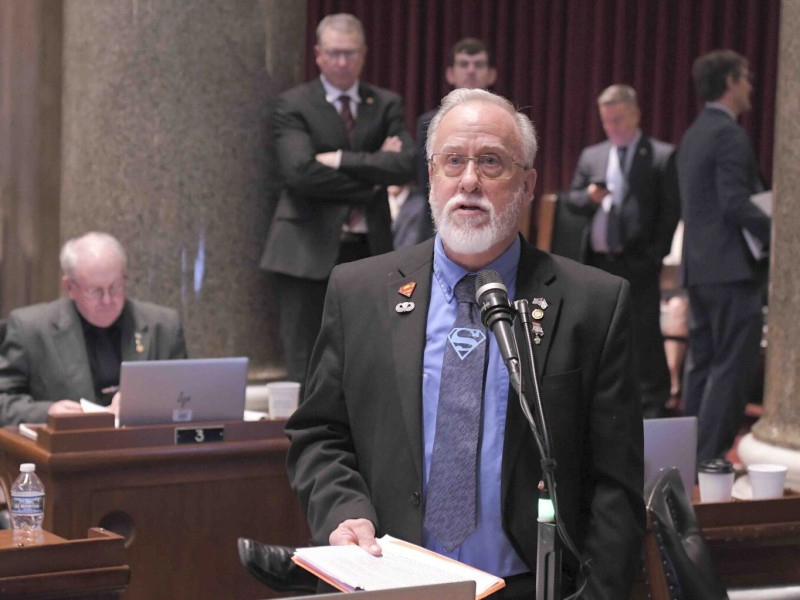
A sponsor of legislation to make Missouri’s restrictions on cross-sex hormones and puberty blockers for minors permanent argued Tuesday night that the ban has “no detriments.”
But for six hours, transgender people, their loved ones and physicians told the House Emerging Issues Committee about the hardships they’ve experienced because of the law. Those in opposition to the bill outnumbered those in favor almost four to one.
“I’ve seen the lifelong damage that comes from bills like these,” St. Louis pastor Elijah Anthony told the committee.
“I know that everybody here wants to protect children, but your intent and impact are different,” he said. “These bills do not tell trans kids that you want to protect them.”
The committee also discussed a bill that would remove the expiration date on a law that bars transgender athletes from competing according to their gender identity.
Currently, restrictions on cross-sex hormones and puberty blockers and the transgender athletes law are set to expire Aug. 28, 2027.
“Let adults make adult decisions,” said state Rep. Brian Seitz, a Republican from Branson and one of four sponsors of the legislation. “This is current law and needs to remain law.”
The bills also seek to remove a provision that allows those who received prescriptions for cross-sex hormones and puberty blockers prior to the law’s passage in 2023 to continue their medication.
The state’s ban on gender-affirming surgeries for minors is already permanent.
Months after the law went into effect in 2023, Washington University and University of Missouri Health Care stopped providing cross-sex hormones and puberty blockers to those under 18 — including patients covered by the law’s grandfather clause.
Kelly Storck, a licensed clinical social worker who treats many young people with gender dysphoria, told the committee that losing gender-affirming care in Missouri has created a hardship for her clients.
“I now have clients that have to travel multiple states away, spending thousands of dollars when they used to be able to travel 20 minutes to really high-level, trustworthy, solid, effective, safe care,” she said. “It is an incredible loss.”
Some families, seeking access to gender-affirming care and a supportive environment, have fled the state.
Michael Walk, a volunteer leader with parent organization TransParent, said he knows families that have moved in order to access gender-affirming care for their children.
“People with strong roles in their communities have been uprooted. They no longer live here, work here or pay taxes here,” he said. “But those who remain still need this care.”
Walk was one of the dozens who warned the committee not to pass the restrictions in 2023. The crowd that came to testify that year was different, noted state Rep. Aaron Crossley, a Democrat from Independence.
The hearing room “was just filled with kids and families,” he said. This year, there aren’t any.
“I was really moved by the testimony of the children and them sharing how this kind of treatment has helped them, has made them feel more whole,” Crossley said.
Each year since 2023, fewer families have come to the state Capitol to oppose anti-transgender legislation. Some have moved out of state or have felt unsafe publicly identifying as transgender. Others feel beaten down.
Kyle Freels, a father from St. Louis, tossed his hands up as he sat at the witness desk.
“Coming here is a waste of your time and ours,” he said. “These bills will pass with or without our testimony.”
His wife, Rene Freels, said she anticipates that the General Assembly will pass the bill. But she still insists on sitting face-to-face with lawmakers and sharing her concerns.
“Us parents, we love our kids, and we love our family. And everyone is our family,” she said. “And we are not going to stop fighting until they have full, equal rights.”
Transgender athletes
Debate on a bill that would ban transgender athletes from competing according to their gender also brought hours of testimony, largely in opposition.
Three bill sponsors told the committee their aim was to “protect” women’s athletics.
Allowing transgender girls to compete in women’s sports causes “women and girls to suffer and become less than rather than equal,” Seitz said. “Years of training, practice and hope are extinguished.”
State Rep. Hardy Billington, a Republican from Poplar Bluff, and state Rep. Bennie Cook, a Republican from Houston, filed identical bills to Seitz.
Of the three bill sponsors, only Billington said he watched women’s sports. But he could only name one female athlete.
But it’s not about being a sports fan, Billington said. He filed the bill out of concern for “men harming women.”
Seitz told the committee it was a matter of “fairness” and an extension of women’s fight for equality.
“I am old enough to remember the (establishment of) Title IX, when women finally broke through the glass ceiling and they could compete,” he said.
State Rep. Wick Thomas, a Kansas City Democrat and the state’s first nonbinary lawmaker, said the bill does not support women or advance equality.
“This bill doesn’t do that,” they said. “This bill just takes away from people.”
A group of softball players from Lincoln University disagreed. One of those players, Reese Smith, testified that the idea of playing against a “six-foot, two-hundred-something” person scared her.
“I don’t see why it would be fair for biological men to play a female sport when we already had to fight hard enough,” she said.
State Rep. Ashley Aune, a Kansas City Democrat, told Smith that the bill was about athletes competing according to their gender identity.
“No one is suggesting that we put a full grown man on a field with you,” she said. “To be very clear, that is not what this is about.”
Sage Coram, representing the ACLU of Missouri, warned the committee that the restrictions on transgender athletes could be subject to heightened scrutiny in court and therefore vulnerable to being struck down.
“Trans youth like all youth simply want to participate in the activities that they love, including athletics,” she said. “The statute is ineffective in its aims and discriminatory towards children and families across the state.”
The committee did not take action on the bills Tuesday evening, adjourning around 11 p.m.
Missouri Independent is part of States Newsroom, a nonprofit news network supported by grants and a coalition of donors as a 501c(3) public charity. Missouri Independent maintains editorial independence. Contact Editor Jason Hancock for questions: info@missouriindependent.com.
This article, “Missouri lawmakers seek to make restrictions on transgender health care, athletes permanent,” has been republished from the Missouri Independent under Creative Commons license CC BY-NC-ND 4.0.
Heartland Signal encourages news organizations and content creators to use our content. You're welcome to republish this article for free as long as you follow our republishing guidelines.
Related Articles

Jackson County GOP names 9/11 golf sponsorships after attack sites
Sponsorship tiers named for the Twin Towers, the Pentagon and Flight 93 are on sale for a “Tee Off in Remembrance” event on the attacks’ 25th anniversary.

Michigan Senate passes new versions of nine bills held up in House, vetoed by Whitmer
Members of the Michigan Senate on Thursday pushed forward with new versions of nine bills that became the subject of controversy when the legislation was prevented from reaching the desk of Gov. Gretchen Whitmer by the Republican-led House of Representatives.

Skinner brags about failed Lake Altoona project in campaign ad
The Wisconsin Senate candidate’s ad brags about a project she says cleaned up Lake Altoona for free. County records — and Skinner’s own voting record — tell a different story.