
How one Minneapolis man is helping neighbors surveil ICE back
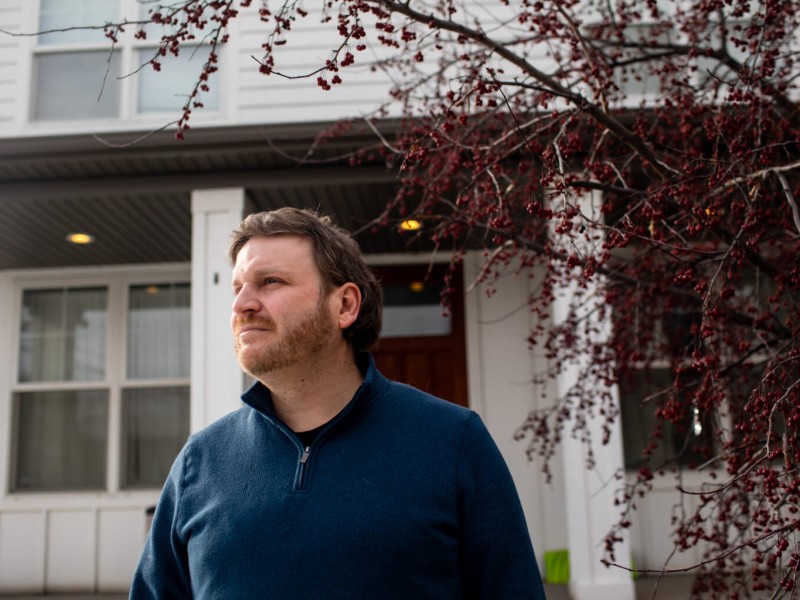
Garrett Guntly poses for a portrait at his home Tuesday, Feb. 10, 2026. (Photo by Nicole Neri/Minnesota Reformer)
When thousands of immigration agents flooded Minneapolis late last year, Garrett Guntly had an idea: a network of neighbor-owned security cameras, pointed towards public areas, that they could use to monitor ICE activity in the area.
He affixed a security camera first to his own south Minneapolis home, pointing it at the bus stop across the street. In early January, the camera captured Immigration and Customs Enforcement agents detaining a man while he waited for the bus.
Now, nearly one month later, he’s installed more than 20 cameras on willing neighbors’ houses — and they’ve worked together to interrupt around a dozen immigrant arrests, Guntly says.
The goal is to cover public areas where immigrants may be arrested — like bus stops and businesses — but Guntly envisions the network persisting beyond Operation Metro Surge, becoming a more technologically advanced “neighborhood watch,” providing peace of mind to residents.
He remembers reading a couple white papers on the topic more than a decade ago while working in information technology and cybersecurity.
“I always bookmarked that in the back of my head, but there was never really a need for it until now,” Guntly said.
Federal agents have liberally employed surveillance technology in their search for immigrants, from automatic license plate readers to AI-powered facial recognition software.
Just as other anti-ICE volunteer activists track and record confirmed ICE vehicles via observers and a crowdsourced database, Guntly’s system empowers neighbors to surveil the feds back.
He set up some ground rules: Only people who have cameras on their properties can access the live feeds — and Guntly vets each neighbor in-person before installing the cameras. Unlike popular security cameras like Ring, none of the video is uploaded to cloud storage; the data is all stored on hard drives at Guntly’s home. All of the cameras are pointed at public areas.
Many of the neighbors who have joined the network work from home.
“This is what I was really hoping for and validated and excited to see — they’re opening up these feeds and just keeping them on their third monitor, or a second monitor off to the side, so if something happens, they can catch it,” Guntly said.
Guntly shares information with neighbors in rapid response groups to track ICE agents, whether they’re driving through the neighborhood or getting out of vehicles to detain someone.
In a neighborhood that has been rocked by police violence in recent years — first the murder of George Floyd in 2020, then the killing of Renee Good last month — he said he realizes the idea of cooperating with the police is unappealing to most of his neighbors. Decisions about what to do with footage of a crime will be made by the community of camera-owners, Guntly said.
In his home, a table is stacked with network cables, extension cords and spare cameras he purchased himself. On one monitor, he watches a grid of 16 live camera feeds, and on another, he singles in on the camera at his house, watching the intersection with the bus stop. When he zooms in, he can see details: license plate numbers, dirt on the car hood and the drivers’ faces.
Minnesota Reformer is part of States Newsroom, a nonprofit news network supported by grants and a coalition of donors as a 501c(3) public charity. Minnesota Reformer maintains editorial independence. Contact Editor J. Patrick Coolican for questions: info@minnesotareformer.com. This article, “How one Minneapolis man is helping neighbors surveil ICE back,” has been republished from the Minnesota Reformer under Creative Commons license CC BY-NC-ND 4.0.