
Proposal 2 backers move to shield utility donation ban from lawsuits
Groups behind Michigan’s Proposal 2 want to join two federal lawsuits over the voter-approved ban on utility campaign donations. Here’s what each side argues.
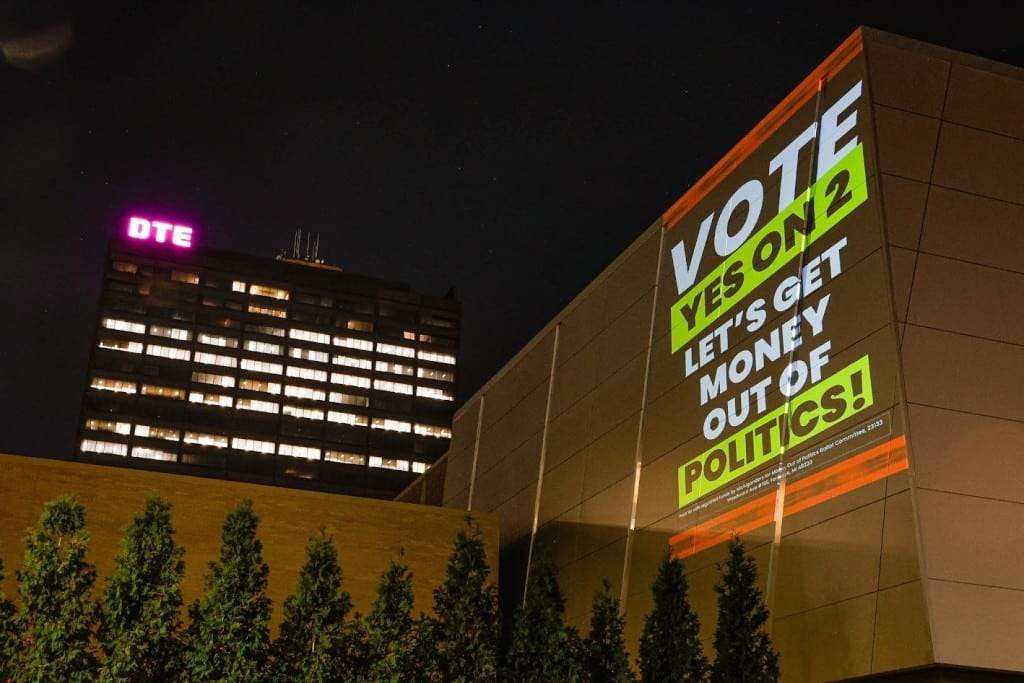
Three organizations and one newly elected politician have filed a motion to intervene in lawsuits opposing a new citizen-led ballot initiative in Michigan.
Clean Water Action, Voters Not Politicians, Michiganders for Money Out of Politics and Democratic state Rep.-elect Joanna Whaley are asking to join two lawsuits challenging Michigan’s Proposal 2. The suit was filed in the U.S. District Court for the Western District of Michigan.
The ballot initiative passed by more than 80 percentage points in the 2026 midterm elections. Only one of Michigan’s 83 counties voted against it.
It bans utilities and certain government contractors from contributing to political candidates and elected officials at the state level. It also broadens the disclosure requirements for any organization that publishes material related to a candidate for public office or elected official.
The law will take effect on Dec. 3, ten days after the Board of State Canvassers certifies election results. DTE Energy and Consumers Energy, the two largest energy providers in the state, filed a joint lawsuit against Secretary of State Jocelyn Benson and Attorney General Dana Nessel on Nov. 5, two days after the election. If approved, the intervening parties would join the state officials as defendants.
DTE and Consumers argue the law violates their and their employees’ First Amendment rights. The intervenors argue the law is necessary to curb large utility corporations’ influence on Michigan politics and improve service in the state.
Expensive, unreliable electricity
Together, DTE and Consumers provide electricity for 4.1 million customers. That service is some of the worst in the country, according to a 2025 report by the Citizens Utility Board of Michigan.
The report found that on average, Michigan residents had to wait longer than any other state for power outages to be fixed in 2023. The state ranks close to last for that metric in other years.
This year alone, DTE Electric customers suffered multi-day power outages over two separate holiday weekends.
For over a decade, DTE Electric has filed a rate increase request almost every year. Consumers Energy has followed a similar pattern, and both utilities have requested similar rate hikes for the natural gas they provide for a combined 3.1 million customers.
The result is increasingly expensive energy bills for Michigan residents — for unreliable electric service.
The utilities argue the rate hikes are needed to cover infrastructure improvements and create a more resilient grid. But both companies have reported large profits for years — profits that consumers pay for, according to the Energy and Policy Institute, a watchdog group focused on utility reform.
There are no laws in Michigan that ban utilities from filing year-over-year rate hike requests. And since Michigan’s electric and gas utilities are monopolies, consumers don’t have a choice in where they shop for energy.
No changes in Lansing
It’s up to the governor-appointed Michigan Public Service Commission to approve a utility’s rate increase request. But the legislature can pass laws that give the commission more teeth — and that’s what the commission requested in July. In a letter to Gov. Gretchen Whitmer (D), commissioners outlined legislation that would address both reliability and affordability concerns for Michigan residents.
But efforts to regulate utilities through the state legislature have stalled in the past.
DTE and Consumers have donated to legislators and candidates on both sides of the aisle for years. Neil Thanedar is the executive director of the Michigan Campaign Finance Network, a nonprofit organization focused on educating Michiganders on campaign finance transparency. He said voters suspect those donations have influenced state-level decisions about regulating the monopolies.
“When you have a bipartisan coverage of funding by a group of utilities, it’s very easy to see the appearance of corruption when there are huge rate increases,” he said.
“Choking off” utilities’ free speech
DTE and Consumers filed the joint lawsuit on Nov. 5, two days after Proposal 2 passed. The utilities argue the law violates the First Amendment by restricting the corporations and their employees from expressing their political beliefs through donations.
“By choking off Plaintiffs’ perspective in public debate and enhancing the relative influence of speakers who disagree with them, Section 30a is an unconstitutional, content-based restriction on political speech,” the complaint said.
The law only applies to campaign contributions, not all political activity. But Supreme Court precedent considers campaign donations a form of speech protected under the First Amendment. To restrict that speech, the state has to show evidence of corruption or the appearance of corruption.
DTE and Consumers argue that there is no evidence of the utilities committing “quid pro quo” corruption, so the law unfairly targets utility companies for political reasons.
In a brief filed Tuesday, the intervenors pointed to evidence that DTE Energy has ties to Michigan Energy First, a dark money non-profit that has funneled money to politicians on both sides of the aisle for more than a decade.
A 2023 investigation by Planet Detroit found that the nonprofit gave $100,000 in 2020 to the largest funder of Unlock Michigan, a campaign to repeal the governor’s emergency powers. DTE said at the time that it did not make the donation and does not speak for Michigan Energy First. A 2025 analysis by the Energy and Policy Institute cited criminal court filings showing that a DTE executive arranged that contribution using her company email.
“The People of Michigan voted to adopt this provision in the wake of numerous scandals regarding utility-company campaign contributions to the state officials who regulate them, both in Michigan and in other states,” the intervenors’ brief said, referring to the massive FirstEnergy bribery scandal in Ohio.
Michigan Energy First donated $117,000 to Protect MI Free Speech, a PAC organizing against the ballot measure, while Consumers donated $115,000 to the committee. No PAC bearing DTE Energy’s name appears in state campaign finance records for this committee.
Thanedar said the defendants could also use widespread support for the proposal to argue that constituents see these companies as corrupt.
What’s next?
The law also faces a separate lawsuit from the Mackinac Center for Public Policy, a free-market think tank, challenging the other provision in Proposal 2 that broadens disclosure requirements in political communications spending.
Proposal 2 also includes a provision that if one part of the law is struck down, the other is still valid. If one lawsuit succeeds but the other doesn’t, part of the law will remain.
Heartland Signal encourages news organizations and content creators to use our content. You're welcome to republish this article for free as long as you follow our republishing guidelines.
Related Articles
House Republicans elect Jim Jordan minority leader over Steve Scalise
Ohio Rep. Jim Jordan beat Steve Scalise 106-73 to lead House Republicans in the minority. Here’s who he is, how he won and what his record brings to the job.

Pennsylvania House panel votes to censure GOP Rep. Bernstine over alleged slurs
In a move before the end of the legislative session, the Pennsylvania state House Rules committee voted unanimously to censure Republican Aaron Bernstine over alleged homophobic remarks made at a Harrisburg bar this fall.
26 House Democrats push Illinois Speaker Chris Welch to step aside
Illinois House Speaker Chris Welch won’t seek a fourth term after 26 Democrats called for new leadership amid the Benton scandal. Here’s who could succeed him.