OP-ED: Tuesday’s Wisconsin Supreme Court race and the terror of tiny margins
Chris Ruen writes about “last-minute actions can help liberate Wisconsin from its Republican-led oppression.”
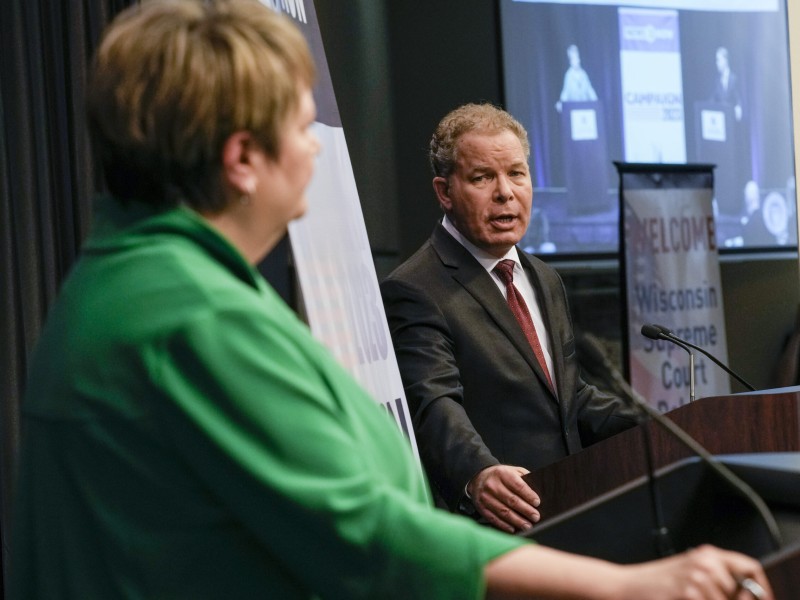
Politically engaged Midwesterners have likely heard about Wisconsin’s Supreme Court election by now; how it feels, to us, like an all-or-nothing moment for the restoration of abortion rights and democracy itself via fair maps. The thing is, Wisconsin could have already restored both if Democratic turnout in the 2019 Supreme Court race had been just slightly higher; conservative-aligned Brian Hagedorn won the race for his seat on the 4-3 split court by only 5,981 votes, less than one vote per ward in Wisconsin.
There is plenty of reason to fear that the election Tuesday becomes another agonizing what-could-have-been scenario, and it is worth asking what last-minute actions remain, even if you don’t live in Wisconsin, to help lift the curtain on a future of progress and renewed possibility for the Badger State.
Wisconsin, swing-iest of the swing states, knows all about how tiny electoral margins can thrust history into vastly divergent trajectories. For the past two presidential elections, Wisconsin joined with two other swing states to narrowly determine victory in the Electoral College; for Trump in 2016 (by 80,000 votes, or .06% of total cast) and Biden in 2020 (by 44,000, or .03% total cast). In the 2022 midterms, we came within a handful of winnable House seats and only 26,718 votes in the Wisconsin U.S. Senate race from achieving a House and Senate Democratic majority, which could have finally eliminated the Senate filibuster to make Roe v. Wade the law of the land and usher in a new age of legislative reform.
The probable margins on Tuesday will be minimal, with maximal consequences. The New Yorker proclaimed that the race “could change the course of the entire country” last week, in a piece by Dan Kaufman that offered up a dismal chronology of Republican-led political oppression in Wisconsin, anchored by a secretive, bad-faith gerrymander in 2011 that transformed the state from a national example of good government into something akin to a banana republic, where legislative self-determination by citizens became impossible.
The astronomical stakes of the election are confounded by the low-voter-turnout nature of spring elections. Turnout as a percentage of registered voters is only expected to reach the mid-30s statewide, compared to the 57% that turned out in the most recent midterms. What does this mean? In short, don’t make any assumptions about who will turn out to vote or understand the importance of the race. A family member of mine, a dependable voter for decades, admitted they didn’t even know Wisconsin had a Supreme Court when we discussed the primary election last February.
Making matters more dicey is the state weather forecast on Tuesday, with chances for severe weather increasing from the afternoon through the evening, potentially cancelling voting plans for some at the last minute — exactly the kind of voter suppressing inconvenience that explains the GOP malice toward mail-in ballots and drop boxes.
All of the above may add up to justifiable anxiety for Tuesday, but it also means that individual action likely has more political efficacy in this election than any other in our lifetimes. So, at this midnight hour, what can be done?
Whether you are in Wisconsin or within driving distance, there are still canvassing opportunities through Tuesday to get out the vote as well as phone banking that anyone outside of Wisconsin can participate in by visiting wisdems.org.
An even easier idea for in-and-out-of-staters: go though your phone and text (or email) anyone you know that lives in Wisconsin to make sure they have a plan to vote for Judge Janet on Tuesday. It’s a simple act, and — in this age of inundation by campaign ads, political texts and e-blasts — it may be personal contacts that have the best chance to move the needle; with even the slightest nudge holding the power to tilt history this Tuesday.
Chris Ruen is a New York Times-published writer, author of “FREELOADING: How Our Insatiable Hunger for Free Content is Starving Creativity,” a voice actor and digital consultant. He lives in the Milwaukee area and can be found on Twitter at @Chris_Ruen and also chrisruen.com.
Related Articles

DFL lawmaker mocks JD Vance’s ‘losing streak,’ urges him to visit Minnesota
After Viktor Orbán’s landslide loss days after a JD Vance visit, Minnesota Rep. Andy Smith is publicly urging the vice president to bring his “magnetic personality” to campaign for state Republicans in 2026.