
Supreme Court decision makes path easier for Wisconsin to reverse Republican gerrymandering
On Tuesday, the U.S. Supreme Court delivered a decision in the Moore v. Harper case and rejected giving state legislatures unchecked power over election laws and gerrymandering, giving the opportunity for the Wisconsin Supreme Court to do the same.
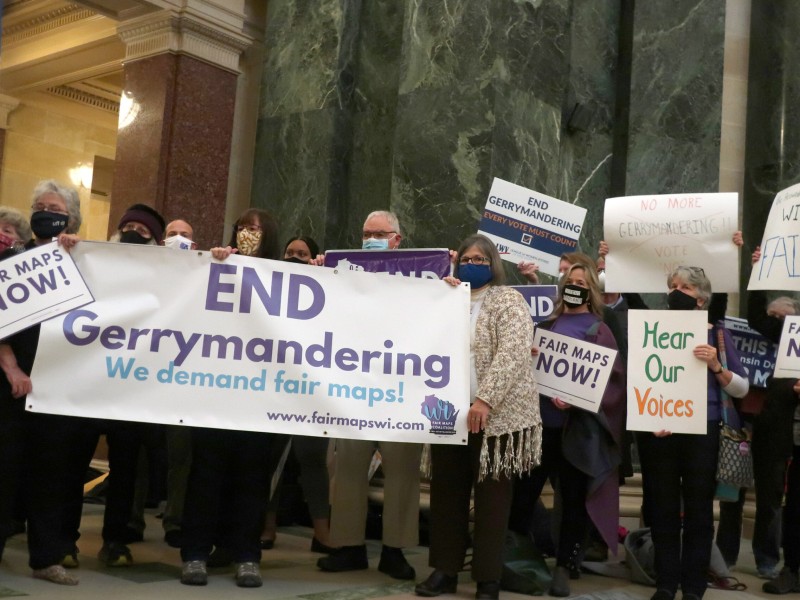
On Tuesday, the U.S. Supreme Court delivered a decision in the Moore v. Harper case, which rejected giving state legislatures unchecked power over election laws and gerrymandering.
The case originates in North Carolina, where an additional seat in the U.S. House of Representatives was added after the 2020 Census. The Republican-controlled state legislature delivered a gerrymandered map that made the new congressional district favor Republicans. A lawsuit disputing the map made it to the North Carolina state Supreme Court, which struck down the map in February 2022 for violating the state’s “free elections clause.”
The state legislature argued that the Elections Clause of the U.S. Constitution gives only state legislatures the authority to regulate federal elections. This is the basis of a controversial legal theory called “Independent State Legislature,” which would give state legislatures unchecked power to regulate elections without oversight from the other two branches of government.
The Supreme Court struck down independent state legislature theory with their decision on Tuesday, effectively rejecting the idea that state lawmakers have no oversight from Governors or state courts when it comes to election laws.
The decision was made 6-3, with all three liberal justices joining Justices Amy Coney Barrett, Brett Kavanaugh and Chief Justice John Roberts. In the majority opinion, Roberts wrote that the U.S. Constitution’s election clause “does not insulate state legislatures from the ordinary exercise of state judicial review.”
Now that state courts are upheld in their authority to check state legislatures on election laws, some states may be able to curb rampant gerrymandering. One prime example is Wisconsin, whose Republican-controlled legislature routinely turns in some of the most gerrymandered maps in the country. The Wisconsin Supreme Court upheld these maps on several occasion due to its conservative majority. That majority flipped liberal earlier this year, however, meaning that if a new challenge made it to the body, the court would likely overturn the skewed maps.
While state courts’s ability to curb gerrymandering may have been upheld, some experts warn that the Harper case is not clear enough on what exactly state courts can and cannot do when interpreting state constitutional provisions. There may be more litigation in the future, according to some law professors.
Heartland Signal encourages news organizations and content creators to use our content. You're welcome to republish this article for free as long as you follow our republishing guidelines.
Related Articles
Federal court blocks Ohio’s proof of citizenship requirements for voter registration
Federal courts have blocked a voter registration provision slipped into Ohio’s latest two-year transportation budget.

Skinner brags about failed Lake Altoona project in campaign ad
The Wisconsin Senate candidate’s ad brags about a project she says cleaned up Lake Altoona for free. County records — and Skinner’s own voting record — tell a different story.

Michigan GOP candidate Tom Smith confirms he attended Jan. 6 protest
Smith suspended his campaign in July and won the Republican primary anyway, beating Trump’s endorsed candidate by 17 points. Posts from his family business account, and his own statement, place him at Trump’s Jan. 6 rally.