
WCPT’s Joan Esposito interviews Chicago Mayor Brandon Johnson
On Monday, Chicago Mayor Brandon Johnson joined WCPT’s Joan Esposito for his first interview on the station since becoming mayor in 2023.
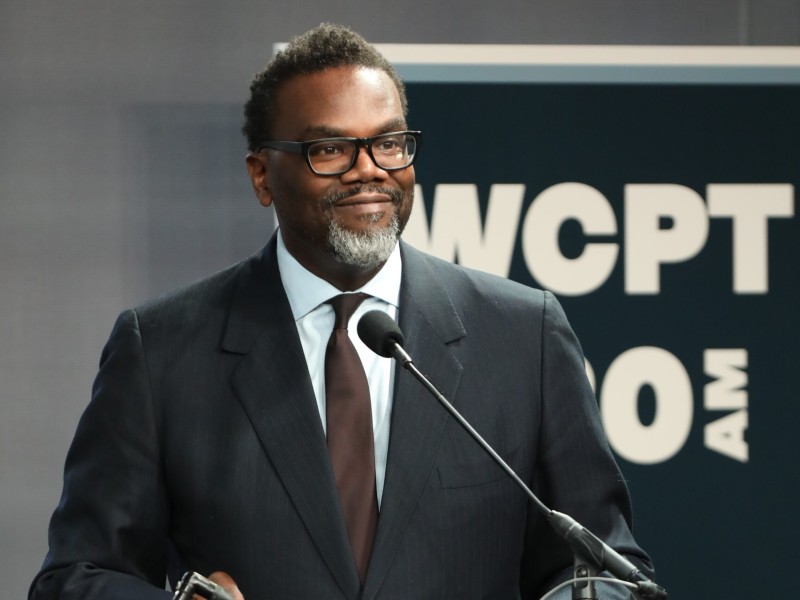
On Monday, Chicago Mayor Brandon Johnson joined WCPT’s Joan Esposito for his first interview on the station since becoming mayor in 2023.
Esposito began the 28-minute conversation by asking Johnson about last month’s Democratic National Convention in Chicago, which the mayor described as “a full display of the beauty, the soul that’s Chicago,” adding, “I promised a safe and a vibrant DNC and that’s exactly what we delivered.” Johnson praised the combined efforts of the Chicago Police and Fire Departments, the city’s Office of Emergency Management and Communications, the Department of Streets and Sanitation and the train and bus operators “that made this convention a worthwhile expression of who we are as a city.”
When the conversation turned to crime and perceptions that some residents have of the city is not as safe as it was 10 or 15 years ago, Johnson said he was “very proud” that “every single category of violent crime in this city has gone down since I’ve been in office — homicides, shootings, vehicular carjackings, robberies.”
“Look, there’s still a lot of work to be done; don’t misunderstand me. But 10, 15 years ago was actually worse. In fact, in the ’90s, when I was in high school, there were 900, almost a thousand people being murdered every year in this city, and since I’ve been in office we’ve had double-digit reductions in homicides and we’re seeing that trend continue this year.”
Johnson also touted the city’s economic strength, highlighting “significant investment” in the Southeast Side of Chicago, as well as the West Side and downtown. Asked whether the city is in for some new taxes, Johnson told Esposito, “[W]e have to put everything on the table and begin to have real honest conversations … Look, I knew exactly what I was signing up for when I decided to run for mayor of the city of Chicago, is that after decades of not paying pensions and using the pension revenue to develop downtown and to line the pockets of corporations — now that bill is due. I’m going to pay it because that’s the responsible thing to do.”
The mayor also vowed to continue fighting for “Springfield to change its funding formula, where we’re not basing the funding formula for children per person but we’re basing it on need,” declined to comment on whether he will keep Dorval Carter in his job as president of the Chicago Transit Authority, and defended the Bring Chicago Home initative that sought to raise $100 million through a real estate transfer tax hike but was rejected by voters earlier this year.
“This [was] not about PR. This was not about ambiguity. This is about corporate interests who do not want to pay their fair share,” Johnson said. “And as progressives, we have to remain aligned and we cannot be subject to the hypocrisy as well as the dogma that the corporate interests use to try to separate and divide us,” the mayor said.
Johnson, who previously hosted a weekend show on WCPT, concluded the conversation by saying that he is “looking forward to one day coming back in the studio. Maybe I can get in my old seat again. That would be cool.”
Below is the transcript of the full conversation.
Joan Esposito: I am very pleased to welcome back to our airwaves Brandon Johnson. When we last spoke, he was a Cook County commissioner. Now, of course, he is the mayor of the city of Chicago.
Brandon, how are you?
Mayor Brandon Johnson: Hey, Joan. I’m doing terrific. I miss you all over there at WCPT, progressive talk radio, the place in the world where we know the facts matter, Joan. So thanks for having me back.
Joan Esposito: I’m so glad. I was hoping to connect with you at the DNC; that didn’t happen.
How did you like being there? How did you like speaking to that crowd?
Mayor Brandon Johnson: Well, look, it’s been the joy of my life serving as mayor. Let me just, first of all, just thank you and the WCPT family. I know you all remember a long time ago when I had my hour program there on the weekends and really enjoyed filling in on occasion. But, you know, being the mayor of the city of Chicago, lifting up our progressive values has been one of the joys of my life. And the DNC was a full display of the beauty, the soul that’s Chicago, right? I mean, this is the place where history is often made. And I promised a safe and a vibrant DNC and that’s exactly what we delivered.
Joan Esposito: It really did go off without a hitch. Some of us were a little nervous that something would happen to throw the pace off. But I thought it went beautifully, and kudos, I think, to the Chicago Police Department. Maybe, Brandon, you knew about this before. I’ve never seen that, the walking bicycles. There were some protests and sometimes the protests were on the move, and Chicago Police officers had a line of bicycles, and they walked their bikes along with the protesters, just to make sure that everything stayed where it was supposed to stay, and I thought it was brilliant. I thought the city pulled it off brilliantly. I know that in front of one of the — I think in front of the Israeli consul there were some arrests, but all considered, I thought it was a real beautiful focus on our city, the wonderful parts of our city, and it went off so smoothly. And, you know, congratulations for that. Man, I don’t know about you but that’s a load off my mind. (Laughs.)
Mayor Brandon Johnson: Well, as you can imagine, as mayor of the, you know, third largest city in America and one of the most expansive economies in the world, you know, it was important for me to put forth a vision that every aspect of government could carry out. And I said from the very beginning, as a candidate, as a Cook County commissioner, as an organizer, that our police department deserves leadership that’s going to, you know, commit itself to constitutional policing. That’s what my vision has been for the Chicago Police Department, and Superintendent Snelling is very much aligned with my vision for not just the Chicago Police Department but the city as a whole. We also had organizers on the ground, too. You know, this is a collective effort from our police department to our fire department to organizers that were embedded and worked with, you know, many of the protesters, some of whom — those organizers that I’ve known over the course of my career as an organizer and have led massive demonstrations. But, you know, the real beauty, I think, in all of this is the fact that the city of Chicago really stood up, right? I’m thankful to all of the residents of the city who trust my leadership, and whatever anxiety and trepidation that people may have had, what I’ve said, you know, from the very beginning, whether it’s our police department, our fire department, our transportation system, OEMC, every aspect of government, Streets and Sanitation, we have to live up to the expectation that I set as a candidate and as mayor of Chicago for these first 15, 16 months. And the workers of this city did that. I couldn’t be more proud of our bus operators, our train operators, again, Streets and Sanitation, fire department, our police department, all the workers, OEMC, that made this convention a worthwhile expression of who we are as a city.
And look, I always say, Joan, that Chicago’s the greatest freakin’ city in the world, and I mean that. And I’m raising, you know, three children, my wife and I, on the West Side of Chicago, so we are deeply vested in the progress of our city, and I’m glad that people who may not have known about the beauty of our city got a chance to see it.
Joan Esposito: This morning, when I knew you were going to be joining us, I asked my listeners — formerly your listeners but now they’re all my listeners, Brandon — if they had questions for you and oh, my gosh, the text line blew up. As long as we’re talking about the DNC, I know that the Democratic Party raised money to put on the DNC, but one person wanted to know, did the city of Chicago pay any of the bills for the DNC?
Mayor Brandon Johnson: Yeah, so there’s a couple of aspects, right? There’s, you know, what the DNC raised to put on the more performative side, but there’s also some investments in infrastructure that was also contributed, so we had $75 million that was — that we used to pull off this convention, of which one of those elements that, you know, we worked with through grants and other opportunities — we have a brand new helicopter; we’re going to get two more helicopters by the end of the year; that’s going to provide us with more support in the air as we respond to the number one issue that I think about every single day and that’s community safety. But right, there are some just day-to-day costs of — again, you know, we still paid for the salaries of the bus operators, the train operators. You know, all of that was a part of our, you know, regular city, you know, budget. However, the vast majority of the operations that we assumed, that we would have otherwise not had to provide, that was provided for either through fundraising for, again, the performative side of the Democratic National Convention but also the actual infrastructure, and that was the $75 million, which was $25 million more than what they had initially budgeted for, to help us pull this off.
Joan Esposito: You touched on something that I got a lot of questions about, a perception that crime needs to be reined in, that people who live in neighborhoods don’t feel as safe as they felt 10 or 15 years ago. I know the statistics on murder are down, but we also have statistics going up on things like carjackings, things that happen in the neighborhoods and tend to make people feel unsafe when they hear about it. There are also concerns that we won’t be able to address the crime because of our upcoming budget crunch. So, talk about crime. How are you going to make the city safer and how are you going to fund those efforts?
Mayor Brandon Johnson: As I said, it is the number one issue that I think about every single day. You know, I mentioned Austin on purpose, my neighborhood on the West Side of Chicago. It’s beautiful. We love it. My wife and I, we’re not moving anywhere. And you know, we experienced violence, you know, well before I was mayor, certainly, at rates that are higher than most neighborhoods. In fact, it’s known as one of the most crime-ridden neighborhoods, and it has more to do with the fact that these — you know, Austin and other neighborhoods around Chicago, I think we all can agree on, have been grossly, woefully underfunded. You know, my political chops actually were birthed out of the movement to keep schools open, to make sure that good-paying jobs were available to families, whether it’s a, you know, bus operator, train operator or teacher’s assistant, teacher positions, so it’s very, very well documented that the disinvestment has left, you know, a trail of destruction. So what my, you know, plan has done is to invest in people.
One of the things that we’re very proud of is the fact that in every single category — I want to make this very clear: In every single category of violent crime in this city has gone down since I’ve been in office — homicides, shootings, vehicular carjackings, robberies. Look, there’s still a lot of work to be done; don’t misunderstand me. But 10, 15 years ago was actually worse. In fact, in the ’90s, when I was in high school, there were 900, almost a thousand people being murdered every year in this city, and since I’ve been in office we’ve had double-digit reductions in homicides and we’re seeing that trend continue this year.
Now, as I said, there’s a lot more work to be done and here’s what we’re doing: We’re investing in community safety in a variety of ways. One: $100 million for violence prevention. It’s important that we are funding support services that can provide additional support to law enforcement because everyone agrees that it’s not policing alone. Policing alone is not going to build a better, stronger, safer Chicago. Forty percent of the calls that come in on 911 are either domestic or mental health, and that’s why, you know, I have invested significantly in behavioral mental health. We’re reopening a mental health clinic in Roseland, reopening — providing mental health and behavioral health care services on the West Side, the lower West Side at Garfield Park Legler Library, UIC clinic. But we’re also seeing real strong returns of our investments with young people. We hired 27,776 young people this summer; that’s a 32% increase since I’ve been in office. And I made a commitment to hire 200 more detectives by the end of my first year. Well, guess what, Joan. We’re going to get to 200 more detectives by the end of this year. So halfway through my term we’re going to make sure there are more detectives. We have civilianized positions so that law enforcement that has historically had to provide many of the paperwork and administrative aspects to the policing — we have freed those positions up so that we can put more police officers, you know, out on the beat. And so, look, it’s going to take all of us. Bottom line is that it’s not one person or one thing; that’s why we’re building more affordable homes. I’m very proud of the fact that we had a $1.25 billion investment for housing and economic neighborhood development. It’s the largest single investment in the history of Chicago for neighborhood and economic investment. Everybody knows that the immediate response to violence is making sure that we have people who are in position, whether it’s behavioral health care workers, whether it’s law enforcement, that we put that work in place. So we also have to be committed to eradicating poverty. That’s what President Johnson said 60 years ago; we decided to go into a different direction and the so-called war on drugs has left us nowhere. So, you know, community safety is a collective work, and again, the work that we’ve done that has reduced violence in every single category, we can’t be satisfied until we, you know, really put ourselves in the position where there are greater investments and less violence.
Joan Esposito: You talked about how you want to allocate money to alleviate some of these problems and get more detectives. That’s been a big concern. And, you know, we know the COVID money is all but gone, if not gone. The budget director under you, Annette Guzman, said that there was now going to be a citywide hiring freeze because her office was looking at a deficit for next year that could be close to a billion dollars. How are you going to — people are very scared about whether or not there’s going to be a big increase in property taxes and other taxes to make up for these shortfalls. What’s your plan?
Mayor Brandon Johnson: Well, let me just say that, you know, the reason why we have, you know, the economic conditions that we have now is because we have had, you know, for too long, you know, administrations not willing to tackle the real tough decisions. And I predicted this when I was running for office. As you’ll remember, I was the only person who put forth a budget plan, of which we projected a half a billion dollars in my first budget, which we did have that, and I closed it, and then last year we projected this $1 billion forecast of a budget gap.
Let me just say this: The city of Chicago is strong, with $20 billion in new investments that have come in in the city of Chicago since my administration, $7 billion from the Reinsdorfs and the Wirtz family to develop even greater opportunities on the West Side of Chicago, brand new quantum computing coming to the Southeast Side of Chicago. It’s the first time since the steel mills closed where you’re going to have significant investment in the Southeast Side of Chicago. So we are still attracting corporate leaders all over the globe to come to Chicago and we’re building affordable homes downtown; we’re expanding old office space, converted it into housing downtown, making 30% of it affordable. Chase Bank has expanded its footprint. They have shovels in the ground, expanding their work there. Google has a billion-dollar investment. So our economy is still strong, and in the “out” of this dynamic, by the time we get into ’26 and 2027, we’re going to be in an even stronger position.
So what does that mean for us today? Yes, there will be difficult decisions that we will make, but we’re going to get there. We’re going to make sure that we find more efficiencies where we can. Just this past budget our expenditures were under $200 million, so we saved the taxpayer $200 million. The challenge that we have is that we have a jacked-up taxing structure and as progressives we know this, that we have such an emphasis on sales but, you know, the economy is moving towards service. But guess who utilize services more? People who are more affluent, who have, you know, access to resources, right? Those of us who are, you know, who don’t rely upon services as much, you know, we purchase things just to get through our day to day, you have a lopsided tax structure where sales is the greatest emphasis on taxes, versus services. So that’s something that we have to think about, not just as the city of Chicago but the state of Illinois. So I’ll be working with stakeholders, our labor leaders, our business leaders. Folks are providing ideas now about how we can generate revenue and where we can cut costs. And we’re going to roll up our sleeves like we do as Chicagoans and we’re going to finally do what other administrations refuse to do and that’s actually pay our bills. And I’m committed to doing that.
Joan Esposito: Well, everybody knows that — particularly Rahm Emanuel was famous for the scoop-and-toss economic policies of kicking these debts down the road. If you are not going to scoop and toss, are we most likely in for some new taxes, whether they’re property taxes or some other kind of tax?
Mayor Brandon Johnson: Well, you know, none of that has been determined. You know, what I’ve said is that we have to put everything on the table and begin to have real honest conversations. We’re going to have, you know, open budget hearings. I had four community budget meetings, which included a budget community meeting with young people. There’s nothing surreptitious about the work that we are doing. We’ve been very clear and open and transparent about what we’re dealing with. And to your point about just bad, toxic deals, whether it was for Chicago Public Schools, where they had these awful, toxic spots where banks and corporate leaders were able to make, you know, a killing — I hate to use such a strong word there — off of the misery and pain of everyday taxpayers, right, and instead of renegotiating those toxic deals, you know, the banks and big corporations were able to get paid while teachers and students and families had cuts to services. Look, I knew exactly what I was signing up for when I decided to run for mayor of the city of Chicago, is that after decades of not paying pensions and using the pension revenue to develop downtown and to line the pockets of corporations — now that bill is due. I’m going to pay it because that’s the responsible thing to do. But, you know, again, my work is to make sure that we continue to invest in housing and mental health, youth employment and community safety, right, and I’m going to continue to work with the City Council, corporate leaders, business leaders, labor leaders to ensure that the people of Chicago’s interests, everyday people, who want safe communities — and I want to continue to invest in safety — who want affordable homes — I’m going to continue to invest in affordable homes. We built 1,300, I believe, affordable homes since I’ve been in office; 1,700 more will be built by the end of this year. We’ve had about eight — almost $17 million for community development block grants; that’s double the amount that was invested in community development block grants in years ’21 and ’22 combined. So we’re still making investments. Our investments are up, you know, violent crime is down, you know, and it’s going to take all of us to build a better, stronger, safer Chicago and that starts with our budget.
Joan Esposito: You mentioned the Chicago Teachers Union. How are those negotiations going? And are you going to be able to fund a contract? I know your idea of a short-term loan to make that happen was shot down. So how is that going? And is it going to be fundable?
Mayor Brandon Johnson: Well, one of things that I just think it’s important to lift up is that, you know, you’re not going to find a mayor anywhere in the country that is more pro-public education than me. I’m a product of public schools. My children attend the public schools here in Chicago. In fact, I’m the first mayor to actually send their children to the public schools in Chicago. I taught in our Chicago Public Schools. It’s a fundamental right that we have to protect for all of our residents, no matter where you live in this city. And what I’ve vowed to do is to make sure that not only are we investing in our children, we’re investing in the people who actually service, you know, our children. And, you know, my job is to make sure that there are no cuts to the classrooms, right? I mean, our children cannot afford to take a loss. And then when we think about — whether it’s special education, our English-language learners; we have new arrivals that are here; we have — many of our schools, particularly in Black Chicago, that are always being threatened to be closed. I mean, these are not policies that I’m going to tolerate, quite frankly. And so, the question about, you know, whether or not, you know, we have to make some other financial decisions to ensure that families in the city of Chicago do not lose — you know, again, having a board and — (laughs) — you know, a CEO who understands that that’s what the people of Chicago want.
Let me just say this last thing: I fought — as you know, Joan, I fought before I was in an elected office for Springfield to change its funding formula, where we’re not basing the funding formula for children per person but we’re basing it on need. Well, when I became mayor, I made the Board of Education and the CEO embrace the funding formula model that I fought for in Springfield, where we base it on need and not on a per-people basis. Here’s why that’s important: Based upon the funding formula that we fought for in Springfield, the state of Illinois essentially owes the entire state school districts $3.6 billion. The city of Chicago’s portion of that is $1.1 billion. That’s really where our efforts have to — we have to direct our efforts towards Springfield because, look, when I was an organizer, the state of Illinois was ranked 49 out of 50 in relation to education funding. Now we’re 32nd out of 50. Now, look — (laughs) — that’s progress, but I don’t think anybody’s jumping up and down when you come in 32nd place. And I’ve made it, you know, very clear that what we do right now to ensure that we’re not cutting to the classroom, the $1.1 billion that the state of Illinois — by their own calculation, by the way; this is not my calculation; this is their calculation — that they know that it is rightfully ours for the city of Chicago. We have to fight for that. We have to put, you know, more onus, quite frankly, on the General Assembly, including, you know, the executive branch, the governor, and say that the state of Illinois has to work harder to ensure that the $3.6 billion is properly appropriated throughout the state of Illinois and that the $1.1 billion that the city of Chicago deserves, that we have to ensure that that actually becomes, you know, a part of our ongoing efforts to sustain our school district, not just here in Chicago but across the state.
Joan Esposito: Couple more things I want to get in that I’ve got questions about. People are still worried about safety on the CTA. They’re still worried about ghost buses. And they want to know if you’re going to continue to stick with Dorval Carter, who is head of the CTA.
Mayor Brandon Johnson: You know, look, you know, with the public transportation — again, another, you know, right for the people of Chicago and the entire region. Look, there’s a lot more investments that we have to provide for our public transportation system. But here’s the thing: We have almost reached with bus operators and train operators pre-pandemic hiring levels. So we are graduating more and more workers who are committed to working with the CTA, and the more workers that we have, the more regular bus routes that we, you know, can consistently have in place. Same thing with our trains.
Joan Esposito: Are you going to stick with Dorval Carter then?
Mayor Brandon Johnson: Well, you know, Joan, you know, I don’t discuss personnel issues. I don’t do that.
Joan Esposito: You could. I give you permission! (Laughs.)
Mayor Brandon Johnson: I know. I know. I know. I know. And you’re — look, WCPT is family so, you know, even if I were to bend the rules a little bit for family, you know, just, again, I don’t think that that’s appropriate. But what I can say is this: You know, my long-term vision for public transportation, particularly through our safe streets, safe buses, creating, you know, more dedicated lanes for buses to move through the city faster — we piloted some of that during the DNC. Again, the more workers that we can put online — and we’re doing that. And ridership is up, by the way. We’ve reached over a million riders on a more consistent basis daily and weekly. People are returning back to downtown. They’re not at the rates in which, of course, you know, we want to see them, but that’s going to take some creativity. And, you know, right now, you know, my vision for public transportation is to continue to work to invest in public transportation. And, you know, I’m going to do everything in my power to ensure that we get more workers and that we keep them safe.
Now, look, you know, the tragedy that happened is not lost on me, on the Blue Line. It’s just horrific. You know, you have people who are often simply unhoused. But, Joan, as you know, as progressives we fought for Bring Chicago Home, but we have power, corporate folks who fought against, you know, that revenue stream, which would have addressed the unhoused crisis, the revenue challenges that we’re having right now. You know, so clearly you have a dedicated, you know, mayor who’s committed to progressive forms of revenue and invested in people.
Again, this has been the joy and the honor and the privilege to serve in this capacity: the first mayor in the last 60 years, quite frankly, that has not had any ties to the political machine, to no political machine, right? You know, a working class, middle school teacher who rose up through the ranks. You know, so I’m still very much committed to the investments that I’ve already talked about: $1.25 billion investment, the largest investment for neighborhood and economic development in the history of Chicago; hiring more young people. Public safety and community safety is top priority, and we’re heading in the right direction. Reopening mental health clinics — all the things that I promised that I would do, we’re doing that, but I can’t do it by myself. I need the support of the progressive movement to continue to challenge alders, state reps, state senators and whomever else to ensure that a better, stronger, safer Chicago is realized.
Joan Esposito: Well, I know that some people were nervous about Bring Chicago Home because it didn’t seem like there was a clear plan of how the money should be spent and people were hesitant to give the City Council-
Mayor Brandon Johnson: You know what that was about? That was a scare tactic, Joan. I mean, I’m just going to be very direct here because this is family. That was a scare tactic that was used, you know, to prevent revenue from going to the areas that we have need for and the people who have the ability-
Joan Esposito: Well, I’m not saying that there wasn’t partly, maybe some bad PR there-
Mayor Brandon Johnson: This is not about PR anymore.
Joan Esposito: But I talked to a couple of progressive alderpeople on the radio, and I asked them how the money — I asked Jessie Fuentes, I believe it was, how is the money going to be spent?
Mayor Brandon Johnson: Because there was an ordinance that will ultimately help to determine that. But let’s be very clear: President John Stroger tried to do the same thing. This was in 1995, I believe, ’96, you know, about a year after I graduated from high school, and the corporate interests that blocked it then, before he could even take it up for a vote, they went to Springfield, in 1995 and 1996, and forced the Republican General Assembly at that time to put a law in place that the real estate transfer tax could not be raised except through ballot initiatives, as well as the chief executive of the city of Chicago could not actively lobby for it. They knew what they were doing when I was in high school to stop this. This is not about PR. This was not about ambiguity. This is about corporate interests who do not want to pay their fair share. You can’t talk about public safety and the unhoused and then refuse to fund that. And then now people are asking, are you going to raise property taxes? You can’t have it both ways. You can’t say, you know, there was a scare tactic — I’m sorry, you can’t say that we were unsure about, you know, how these funds were going to be used and then, at the same time, talk about how, you know, I guess the only other option is to raise property taxes.
You know, the bottom line is this: The interests of corporations continue to use their power and their influence to try to divide and scare progressive leadership, but I’m not going to tolerate it. You know, I’m very excited about the fact that 45% of my administration are made up Black folks, 25% of Latin-a; 60% are made up of women. We have the most expansive, you know, comprehensive coalition that is calling for real equity and justice. Just a couple weeks ago we had a brand-new airport expansion through the cargo section; the first time in the history of America the prime construction company is led by a Black person. And then the subprime contract companies will be Black, brown, women-owned, minority-owned businesses. There are individuals that are intimidated by this broad coalition of Black, brown, white, Asian, young, the intergenerational movement that propelled a middle school teacher to the fifth floor and they are trying desperately to disrupt our effort. And as progressives we have to remain aligned, and we cannot be subject to the hypocrisy as well as the dogma that the corporate interests use to try to separate and divide us. We know exactly where those resources are going: They’re going to go to deal with the unhoused crisis in this city. That’s why the $1.25 billion bond investment — people voted for that because, you know, the City Council was very clear about where those dollars are going. Once they got into the public space, you know, corporate interests did what they normally do. But here’s one thing that I know for sure. And you’ve known me for a very long time, Joan. I don’t stop just because you tell me no. We’re going to go. I’m going to continue to organize because it is a matter of life and death.
Joan Esposito: Chicago Mayor Brandon Johnson, thank you so much for being here. It is such a delight to talk to you after all this time and I know how busy you are. Thanks for finding time for us.
Mayor Brandon Johnson: You’re certainly welcome. And I promise I’ll be back, and I’m, you know, looking forward to one day coming back in the studio. Maybe I can get in my old seat again. That would be cool.
Joan Esposito: (Laughs) OK, it’s a deal. It’s absolutely a deal.
Mayor Brandon Johnson: All right.
Heartland Signal encourages news organizations and content creators to use our content. You're welcome to republish this article for free as long as you follow our republishing guidelines.
Related Articles
Bill to end Pennsylvania’s closed primary elections passes state House
A bill to allow independent and third-party voters to cast ballots in Pennsylvania primary elections passed Tuesday in the state House.
Minnesota Truth Council concludes public testimony on Operation Metro Surge
A council tasked with documenting the harms of — and resistance to — the federal government’s immigration crackdown held its final public meeting Tuesday in Rochester.
Missouri education board declines to seek $300 million increase in school aid
After a stalemate, the board voted to keep its foundation formula request flat despite rising costs under state law.