
Ohio will lose 51,000 jobs, $5.3 billion due to Trump cuts by 2029, new analysis finds
Ohio will lose 51,000 jobs and $5.3 billion from its economy by 2029 due to cuts in Trump’s signature spending law. A new Commonwealth Fund analysis reveals that deep rollbacks to Medicaid and food assistance will heavily penalize lower-income residents while the wealthiest benefit from tax cuts.
This post has been republished from the Ohio Capital Journal under Creative Commons license CC BY-NC-ND 4.0.
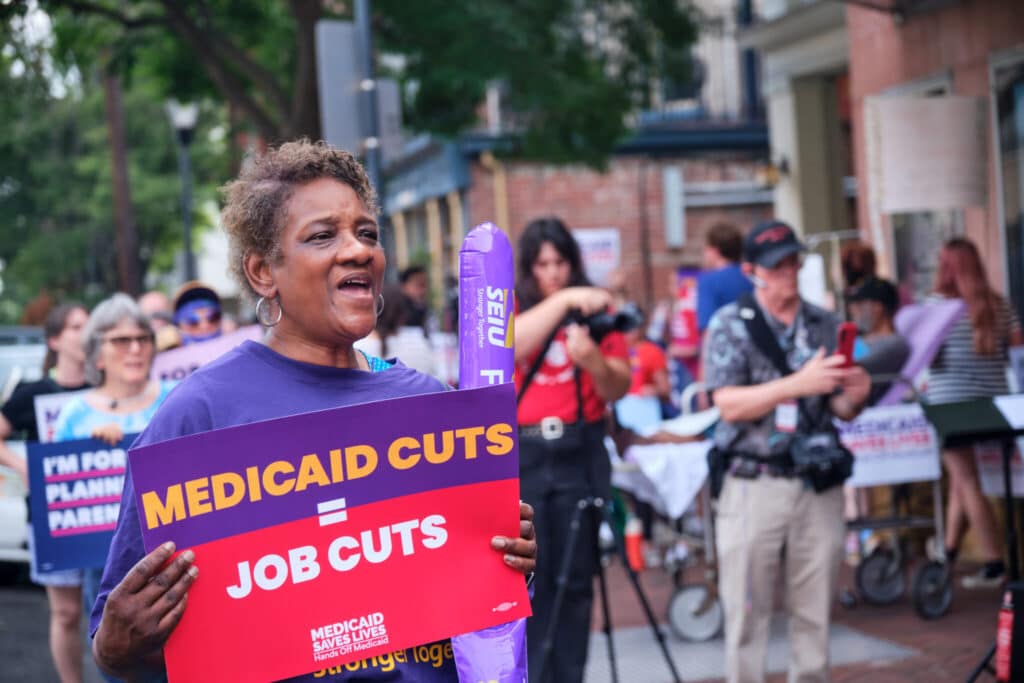
Ohio will lose 51,000 jobs and $5.3 billion from the state economy in 2029, according to a new analysis.
That’s the effect that cuts to Medicaid and food assistance under a massive 2025 spending law will have when they’re fully phased in. It’s also the consequence of Republicans allowing Affordable Care Act subsidies to expire at the end of the last year, according to a Commonwealth Fund analysis which was published last week.
Those losses come despite $200 million in rural health money Ohio will get from a fund that Republicans built into the spending bill. The measure was meant to quell concerns that Medicaid cuts could close rural hospitals, the analysis said.
“While the infusion of $10 billion into state economies for rural health contributes to some economic growth, it is overshadowed by the $31 billion in federal funding cuts to ACA marketplaces,” the analysis said.
That’s a reference to pandemic-era subsidies to buy insurance in Affordable Care Act Marketplaces.
When Congress allowed them to expire, most of the 600,000 Ohioans who bought insurance on the exchanges saw premiums for their plans double. That prompted many to drop down to cheaper, lower-quality plans and many more to leave the marketplace altogether. KFF reports that Ohio enrollment was down 20% this year.
Even bigger losses to the state loom when the provisions of Trump’s “Big Beautiful Bill” take full effect, the Commonwealth Fund report said.
The legislation cut more than $900 billion over 10 years from Medicaid. It also cut $187 billion from the Supplemental Nutrition Assistance Program, commonly known as food stamps or EBT.
Along with deep cuts to the safety net, Trump’s signature law gave huge tax cuts to the richest Americans. The Commonwealth Fund analysis said it amounted to yet another upward redistribution of wealth.
“Under (the Trump spending law), cuts to health and nutrition programs largely harm Americans with lower incomes, while tax cuts primarily benefit those with higher incomes,” it said.
“The (Congressional Budget Office) estimates that Americans in with lowest 10% of incomes will lose about $1,200 per year (3.1% of their incomes), while those with the top 10% of incomes will gain $13,600 per year (2.7% of their incomes). Other analyses reached similar conclusions.”
The cuts won’t just harm low-income Americans, the analysis said, they’ll damage entire state economies. It’s a consequence of taking away huge streams of funding for healthcare and food.
“In 2029, federal Medicaid funding will drop by $90.9 billion, causing state GDPs to fall by $118.5 billion,” it said.
“Medicaid cuts also mean 996,000 fewer jobs nationwide in 2029, half of which will be health-related, including in hospitals, clinics, pharmacies, or nursing homes. States with the largest job losses include California, New York, Pennsylvania, Illinois, Texas, Arizona, Ohio, and Michigan, which lose between 150,200 and 36,600 jobs.”
It projected that Ohio will lose the eighth-most jobs — 51,200.
It also said the state will lose $4.4 billion in federal funding, thereby reducing state GDP by $5.4 billion and state and local revenue collection by $368 million.
The largest single measure to produce Medicaid savings in the Trump spending law is a broader, stricter work requirement.
But the Commonwealth Fund report predicted that it will end up making it even harder for recipients to find jobs.
“Proponents of the law explained that the budget cuts were intended to exclude ‘undeserving’ populations from accessing benefits, such as able-bodied people who choose to not work, claiming these changes would ultimately help them gain jobs and incomes,” it said.
“But evidence indicates that work requirement programs do little to increase employment because they fail to address underlying reasons for unemployment. Moreover, by reducing the number of jobs in low-income communities, the new law could make it even harder for people to find jobs.”
Heartland Signal encourages news organizations and content creators to use our content. You're welcome to republish this article for free as long as you follow our republishing guidelines.
Related Articles

Wisconsin high court agrees that race-based college retention grants must go
The Wisconsin Supreme Court ruled Thursday that a state program providing $250 to $2,500 retention grants to minority students is unconstitutional. The decision relies on a 2023 U.S. Supreme Court ruling that ended affirmative action in college admissions.

Labor and faith groups decry federal indictment of 15 anti-ICE protesters
Fifty labor, religious and other progressive groups condemned the federal indictment of 15 anti-ICE protesters in a statement released on Thursday, accusing the Trump administration of weaponizing the Department of Justice in an effort to intimidate political opponents.

Senate Minority Leader Dianne Hesselbein lays out policy plans for a Democratic trifecta
Senate Minority Leader Dianne Hessenbein (D-Middleton) said legislative Democrats, who are seeking to win majorities for the first time in more than 15 years, are talking about their priorities for the next session including school funding and affordable housing.