
Missouri Supreme Court questions effort to keep redistricting referendum off ballot
The court heard arguments that will determine whether Missourians vote on a gerrymandered district map and the boundaries of districts for the November election
This post has been republished from the Missouri Independent under Creative Commons license CC BY-NC-ND 4.0.
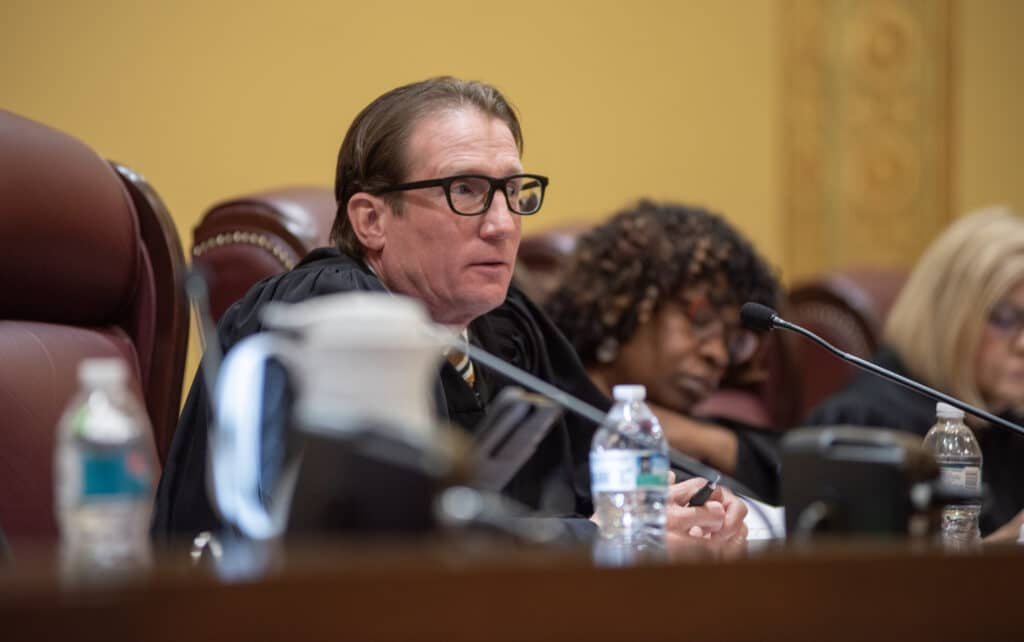
Judges of the Missouri Supreme Court on Wednesday repeatedly pressed attorneys defending Secretary of State Denny Hoskins to explain why voters should not see a referendum on congressional redistricting on the November ballot.
The case over the gerrymandered congressional redistricting plan forced through by Republicans in a 2025 special session is the final legal battle to be settled before the November election. The result means more than just whether the plan will be on the ballot — it will determine the district lines used on Nov. 3 and potentially affect the fight over control of Congress.
The court also heard an appeal Wednesday in a separate case over when petitioners may begin collecting signatures on a referendum. More than 100,000 signatures were not checked on the referendum petition because they were collected before the form of the petition was approved.
The court must rule by Sept. 8 on whether the referendum, which would be Proposition A, will be on the ballot. The case over signatures is not as pressing because there is time to check additional signatures and there is no dispute that the referendum had enough signatures to qualify for the ballot without them.

On Aug. 4, Hoskins declared the referendum petition insufficient. He said the Missouri Constitution does not explicitly allow a statewide vote on a congressional redistricting plan and the U.S. Constitution does not allow it, attaching an opinion from Attorney General Catherine Hanaway. Cole County Circuit Judge Daniel Green agreed with Hoskins, and People Not Politicians, the political action committee that gathered more than 300,000 signatures, filed the appeal heard Wednesday.
If it allows the referendum, the court has several questions to answer:
- What district boundaries will be used for the November election?
- Are the nominees selected in the Aug. 4 primary the legal nominees if the districts revert to the previous map? The boundaries of six of Missouri’s eight districts changed in the map passed in 2025.
- What are the limits of the secretary of state’s power to interpret the state and federal constitutions to determine if a ballot measure is legal?
During arguments, the judges were told that Hoskins did not include the text of Hanaway’s opinion in his certification of insufficiency. That may be a flaw that is fatal.
“What authority do you have that the secretary can incorporate anything they want and staple it to their certification?” Judge Zel Fischer asked at one point.

Arguing in defense of the decision, Lou Capozzi, state solicitor general, and John Gore, representing three Republican Party committees, said the Missouri Constitution lacks a clear statement that a referendum is possible on redistricting.
But, they said, even if a referendum is legal, the passing of the primary election and the plans politicians have made for the November election means that voters should elect members of Congress using the gerrymandered map.
“Anytime an election is looming, (a court) has to consider the impact of its decision on the electorate,” Gore said.
The goal of the new map is to flip the 5th District, one of two held by Democrats in Missouri. Republicans nominated state Sen. Rick Brattin of Harrisonville to run against incumbent Democratic U.S. Rep. Emanuel Cleaver from Kansas City.
In an election in the district drawn by lawmakers, Brattin would be in a strong position if past voting trends continue. Otherwise, Cleaver has the edge. Since winning election in 2004 with 55% of the vote, Cleaver has fallen short of that majority only twice and not since 2014.
Chief Justice W. Brent Powell raised questions about whether the map used in the primary had to be the one used in the general election.
Hoskins ruled against the referendum petition on constitutional grounds and could have done that at any time, Powell noted. That could have resolved all the issues much earlier.
And, he said, in a case decided in May, “we have already said the new map would not go into effect if the referendum is sufficient,” Powell said.
The court only needs to read the plain language of the Constitution to know what to do, said Chuck Hatfield, attorney for People Not Politicians. The court should order Hoskins to put the referendum on the ballot, he said.
“If you put the consequences and the controversy aside,” Hatfield said, “this analysis is really very simple.”
SUBSCRIBE: GET THE MORNING HEADLINES DELIVERED TO YOUR INBOX.
Heartland Signal encourages news organizations and content creators to use our content. You're welcome to republish this article for free as long as you follow our republishing guidelines.
Related Articles
North Dakota Legislature rejects Dem-led attempts to add child care, data center moratorium for special session
North Dakota Democrats attempted to introduce bills addressing child care funding and a data center permitting moratorium during Wednesday’s special session, but Republican majorities blocked both efforts.

Huizenga sides with Trump administration in Canada trade war
The Michigan Republican has voted at least four times to hand tariff authority to the president, even after conceding the costs would land on his constituents.

Some Memphis businesses push back against Memphis Safe Task Force
Business owners said they will refuse to serve task force members or allow them to enter their establishment, citing frightened customers and workers.