
U.S. Rep. Sean Casten talks Trump and believing in America with WCPT’s William Muck
Last Friday, U.S. Rep. Sean Casten (D-IL) joined WCPT’s William Muck to discuss the far-reaching impact of Trump administration actions during the first seven weeks of President Donald Trump’s second presidential term.
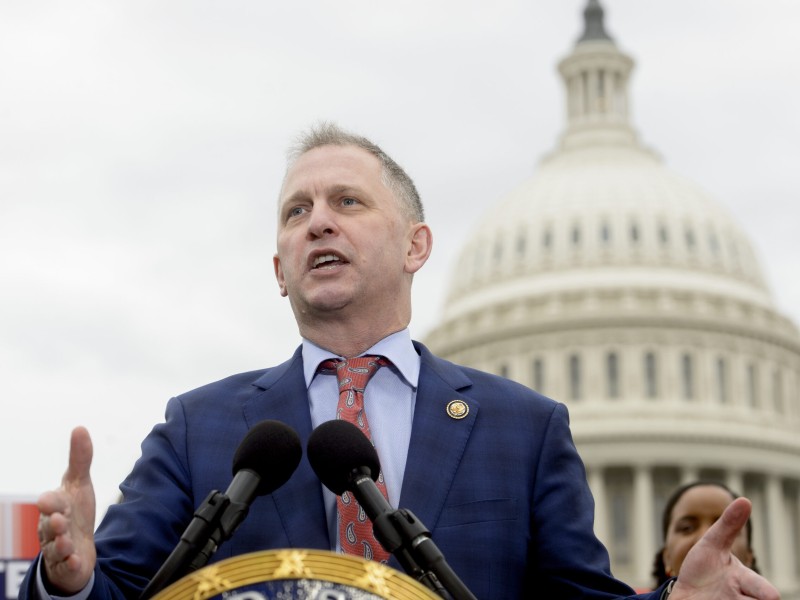
Last Friday, U.S. Rep. Sean Casten (D-IL) joined WCPT’s William Muck to discuss the far-reaching impact of Trump administration actions during the first seven weeks of President Donald Trump’s second presidential term.
“We’re neck deep in a constitutional crisis,” Casten told WCPT. “If we were to end the Trump administration tomorrow, it would probably take a decade to repair the damage,” he said, citing potential leaks of intelligence to adversaries like Russia and China and the erosion of faith in the United States that our historic allies have already experienced.
“If you were a NATO country and we had a Democratic president tomorrow who said, ‘I’m going to fix everything Trump just broke,’ would you believe that the United States [is] back, or would you believe that your relationship with the United States as the leader of the free world is only durable until the next Republican administration comes in?” Casten asked, adding: “That’s really scary.”
Casten also expressed concern about Elon Musk’s outsized influence in the Trump administration, noting that the billionaire businessman was never Senate-confirmed to his government position, and criticized congressional Republicans for their refusal to hold the executive branch accountable or defend legislative branch prerogatives. “If the executive branch is not going to execute the legislation that the legislative branch crafts and the legislative branch is also not going to do oversight, what is the point of Congress?” Casten asked. “It’s just a real concern. I mean, there’s a scenario where someone of Musk’s talents and abilities might have a role in Congress, but it’s not one where you first fire all the inspectors general, fire the whistleblowers, don’t have him confirmed, and then just let him run around data systems that he’s got economic conflicts of interest in. It’s a five-alarm fire.”
Casten, who defeated incumbent Republican Peter Roskam in the 2018 midterm elections during the first Trump administration, said that he has spoken to House GOP colleagues who have privately revealed their opposition to certain Trump administration actions but told him they prefer to keep their heads down and not put their families at risk by voting against the president. “As a fellow member of Congress,” Casten said, “I’m very sympathetic to that. At the same time, there is a sense of, if leadership is hard, maybe you’re in the wrong line of work.”
He added: “I think we have to elevate this conversation above partisanship as much as we can. We are in a moment where I think anybody in public office needs to be, for lack of a better word, Churchillian. We need to be making it very clear to the American people, this is the stakes of what’s going on right now; this is the consequences of what happens if we don’t fix it quickly. I make no promise that if we fight, we will succeed. I need to be very clear-eyed about what the consequences and the potential costs of that fight are. But I can guarantee you that if we don’t fight, we will lose this 250-year-old experiment.”
Below is the full transcript of the interview. (Please note: The transcript has been edited for clarity.)
William Muck: We are thrilled and excited to be joined by our next guest, the U.S. congressman representing the 6th District of Illinois, Representative Sean Casten.
Welcome, Representative Casten. Thank you so much for joining us on WCPT.
Rep. Casten: My pleasure. It’s been a while, but nice to be back with you.
William Muck: Absolutely, yes.
So, let’s start with the news of the day, which is this growing concern, even within Trump’s cabinet, it appears, of the role and influence of Elon Musk. Now, you have been a vocal critic of Elon’s role and even suggesting on social media that this may be a good opportunity for mass civil disobedience. Can you walk us through the concerns you have with Elon’s role in the government?
Rep. Casten: So, there’s a quote I like to remind my colleagues of lately that Justice Brandeis, Louis Brandeis, back in the’30s said that when you have great concentrations of wealth in society, you only have three choices: You can let the government take over the wealth, which is to embrace communism; you can let the wealth take over the government, which is to embrace fascism; or you can break up the wealth and embrace competition. And that was how he justified bolstering what became the Sherman Antitrust Act. And we are now in a situation where someone who was never confirmed, who has great wealth, who has massive conflicts of interest is running through data systems, accessing taxpayers’ private information.
As I said on [the] Financial Services [Committee] this week, in the name of Ayn Rand, we should be furious. (Laughter.) They are firing people who they are legally not allowed to fire. They are cutting funding in places that they are legally not allowed to cut funding. Congress has the power of the purse. And they’re able to get away with this, in part, because we have a sundowning narcissist in the White House who may not know that he’s currently being a victim of elder financial abuse.
William Muck: (Laughs.)
Rep. Casten: But, more significantly, because we have leadership in the House and Senate, in the form of Leader [John] Thune and Speaker [Mike] Johnson, who seem to believe that Congress doesn’t have to do oversight anymore. And if the executive branch is not going to execute the legislation that the legislative branch crafts and the legislative branch is also not going to do oversight, what is the point of Congress? It’s just a real concern. I mean, there’s a scenario where someone of Musk’s talents and abilities might have a role in Congress, but it’s not one where you first fire all the inspectors general, fire the whistleblowers, don’t have him confirmed, and then just let him run around data systems that he’s got economic conflicts of interest in. It’s a five-alarm fire.
William Muck: You’re mentioning the point that Congress [is] sort of acceding its power back to the president. I think it’s been one of the more troubling things. On that note, I’m curious about how you see the first 45 days of the Trump administration, and how are you understanding what’s going on? And I will say, the academic world, the political science world, those of us who study democracy, we’re terrified, and we’re ringing the alarm bells. Feels like the first time since the Civil War where the future of the democracy is genuinely at stake. Is that your sense as well? How are you all understanding what we’re watching play out?
Rep. Casten: We’re neck-deep in a constitutional crisis. I don’t know how else to put it. If we were to end the Trump administration tomorrow, it would probably take a decade to repair the damage. I mean, how much information have we given to our adversaries in Russia and China? I don’t know, but I know that a lot of people with unclassified access have been snooping around data files. If you were a NATO country and we had a Democratic president tomorrow who said I’m going to fix everything Trump just broke, would you believe that the United States [is] back, or would you believe that your relationship with the United States as, historically, the leader of the free world is only durable until the next Republican administration comes in? That’s really scary.
I understand you didn’t mean it this way, but when you said Congress is broken, it is the Republican Party in Congress that is broken, not Congress. When Democrats were in control, we passed the biggest infrastructure bill in history, the biggest expansion, the biggest climate bill in history. We expanded NATO. Congress was working quite well. But right now, we’re in this situation where the baby is playing with a gun, right, and Congress has the ability to take the gun away, but the Democrats don’t have the gavels. We can’t get subpoenas without the Republican leadership’s assent. And I think the best I could say of Speaker Johnson is that he is too much of a coward to do his job.
William Muck: Given that circumstance and given the dire world that you’re seeing there, what are strategies for confronting Trump? I mean, Republicans, if they’re not going to take the lead on this — what are effective ways of slowing down or countering what we’re seeing play out?
Rep. Casten: So, I was talking to a bunch of poli-sci students at St. Xavier University this morning, and this was the conversation with a lot of them and [they] are concerned, and the point that I was making to them is that our founders created a government that was predicated not only on making sure that we put people of virtue into elected office but also that we trust that the people who elect them are also virtuous and will do their duty. And I continue to believe the overwhelming majority of Americans are good and decent people. They’re a little scared right now. But I think this is an opportunity to recognize that the fear that is contagious, when we see people cower down in the face of a bully and we think, boy, I don’t want to stand up or he might come after me, the flip side of that is that courage is also contagious.
If you look back to the Civil Rights Era, it wasn’t because a member of Congress gave a great speech. It was because people on the ground said, I’m going to demonstrate with righteous virtue the right thing to do, and that courage becomes infectious. Just a few years ago, when the Parkland students showed that same kind of courage and all of a sudden, people were marching in the streets.
I’m not saying Congress doesn’t have a role here. I’m just saying that all of us have agency in demonstrating what is good and true and being loud about that and reminding everybody that we are fundamentally good people. But we’ve all got to acknowledge the stakes, and we’ve got to be loud.
William Muck: That’s an empowering message, right? That the masses, the demos can actually play a role in this.
I’m always curious about what’s going on in the mind of politicians when they do bad things. Do they know they’re doing bad things and do them anyway? Or have they convinced themselves that the bad things they’re doing are actually good? And I’m not really interested in what’s going on in Trump’s head, but I am curious what you’re seeing among congressional Republicans. When the cameras are not on and it’s an unfiltered moment, do they express the same type of grave concerns that you have, or do you think they’ve convinced themselves that these are actually good times? Like, what do you think is going on in their minds?
Rep. Casten: I mean, look, we all contain multitudes, but I’ll maybe just give you a couple anecdotes.
We led the effort to force the release of Matt Gaetz’s ethics report and that was basically to block him from becoming the head of DOJ. Number one, it should have come out anyway, but we could use a privileged resolution in the House to force that information out. And we brought it to the floor; we only got one Republican to vote with us, which was not enough, but that pressure did lead to the Ethics Committee releasing the report, which is horrific, but thankfully Matt Gaetz is not the attorney general right now. After that vote, I had four separate Republicans come up to me and thank me for bringing it forward, even though they’d all voted no. And I said, well, if you think it was a good idea, why didn’t you vote for it? And there were slightly different stories, but the gist of all their stories was, “Politically that would have been bad for me, but I’m really glad you’re doing it.”
You want to be as empathetic as you can, and on a separate matter, I asked one of my colleagues, what would it take for you to stand up? And he immediately said, how’d that worked out for [former Rep. Adam] Kinzinger? And I think there is a fear that some of them have that they see Trump letting Proud Boys out of prison who attacked police, pulling off people’s security details, and members saying, I don’t want to put my family at risk; it’s better for me to keep my head down. As a fellow member of Congress and subject to the same level of security protection, I’m very sympathetic to that. At the same time, there is a sense of, if leadership is hard maybe you’re in the wrong line of work.
William Muck: That sense of fear — you see articles written about this. It’s at the individual level. They’re afraid of Trump at a macro level, but then their own family security as well. And that’s no way to run a government. But to your point, maybe they shouldn’t be in office, then.
Rep. Casten: No, there’s fear, and there’s also, I think, a part that becomes somewhat self-justifying. I have a good friend who is no longer in Congress, but a Republican, and I was joking with him at one point about, could we do something together on climate change? And he laughed, and he said, that’d be like [you] doing something on gay marriage; I’ll immediately be out of a job, and you won’t like the person who will replace me. And I sort of laughed. I teased him at the time. I said, how about we just make out? (Laughter.) We can put this behind us so we can work on climate change. I’m not worried about — climate change matters to me. I’ll give you a kiss if that helps. (Laughter.)
But I think his answer — and this is someone who I respect, is a good person — was the, “I don’t like that I have to take these votes in this situation, but I’m holding this seat until the fever breaks because if I don’t, it’s going to be taken by someone who is worse and doesn’t share my values.” And again, like, I can empathize with that, in some sense, but as a guy who flipped a seat that had been Republican for 50 years and has never been particularly anxious about doing the “right” thing, there’s two ways you can lose a Republican seat: one of them goes to the right, one of them goes to the left. (Laughs.)
William Muck: Absolutely.
Rep. Casten: And my view is that this is a job where, if you can’t go home at night and tell your kids, look them in the eye and say, I’m proud of what I did today, why have it?
William Muck: That’s a really, really powerful message.
Maybe one more question before we let you go, and maybe shifting to the Democratic Party a little bit and talk about what you see as the messaging or the focus the party needs to embrace moving forward. Are there certain ideas that you think are better for the party, as it thinks about the midterm and the next presidential election?
Rep. Casten: So, everybody’s asking the question, but I think we have to elevate this conversation above partisanship as much as we can. We are in a moment where I think anybody in public office needs to be, for lack of a better word, Churchillian. We need to be making it very clear to the American people, this is the stakes of what’s going on right now. This is the consequences of what happens if we don’t fix it quickly. I make no promise that if we fight, we will succeed. I need to be very clear-eyed about what the consequences and the potential costs of that fight are. But I can guarantee you that if we don’t fight, we will lose this 250-year-old experiment.
And I think, to the extent that any of us in public service — and I think our governor, J.B. Pritzker, is doing a very good job of that; we’ve tried in our way to do that where we can. But I think getting that out there and reminding people that we’re all in this together and that we all have a vested interest in the outcome is how we get through this. And as I’ve said to some of my Democratic colleagues who are more inclined to listen, when the world needs Churchill, don’t serve up a plate of [former Sen. Joe] Manchin.
William Muck: (Laughs.) That’s a powerful message. (Laughter.)
We are so grateful that you took some time to be with us today.
We’ve been talking with Sean Casten, who represents the 6th District of Illinois.
Thank you, Representative Casten. We really appreciate your insights.
Rep. Casten: My pleasure. Always enjoy talking with you.
Heartland Signal encourages news organizations and content creators to use our content. You're welcome to republish this article for free as long as you follow our republishing guidelines.
Related Articles

Nunn vs. Trone Garriott: Where Iowa’s 3rd District candidates stand
Rep. Zach Nunn voted for Medicaid cuts that shuttered health clinics and backed tariffs that raised costs for Iowans. State Sen. Sarah Trone Garriott is challenging the Iowa Republican, campaigning on lowering health care expenses and ending tariffs.
Data centers investments, personal finances take center stage at Michigan governor debate
Michigan gubernatorial candidates Jocelyn Benson and John James faced off over rising living costs, government reform and data center developments. While both candidates agreed on a couple issues, they clashed over transparency and who is best equipped to lead the state.
FACT CHECK: Ryan Mackenzie parrots misleading claim denying Iran War is spiking fuel prices
U.S. Rep. Ryan Mackenzie (R-PA) is repeating misleading claims that recent high fuel prices aren’t driven by the war with Iran. Experts say even with sea passages open, risk premiums and lost oil supply from ongoing Middle East conflict continue to keep prices inflated.