OP-ED: Billionaires got a break. The rest of us got the bill.
Kristin Crowell writes, “Washington may be celebrating. But the people living with this law are not.”
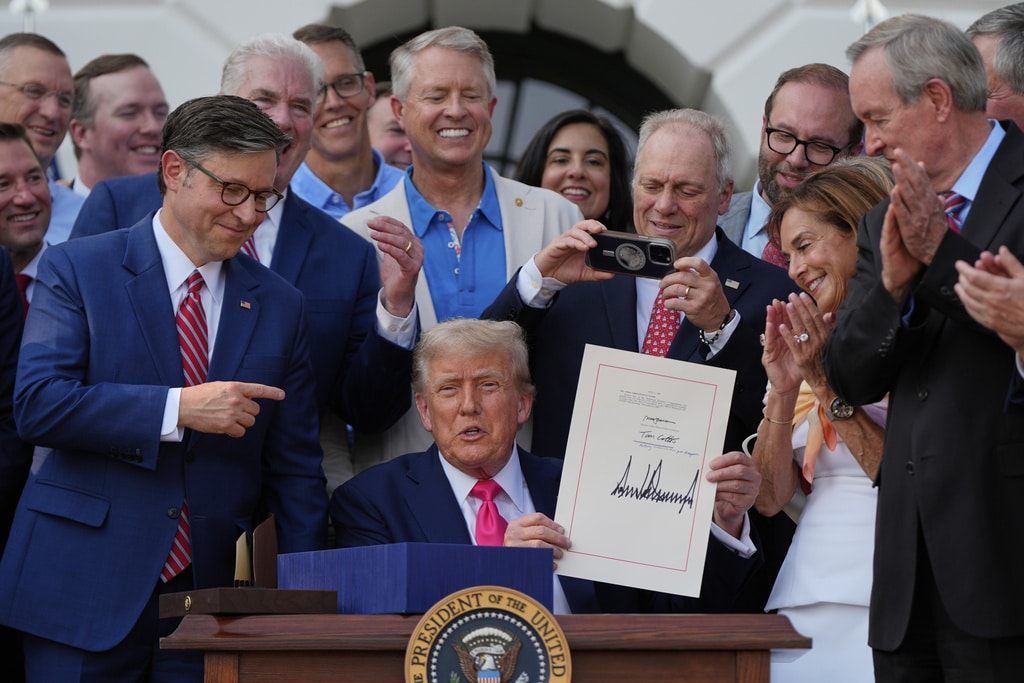
One year ago, President Trump signed the One Big Beautiful Bill Act into law. Last week, Republicans in Congress celebrated it as the “Working Families Tax Cuts” — a victory lap for one of the most unpopular and harmful laws in recent history.
Last summer, I traveled the country as people pleaded with Congress not to pass this bill. This summer, I returned to many of those same communities. The fear is gone. Now, people are living with the consequences.
A mom in New Hampshire struggling to afford groceries and her mortgage who cannot fathom why she pays higher taxes on her hard-earned income than the ultra-rich pay on their passive wealth.
A nurse in Maine whose voice shakes with anger as she describes patients forced to skip basic care because they simply can’t afford it, only to return later with illnesses that have grown far more serious.
A pastor who preaches that owning two homes while your neighbor lacks even one is immoral.
This week, I’ll be in the Chicago metro area. Different places, the same conclusion: Life is getting harder while Washington congratulates itself for helping the people who needed it least.
As America marks its 250th birthday, it’s worth remembering that the founders feared concentrated wealth almost as much as concentrated political power. They understood that when a handful of people can write the rules in their own favor, self-government begins to fail.
Americans recognize that failure today. New polling from Better Taxes for a Better America finds that 86% believe wealthy people have too much influence over government, while 81 percent say requiring the wealthy to pay their fair share is essential to a healthy democracy. For many Americans, the tax code has become the clearest evidence that government no longer works for ordinary people.
On the 250th birthday of this country, we should be asking ourselves whether we are living up to the idea that government exists to serve everyone, not just those who can afford to buy it. Right now, the answer is no. But it does not have to stay that way.
The Roosevelt Institute estimates that households in the richest 1% gained an average of $66,000 a year from the law, while the lowest-income households lost about $1,600 annually. Fifteen million people were projected to lose health insurance, and five million already have. Meanwhile, the fortunes of billionaires — including Elon Musk and President Trump himself — have continued to soar.
Republicans call that the “Working Families Tax Cuts.” The families I’ve met would call it something else.
The pattern here is not new. Americans have been promised for decades that tax cuts for the wealthy would lift everyone else. Instead, inequality has grown, effective tax rates on the wealthiest households have fallen dramatically and trust in the tax system has eroded. The One Big Beautiful Bill Act didn’t reverse that trend — it accelerated it.
Every time billionaires get a tax break, the rest of us get a bill. That is not an accident. It is a policy choice. And it can be reversed.
The question isn’t whether America can afford to invest in working families. It’s whether our leaders have the political will to ask those who’ve benefited the most to contribute more. A wealth tax. Closing carried interest loopholes. Raising the corporate rate. Cracking down on offshore shelters. Taxing wealth like work. Poll after poll, shows Americans across party lines believe they should.
Washington may be celebrating. But the people living with this law are not.
They’re comparing grocery bills. They’re wondering how they’ll afford prescriptions. They’re watching neighbors lose health coverage. They’re asking why an economy that creates so much wealth seems to reserve its biggest rewards for the people who already have the most.
One year after this law passed, they know the answer.
They also know something else: the rules that created this economy were written by people. They can be rewritten by people too.
Kristen Crowell is the executive director of Families Over Billionaires.
Heartland Signal encourages news organizations and content creators to use our content. You're welcome to republish this article for free as long as you follow our republishing guidelines.
Related Articles
Radio Free America: Every political ad sucks
Sorry that political ads are so terrible. If you want them to be better get your message out year round.
Radio Free America: Enforce existing laws against AI companies
AI companies like Elon Musk’s Grok and Sam Altman’s OpenAI have been breaking laws for too long. It’s time to make them afraid of jail again.
Radio Free America: How James Carville could cost Democrats the election
James Carville loves needling the Democratic party for blowing the midterms. Meanwhile, he’s actively lending his name to a toxic text spam machine that preys on older donors and wastes millions on consultants.