
How Tennessee 7th’s 13-point Democratic shift would look across the nation for 2026
Aaron Kleinman writes, “All told, Democrats would win around 600 new seats across the nation, with even bigger impacts beyond that.”

Last week, Republicans won the special election for Tennessee’s 7th Congressional District by 9%, and it has them scared shitless. That’s because the margin was 13% worse than the previous representative and President Donald Trump did in that district.
Normally, Republicans could write off a shift like that by noting that Democrats tend to do better in low-turnout special elections, and that they weren’t predictive in 2023-24. But turnout in the special election was actually higher than in the 2022 midterm electorate. And Republicans can’t chalk the narrow win up to a crummy nominee; newly elected Rep. Matt Van Epps (R-TN) was a pretty generic Republican, while the Democratic nominee had taken some public stances to the left of most voters in the district. In short, Republicans are losing a lot of their own voters, shifting margins by around 13%.
That 13% is a lot, that’s a blue wave-level shift. So that begs the question: What if this special was a preview of 2026? What would a nationwide shift of 13% look like? For starters, it’d mean winning 250 House seats and possibly a Senate majority.
But how would it look at the state level? With 88 state legislative chambers up for election next year we wanted to take a look at how a 13-point swing would manifest itself. How many seats could Democrats win? Could they score any new majorities, or trifectas or supermajorities?
All told, Democrats would win around 600 new seats across the nation, with even bigger impacts beyond that.
New trifecta states
A blue wave could result in new trifectas in Minnesota, Michigan, Arizona, Wisconsin Pennsylvania and New Hampshire, assuming Democrats are able to win the gubernatorial elections in each state next year. Those first three states aren’t very surprising; Minnesota and Michigan were trifectas after the 2022 elections, while Arizona Democrats have been on the cusp of a legislative majority for nearly a decade now. Wisconsin also seems like a reasonable target for Democrats; they made significant gains in 2024 after the legislature finally implemented fair maps after more than a decade of Republican gerrymandering cost Democrats control of the legislature.
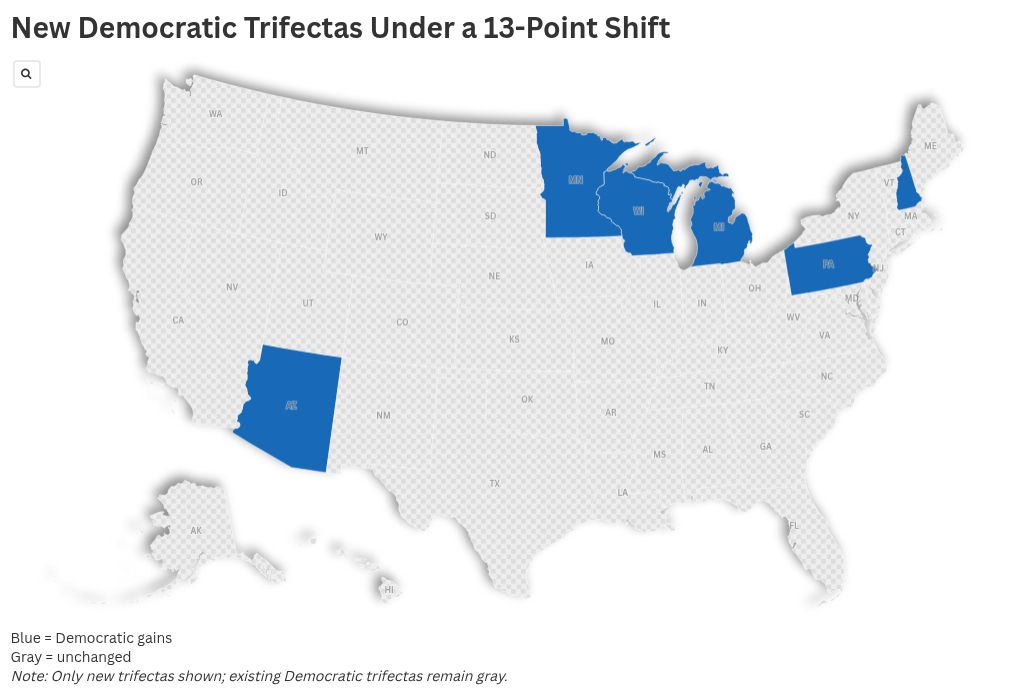
But Pennsylvania and New Hampshire would be shocking because of the uphill climb in both states’ senates. The Pennsylvania Senate staggers terms, so Democrats can only try to win half of the seats in 2026. Meanwhile the New Hampshire Senate is subject to a brutal right-wing gerrymander that was intended to make it impossible for Democrats to win a majority. But in both chambers, Democrats would still eke out narrow majorities in a blue wave similar to the one in Tennessee.
New majority states
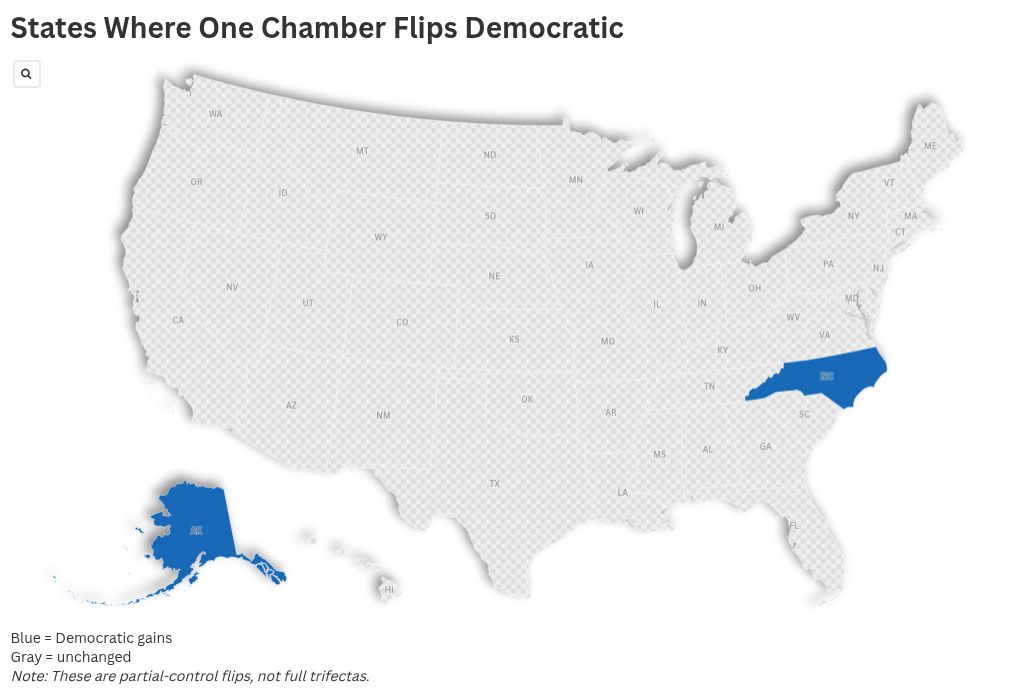
Alaska, similar to Pennsylvania, has staggered terms in the Senate, so a blue wave would only result in a tie in that chamber while leading to a majority in the House. Notably, Alaska’s legislature has been run over the past decade or so by shifting coalitions of Democrats, independents and Republicans. So while Democrats would have a numerical majority after a blue wave, there’s a decent chance of the status quo of a cross-party coalition running the legislature being maintained.
New supermajority states
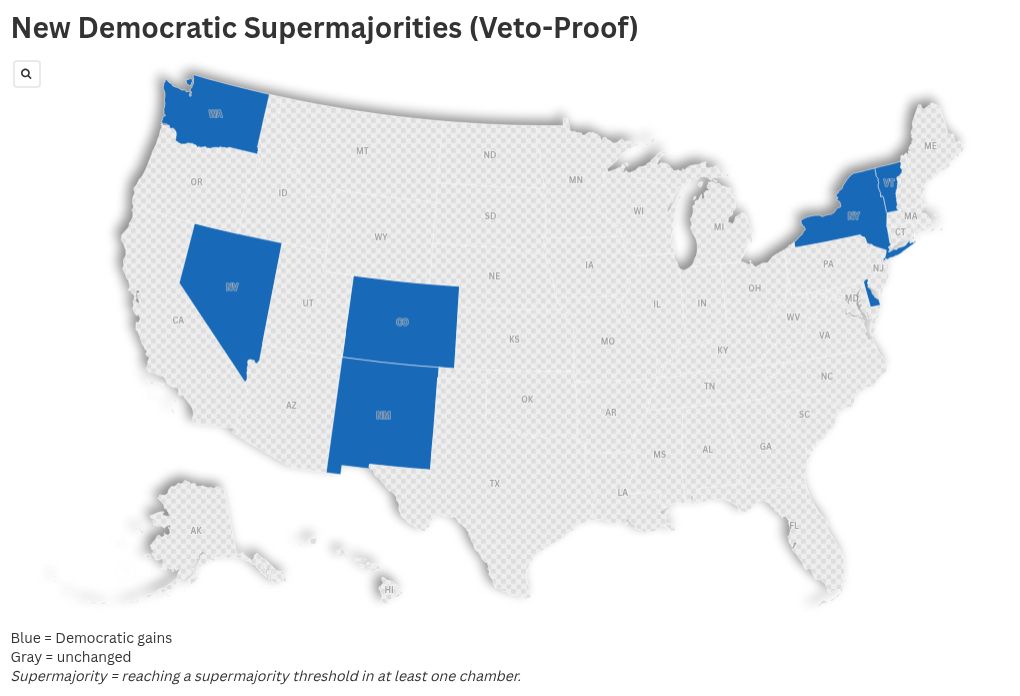
Supermajorities have different powers in different states. Colorado’s would give it more flexibility with its budget, Delaware’s would help it pass constitutional amendments and New York’s and Vermont’s would let them override gubernatorial vetoes. New Mexico, Nevada and Washington would only have supermajorities in their lower chamber, but that’s because either their Senate isn’t up for election in 2026 (New Mexico) or only half of it is (Nevada and Washington). So they could position themselves to win in 2028.
Broken supermajority states
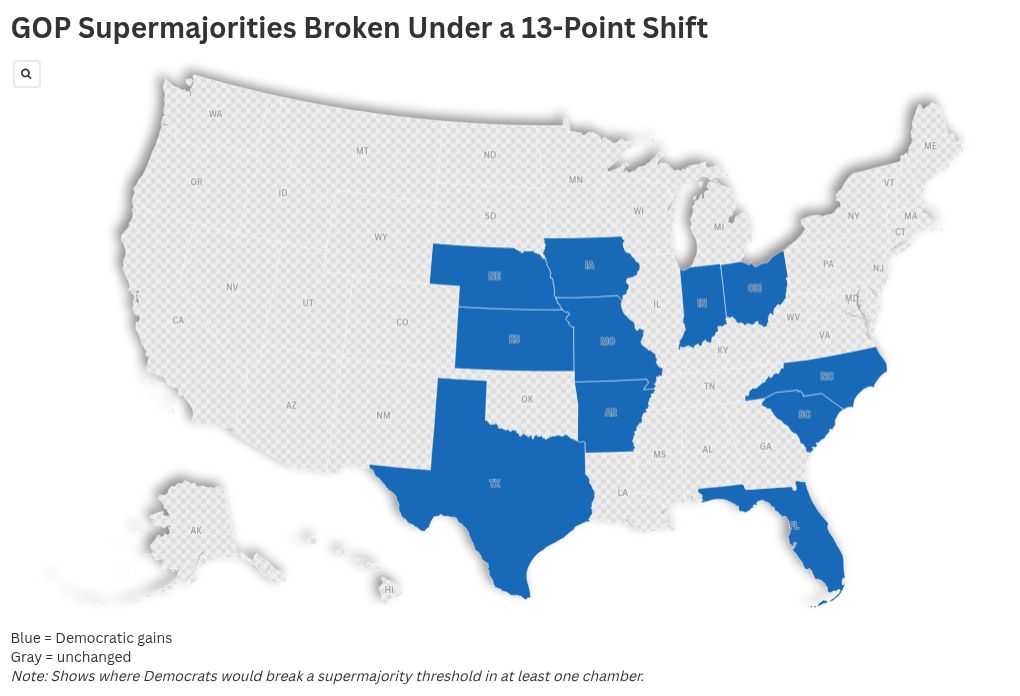
As with above, the state-by-state impacts would differ greatly. In Florida, Iowa, Kansas, Ohio and South Carolina, it would only matter if Democrats can win the governorship as well so they can sustain vetoes. In Indiana, it would allow Democrats to break quorum to prevent things like mid-decade redistricting. In Nebraska, it would allow them to prevent the state from trying to change its electoral rules at the last minute like it almost did in 2024. And in Arkansas and Missouri, they’d have more leverage in negotiations around the budget or laws that need to take effect immediately.
The above would be a stunning rebuke of MAGA. But we have to remember that a uniform 13-point shift is not going to happen. Even if the national electorate shifts 13 points it would be a lumpier distribution than the one portrayed above. For example, Behn’s biggest gains were in the urban part of her district. And in other states, we’ve seen Latino and Asian voters shift even more strongly away from their 2024 dalliance with Trump. And with heightened stakes beyond just a single House seat, it’s possible more of the MAGA base turns out than it did in Tennessee. So while it’s fun to imagine, I don’t actually think Democrats flip, say, 138 seats in the 400-member New Hampshire House.
But this exercise could also be undershooting gains. What if the AI bubble bursts over the next year and we’re in a recession? What if Republicans face candidate quality issues similar to 2022 that weren’t captured in the Tennessee special? Unless Republicans start focusing on running the country instead of enriching their donors, harassing their opponents and fighting pointless culture war battles, then these maps could look a lot bluer.
METHODOLOGY NOTES: These maps were compiled using The States Project’s data. For most chambers, we measured the swing against the previous state legislative election because it tends to capture local nuances better. However, that doesn’t work if the chamber has implemented new districts since the last election, uses multimember districts or has state-specific election laws that make it hard to calculate the swing. Therefore, we used the swing from previous presidential results in the district. We used two-party vote share for all calculations. Trump did slightly better than the GOP congressional candidate in 2024, so the presidential swing was 13.4% while the legislative candidate-based swing was 13.0%. Thus, flips include any district where a Democratic candidate got at least 43.5%. in the previous election or where Kamala Harris got at least 43.3% in the 2024 presidential election, we used the presidential-based method (in the AK Senate, AK House, AZ House, MD House, MI Senate, MT Senate, NH House, ND Senate, ND House, OH Senate, SD House, VT Senate, VT House and WI Senate.
Heartland Signal encourages news organizations and content creators to use our content. You're welcome to republish this article for free as long as you follow our republishing guidelines.
Related Articles

Tiffany campaign blocks Milwaukee Journal-Sentinel reporter from event
The gubernatorial campaign of Republican Tom Tiffany blocked a reporter for the Milwaukee Journal-Sentinel from entering an event in Milwaukee Thursday, preventing the state’s largest newspaper from covering the campaign.

Ohio GOP lawmakers tee up votes for gas tax holiday after Acton, then Ramaswamy, back idea
Ohio Republican candidate for governor Vivek Ramaswamy introduced his plan Wednesday for a 90-day gas tax holiday. It comes on the heels of Democratic candidate Amy Acton calling for a similar halt to the tax.

Amendment 6 could make another Missouri congressional gerrymander much harder
If voters reject the gerrymandered map in November, a second ballot measure could require 80% legislative support and another statewide vote for lawmakers to pass another map prior to the next census.