
Benson, Duggan target each other in UAW-hosted debate
The opening salvo in what is shaping up to be a heated 2026 gubernatorial general election race occurred Monday with a debate hosted by the United Auto Workers — one that put the likely battle between Democratic gubernatorial frontrunner Jocelyn Benson and former Detroit Mayor Mike Duggan, running as an independent candidate, on full display.
This post has been republished from the Michigan Advance under Creative Commons license CC BY-NC-ND 4.0.
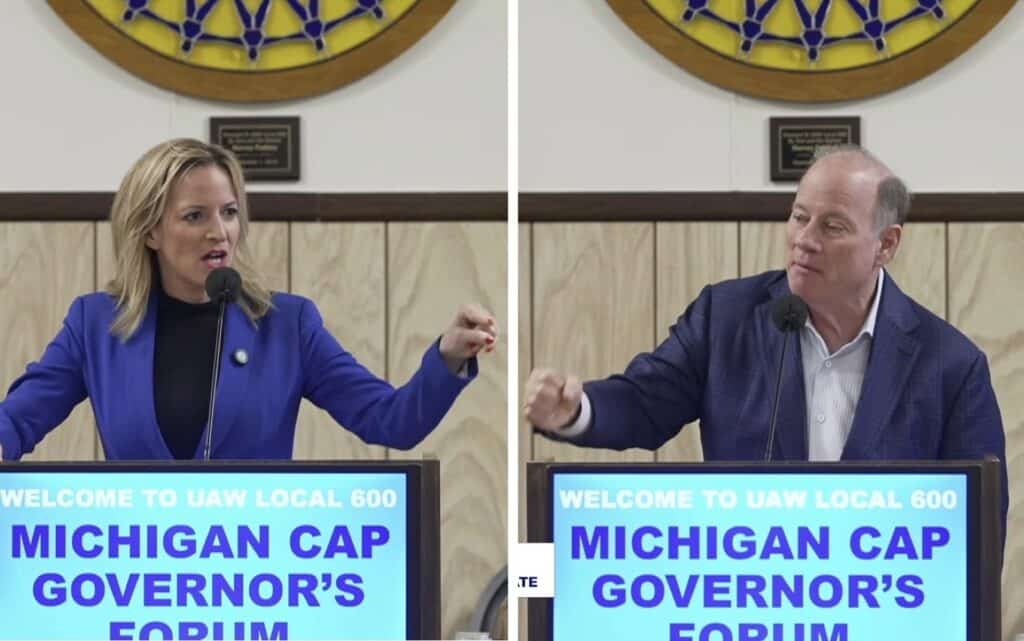
The opening salvo in what is shaping up to be a heated 2026 gubernatorial general election race occurred Monday with a debate hosted by the United Auto Workers — one that put the likely battle between Democratic gubernatorial frontrunner Jocelyn Benson and former Detroit Mayor Mike Duggan, running as an independent candidate, on full display.
Held in Dearborn, the debate also featured Democratic hopeful and current Genesee County Sheriff Chris Swanson, who jockeyed for the powerful union’s support by flashing his labor credentials at every turn.
Not featured were the handful of Republican candidates in the race, who were invited but did not attend.
All eyes, however, were on Benson and Duggan, as the two candidates traded barbs over their past support for labor, stance on Michigan’s regulated utilities, AI data centers and money from corporate political action committees affecting elections.
On the latter, the candidates were asked if they would commit to refusing corporate PAC donations, and if not, how could voters trust that corporate interests wouldn’t guide their decisions if elected.
Benson said she has refused corporate PAC money in her campaign for governor and said the fundamental question facing voters this year is determining who their governor will work for.
“I will work for you, not the highest bidder, not a lobbyist, not Donald Trump, but for the working people of this state, just as I’ve done as secretary of state,” Benson said. “When we look at what’s behind the costs that are skyrocketing on everything from healthcare to housing to energy costs, oftentimes politicians don’t get in the way of that and drive those costs down because they’re more beholden to the corporate PAC that’s funding their campaign than to the people of Michigan.”
SUBSCRIBE: GET THE MORNING HEADLINES DELIVERED TO YOUR INBOX.
Duggan was upfront that he has campaign connections that bridge labor and business, saying that some of his biggest financial support came from the state’s carpenters’ union, while also noting that he took an $8,000 donation from Roger Penske, a billionaire car-racing and trucking magnate who received the Presidential Medal of Freedom from Trump in 2019 and later endorsed him in 2020. Penske also donated large sums to Trump during that bid.
Duggan said he was proud of those seemingly dichotomous donations and support, saying he’ll be truthful to voters about the bridges he’s seeking to build.
“I’m not going to pretend like I’m not taking corporate money when I am,” Duggan said, before turning back to Benson. “But we have got to be honest about what we’re talking about. Madam Secretary, you set up a PAC as Secretary of State. You took a $1.5 million contribution from Ken Duda, the man who builds the data warehouses and connects them across America, $1.5 million personal contribution into that PAC.”
Bridge Michigan reported last year that Kenneth and Jennifer Duda gave a combined $1.5 million to Michigan Legacy PAC, controlled by Benson, which also gave to several other Democratic candidates that year.
A question on how the candidates might prioritize workers first before giving immediate tax breaks or incentives to businesses saw Benson clap back at Duggan.
“I hope, Mr. Duggan, that you’ve up until now refused to say who’s funding the several dark money accounts that are putting out millions of dollars in ads for your campaign, but I hope you’ll tell us who the highest donors are to those now, since we’re talking about who is beholden to who,” Benson said.
In another question regarding the state’s utilities and rising costs, which have gone up as Michigan utilities seek large rate increases from state regulators year in and year out, Benson said she has called for an end to unfair rate hikes. She also said it was important for voters to know if their future governor has been taking money from “the very companies that are driving up those costs” or if that candidate was “instead beholden to the people.”
Duggan then threw another “honest conversation” verbal jab at Benson over DTE Energy money in her previous campaigns.
“For eight years, the secretary of state took money from DTE and the utilities. It’s in your campaign contributions, anybody here can Google it.,” Duggan said. “Two weeks ago, she announced, ‘I’m not taking it anymore,’ and takes some moral high ground. So, feel free to Google what happened.”
Benson countered by saying Duggan’s attack line was inaccurate. Campaign finance records show that Benson did accept $1,000 from the DTE PAC in 2018. But there are no records showing that Benson took any DTE or Consumers Energy money during her current bid for governor.
Benson’s husband to recuse from state work on controversial data center if she is elected governor
In another question geared toward DTE and Consumers Energy PAC money, Benson doubled down that she has not taken contributions from those companies and would not be taking the bait laid out by Duggan.
Duggan turned to ChatGPT on his phone to ask if Benson had taken money in the past and said it indicated she had done so in her 2010 and 2018 campaigns.
Benson pounced on Duggan in a later question regarding voting rights, noting that she didn’t have her phone on stage with her, but she did say she remembered reading that Duggan has Gerry Anders, a former chairman and CEO of DTE Energy, on his campaign policy team.
“I don’t know who’s influencing who here, but I think when the facts are played out, we’ll see exactly where the money is and who’s actually influencing other candidates on this stage,” Benson said.
Duggan said he does have the support of Anderson, but he was helping Duggan devise education policy.
A question on AI technology and protections for workers in the face of the technology putting their jobs at risk was posed to each candidate.
Duggan said that AI was going to take jobs.
“We have to deal with the reality of what’s happening in these tech jobs of the future, and on data centers,” Duggan said. “ We have the most screwed up data center process siting in America. We have to say very clearly one standard: the data center can come here if it pays 100% of the cost of utilities, we are not passing the electric bills on to the neighbors. They will not put the water back into our water system. It will be recycled and safe. They will not conceal their contracts under a bunch of redacted provisions so you can’t see them.”
Benson said she has established a data center plan and said that the state must put guardrails in place to ensure they don’t abuse Michigan’s natural resources and drive up utility costs as a result of their operation. Benson’s husband, Ryan Friedrichs, works for Related Companies, owned by billionaire Stephen Ross, who has also donated directly to Benson’s campaign.
Union battles at Detroit Medical Center may shadow Duggan’s 2026 bid for Michigan governor
The company is currently developing a 1-gigawatt data center in conjunction with Oracle and OpenAI in rural Washtenaw County. Related Companies told Michigan Advance last year that Friedrichs was not involved in the project and that it has no other business happening in the state, which it says eliminates a conflict of interest if Benson becomes governor.
In a direct question, Duggan was asked about accusations of union busting while he was the head of the Detroit Medical Center in his years before becoming mayor of Detroit. A UAW member also accused him of taking money from “anti-union donors like Ron Weiser,” the former chair of the Michigan Republican Party and a proponent of the state’s now repealed Right to Work laws, which negatively affected unions in the state.
Duggan defended himself by saying no one was laid off when he joined the DMC around 2004, and said that he grew DMC during his tenure. He also noted that the leader of one of the union-backed employee groups at DMC helped kick off his campaign for mayor many years ago.
Nurses who tried to unionize at the DMC and their advocates told a different story of Duggan’s time at the hospital system when they spoke to the Advance last year, noting that his administration engaged in actions that were perceived as stymying organizing activities.
Heartland Signal encourages news organizations and content creators to use our content. You're welcome to republish this article for free as long as you follow our republishing guidelines.
Related Articles
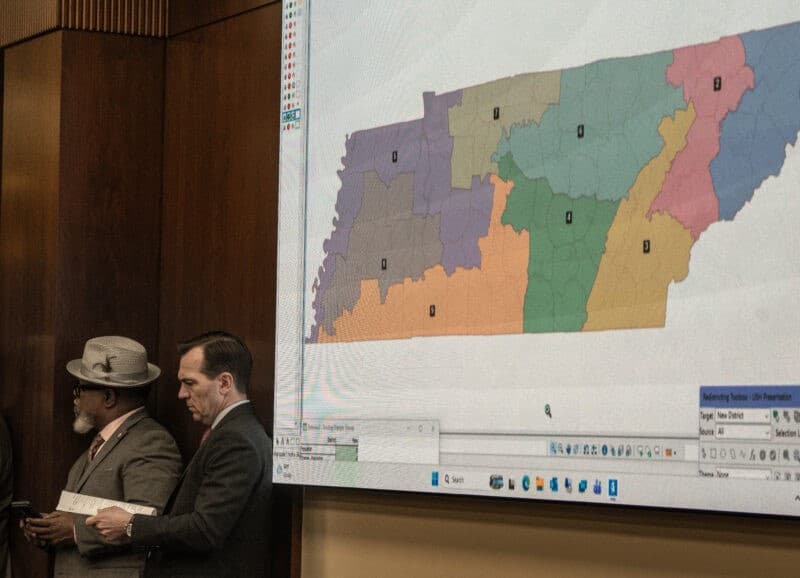
Who’s running in Tennessee’s new 2026 U.S. Congress races
After a last-minute redrawing of Tennessee’s U.S. House map, the one-week qualifying deadline for the races ended Friday, leading to a new slate of candidates.
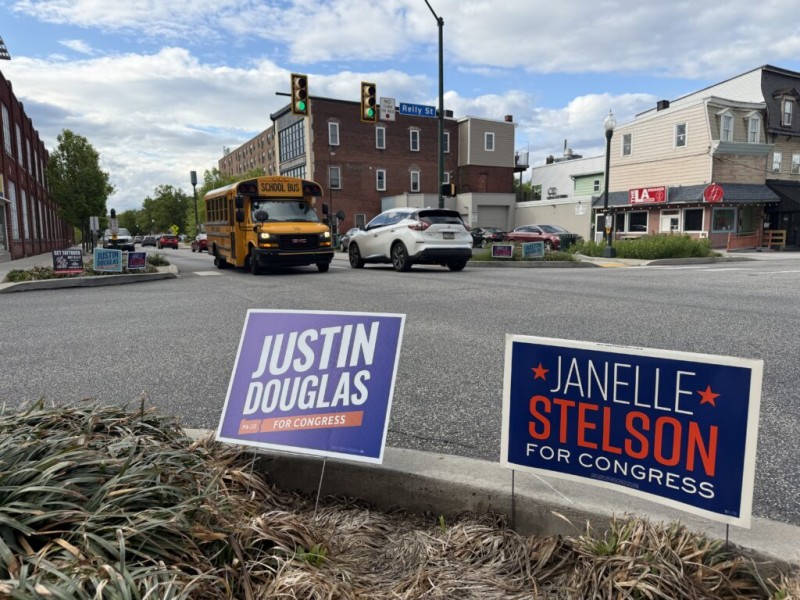
A moderate Democrat with a war chest faces a progressive grassroots campaign in Pa.’s 10th District
In Pennsylvania’s 10th Congressional District, a Democratic primary race between Janelle Stelson and Justin Douglas is highlighting two factions of the party, as the candidates vie for a chance to flip incumbent Rep. Scott Perry’s (R) seat.
Early voting for Kentucky primary elections begins Thursday
Kentucky voters can start voting early Thursday morning across the state.