
Amendment 6 could make another Missouri congressional gerrymander much harder
If voters reject the gerrymandered map in November, a second ballot measure could require 80% legislative support and another statewide vote for lawmakers to pass another map prior to the next census.
This post has been republished from the Missouri Independent under Creative Commons license CC BY-NC-ND 4.0.
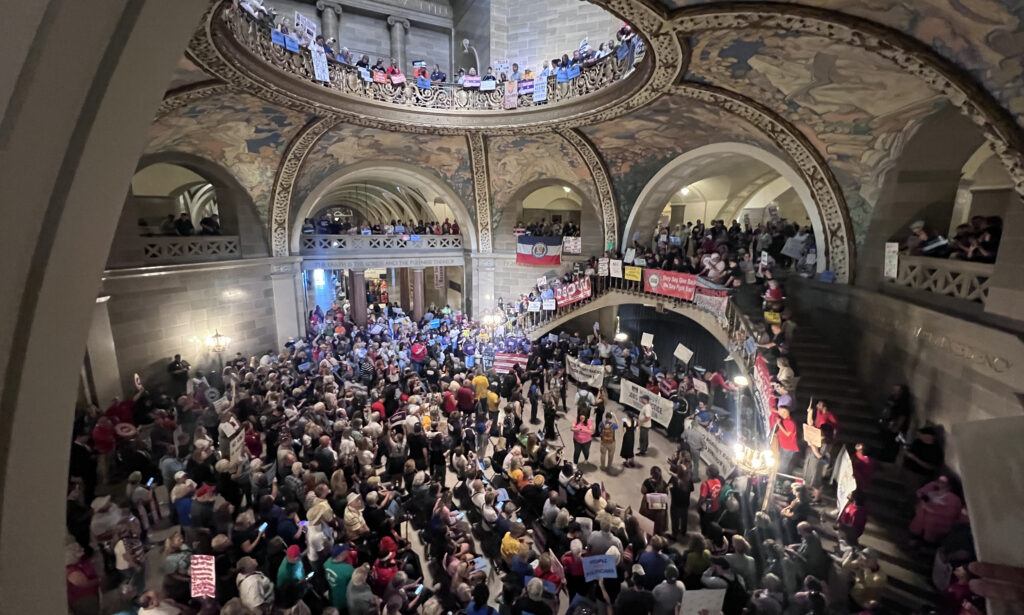
The Missouri Supreme Court had barely settled the immediate question of which congressional map is legally in effect before some Republicans began looking ahead to drawing another one.
Minutes after the court ruled unanimously against use of a gerrymandered map drawn by Republicans last year, GOP state Sen. Nick Schroer posted “8-0 2027” on social media and later said his caucus would discuss “implementing an eight-zero map” in the next couple of years. Secretary of State Denny Hoskins said in a radio interview that he could “most certainly” see lawmakers revisiting congressional redistricting in the 2027 legislative session.
But two measures on the Nov. 3 ballot could make another mid-decade redraw extraordinarily difficult — and potentially complicate Missouri’s redistricting fights for years to come.
If voters reject Proposition A, the congressional boundaries enacted in 2022 would remain in place. And if they also approve Amendment 6, lawmakers could face an 80% threshold in both the House and Senate, as well as another statewide vote, before changing the map again prior to the 2030 census.
Travis Crum, a Washington University law professor who specializes in election law and redistricting, said he believes Amendment 6 would require lawmakers to clear the 80% threshold if they attempted another redraw for the 2028 or 2030 elections.
“A new map would be viewed as similar in effect to the map that was rejected,” Crum said, “and so therefore the 80% requirement would apply.”
Asked specifically about Republicans passing an 8-0 map, or a different 7-1 map that targeted St. Louis instead of Kansas City, Crum said he believed those scenarios would fall under Amendment 6.
The unusual intersection of the two ballot measures stems from the Missouri Supreme Court’s Sept. 3 rulings putting both before voters. The court found that opponents of the 2025 congressional map gathered enough signatures to force a referendum and separately ordered Amendment 6 onto the ballot.
The immediate fight over which map will be used in November remains unresolved. On Monday, the 8th U.S. Circuit Court of Appeals ruled that Missouri must use the 2025 map, but put its decision on hold until Sept. 28 to give opponents time to seek relief from the U.S. Supreme Court.
Election officials are continuing for now under the 2022 map.
Appeals court backs Missouri’s gerrymandered map, but decision is put on hold
One provision of Amendment 6 says the legislature could not pass, propose or refer a law or constitutional amendment “similar in effect” to a law voters rejected through referendum unless at least 80% of both the House and Senate agree to send the proposal back to voters.
That is a high bar even for Missouri’s Republican supermajority. Republicans won 111 of 163 House seats in 2024 and hold 24 of 34 Senate seats going into the election.
Clearing 80% in both chambers would require Democratic votes.
Hoskins, who opposes Amendment 6, argues its impact would reach far beyond redistricting.
“If Amendment 6 passed,” he said in an email to The Independent, “it will basically cut our legislature off at the knees as far as being able to pass laws to reduce crime and cut taxes.”
Allen Rostron, a constitutional law professor at the University of Missouri-Kansas City, said an effort by lawmakers simply to reenact the gerrymandered map before the census, if it were rejected by voters, would be the kind of scenario most likely to trigger Amendment 6’s 80% threshold.
“That would seem like the General Assembly would be ignoring the spirit of what the voters decided,” Rostron said, “and it might be more tempting to interpret Amendment 6 as being meant to prevent that.”
Exactly what counts as “similar in effect,” however, is not defined in the amendment. A lawsuit would likely follow any new redistricting effort, leaving a state judge — and ultimately the Missouri Supreme Court — to interpret the new constitutional language.
The picture gets murkier after the 2030 census.
A literal reading of the amendment, Rostron said, could support the argument that even a future post-census map similar to the rejected 2025 plan would require 80% legislative approval and a statewide vote.
But Rostron said he doubts courts would apply Amendment 6 that broadly after the 2030 census.
“I’d lean a little toward doubting that Amendment 6 would be treated as changing what would be required for redistricting in the future, such as after the 2030 census,” he said.
Among the problems with a broader interpretation, Rostron said, is that Amendment 6 includes no expiration date for its protections. If a referendum rejection permanently restricts future legislation that is “similar in effect,” he said, courts could face difficult questions about how long that restriction lasts and how much resemblance is enough to trigger it.
Crum also sees the 2030 census as a potentially important dividing line.
Once new census numbers arrive, he said, population changes and the federal constitutional requirement that congressional districts contain roughly equal populations create a strong argument that Missouri must start over with a new map. In that circumstance, Crum said, Amendment 6’s 80% requirement would be unlikely to apply to the map drawn for the 2032 election.
But he stressed that the question is unsettled and would likely be litigated.
The campaign supporting Amendment 6, called Respect MO Voters, says the restriction is intended to prevent lawmakers from simply overriding a referendum result, not permanently freeze Missouri’s congressional districts.
“Amendment 6 makes it more difficult for politicians to overturn voter-approved or rejected measures,” the campaign said in an emailed statement. “By its very nature, the new census every decade will produce a unique map and enabling legislation. What politicians will have a harder time doing is passing legislation that’s similar to what was rejected by Missourians through a vote of the people on a referendum.”
But Amendment 6 could also raise the stakes of future redistricting referendums after the 2030 census, Crum said.
If lawmakers enact new districts in 2031 and opponents gather enough signatures to force a referendum, the new map could be suspended while voters decide its fate. And if voters ultimately reject it, Amendment 6 would bar lawmakers from passing a similar replacement without 80% support in each chamber and another statewide vote.
In the meantime, even suspending the new map would leave in place districts based on the 2020 census, likely violating the federal requirement that congressional districts contain roughly equal populations.
That could leave Missouri without a legally usable congressional map in time for the 2032 election. Under that scenario, Crum said, “you’re almost certainly going to have a court-drawn map used for 2032.”
Amendment 6’s 80% threshold could make replacing those court-drawn districts more difficult, potentially extending their use beyond 2032.
Lawmakers could try to avoid a referendum by passing the map with an emergency clause, which requires a two-thirds vote in each chamber. That’s what they had to do in 2022, when pandemic-related delays in census data helped push congressional redistricting past candidate filing and left little time before the August primary.
A law genuinely necessary for the “immediate preservation of the public peace, health or safety” is exempt from referendum, though Missouri courts ultimately decide whether that standard is met.
Amendment 6, Crum said, could fundamentally change the calculus surrounding future attempts to redraw congressional districts between censuses.
“The de facto result of all this,” he said, “is that mid-decade redistricting could become much harder in Missouri.”
Heartland Signal encourages news organizations and content creators to use our content. You're welcome to republish this article for free as long as you follow our republishing guidelines.
Related Articles

Nunn vs. Trone Garriott: Where Iowa’s 3rd District candidates stand
Rep. Zach Nunn voted for Medicaid cuts that shuttered health clinics and backed tariffs that raised costs for Iowans. State Sen. Sarah Trone Garriott is challenging the Iowa Republican, campaigning on lowering health care expenses and ending tariffs.
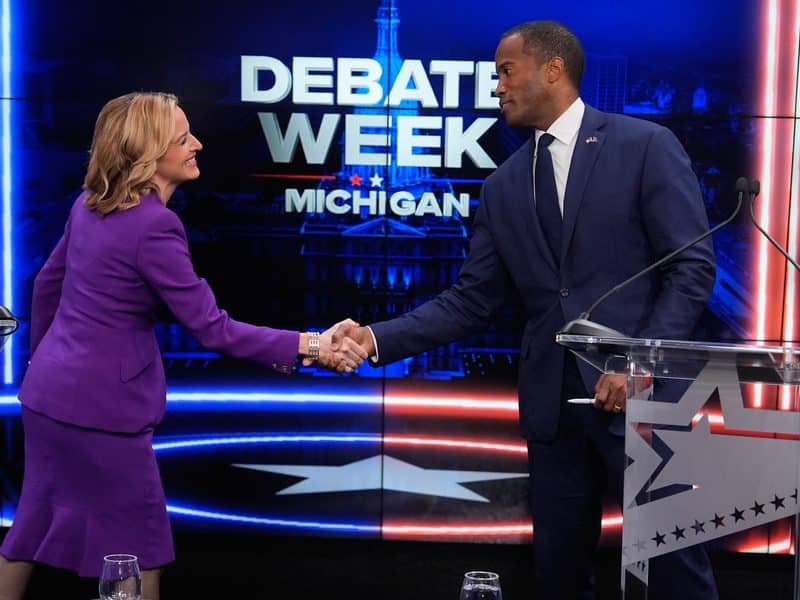
Data centers investments, personal finances take center stage at Michigan governor debate
Michigan gubernatorial candidates Jocelyn Benson and John James faced off over rising living costs, government reform and data center developments. While both candidates agreed on a couple issues, they clashed over transparency and who is best equipped to lead the state.
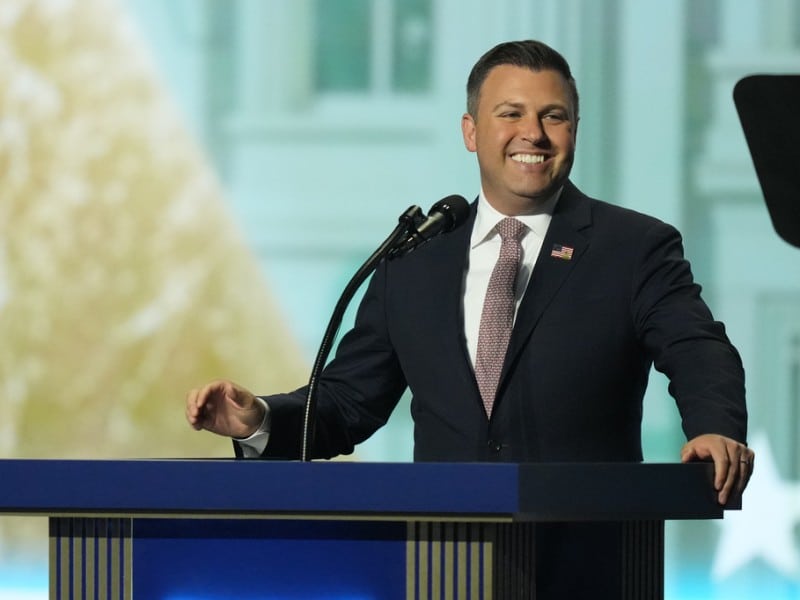
FACT CHECK: Ryan Mackenzie parrots misleading claim denying Iran War is spiking fuel prices
U.S. Rep. Ryan Mackenzie (R-PA) is repeating misleading claims that recent high fuel prices aren’t driven by the war with Iran. Experts say even with sea passages open, risk premiums and lost oil supply from ongoing Middle East conflict continue to keep prices inflated.