
Access to abortion care is improving in Ohio, but abortion opponents continue efforts against it
As studies show improvements in access to abortion care in Ohio, abortion opponents both in and outside of the state legislature are attempting to bring more regulations against it.
This post has been republished from the Ohio Capital Journal under Creative Commons license CC BY-NC-ND 4.0.

As studies show improvements in access to abortion care in Ohio, abortion opponents both in and outside of the state legislature are attempting to bring more regulations against it.
An multiyear assessment called the Reproductive Health Experiences and Access Study found that access to abortion care has improved in Ohio, based on interviews with policymakers, healthcare providers, advocates, and focus groups of women ages 18 to 49.
“Interviewees perceived Ohio’s reproductive rights amendment has meaningfully reduced barriers to care, but said access remains uneven, politically contested, and shaped by institutional, financial, and geographic constraints,”according to the study.
The study was conducted in a collaboration with the Urban Institute, the Reproductive Equity Action Lab at the University of Wisconsin-Madison, and SisterSong Women of Color Reproductive Justice Collective.
Those interviewed said the removal of a 24-hour waiting period for abortion care and other requirements were positives for them, and expansion of medication abortion was described as “especially impactful for rural and Appalachian communities, where access to procedural (surgical) abortions remains limited.”
SUPPORT: YOU MAKE OUR WORK POSSIBLE
Ohio’s constitutional amendment protecting reproductive rights was passed in 2023 by 57% of Ohio voters. Some included in the access study noted that the amendment “has not ended political efforts to restrict abortion access in Ohio.”
Republican state lawmakers have made several attempts to undermine the amendment with regulatory tweaks and measures to bar funding from going to facilities that provide abortion care.
“Consistently, bills keep popping up to undo what we already voted on,” one focus group participant said in the study. “To me, that’s very scary. If whoever can decide, ‘I don’t like that vote, and I don’t care that over half the state voted on it,’ they’re going to keep trying. They don’t care (whether) we have a say.”
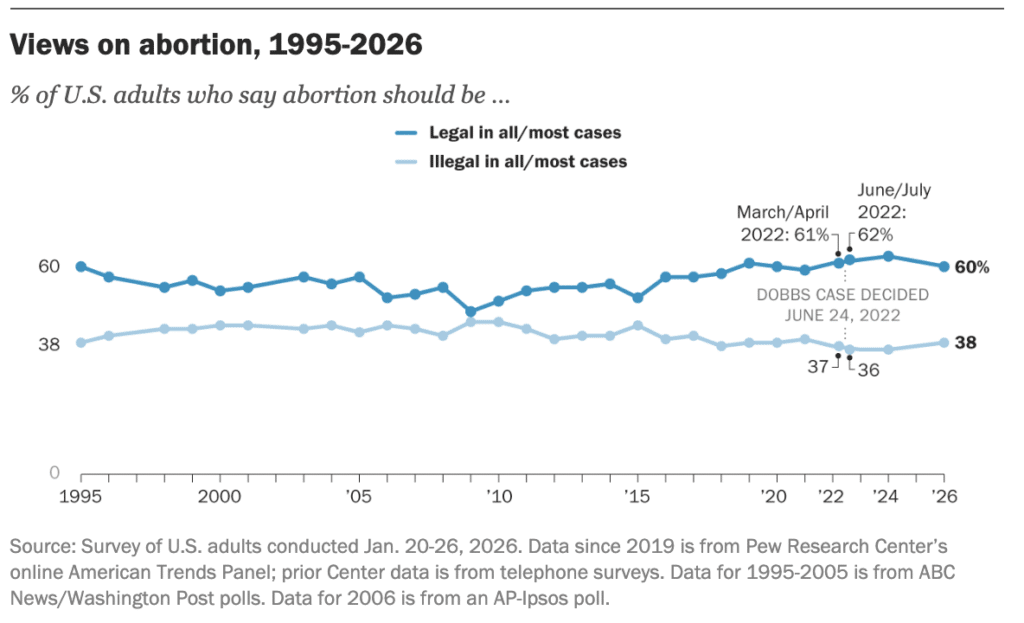
According to the Pew Research Center, most adults in America support legal abortion, with 60% of those surveyed in January of this year saying it should be legal in all or most cases.
 Even among religious individuals, support for abortion is high, except among white evangelical Protestants.
Pew’s survey found only 24% of those identifying as white evangelicals support abortion, while 68% of Black Protestants, 63% of White nonevangelical Protestants, and 57% of Catholics polled said abortion should be legal.
Movements against abortion care are still active in the country and in Ohio.
Ohio Republican U.S. Sen. Jon Husted participated in a congressional hearing on the alleged “dangers” of the abortion drug mifepristone, which has been approved as safe and effective by the FDA since 2000.
The president of the Ohio religious lobby group Center for Christian Virtue signed on to a statement with organizations across the country like the National Association of Christian Lawmakers, the U.S. Pastors Council and anti-abortion rights group Live Action, calling on the nominee for FDA commissioner, Dr. Heidi Overton, to “reverse Biden-era mifepristone policies while the FDA completes its ongoing review.”
In the letter, the groups express skepticism about a re-review of FDA regulations that have controlled distribution of the abortion drug since it was approved more than two decades ago, and arguing that mail-order abortion is “undermining state laws enacted to protect unborn life and women.”
The letter also provides guidance for a congressional hearing to decide whether Overton will be confirmed as FDA director.
Decades of scientific studies have shown that abortion medication is safe to use, and serious complications are rare. Anti-abortion rights groups have used one study in particular to show that “adverse effects” are occurring more frequently than other studies have shown.
Overton has already taken a stance against medication abortion, co-authoring a 2023 piece for the America First Policy Institute saying the institute’s policies should focus on “immediately halting the effort to normalize abortion-on-demand.”
Meanwhile, clinics backed by religious groups and those who don’t provide abortion as an option are receiving funding from national and state sources, according to Reproductive Health and Freedom Watch.
The group conducted a national analysis of legislation for and against “unregulated pregnancy clinics,” also called crisis pregnancy centers and pregnancy resource centers, depending on whether the reference is in support of or in opposition to the facilities.
Overall, the research estimated 2,600 clinics operating in the United States, projecting an annual national revenue of $2.6 billion in 2026. The organization also found more than 100 pieces of legislation related to the pregnancy clinics in 32 states.
Ohio was particularly noted for Ohio Senate Bill 9, a measure that created a tax credit for those donating to the clinics.
The bill was a comprehensive measure to revise tax laws, but one provision specifies that Ohioans can deduct up to $750 in “contributions the taxpayer makes to a pregnancy resource center.”
S.B. 9 was passed unanimously by the Ohio Senate, and 87-6 in the House earlier this year.
“By reducing the total an individual owes in state taxes based on the amount that person donated to a UPC, states effectively route millions in taxpayer funding to UPCs,” researchers from Reproductive Health and Freedom Watch stated.
As the 2026 general election approaches, reproductive rights are likely to come up as part of voters decisions, with a new governor and any changes in the legislature certain to have an effect on abortion and anti-abortion rights measures.
Republican governor candidate Vivek Ramaswamy has taken to social media to call himself “unapologetically pro-life,” while Democratic nominee Dr. Amy Acton has said she supports maintaining and broadening reproductive care including abortions and contraception, though solid plans have not been made clear.
Heartland Signal encourages news organizations and content creators to use our content. You're welcome to republish this article for free as long as you follow our republishing guidelines.
Related Articles

Zach Nunn sticks to phone sessions as Trone Garriott holds open town halls
Iowa Rep. Zach Nunn swatted at a reporter’s phone when asked about rural hospital closures — after calling warnings about the issue a “myth” last year. Meanwhile, his Democratic opponent Sarah Trone Garriott is holding open town halls across all 21 counties, while Nunn opts for telephone sessions.
Deleted posts reveals Pfaffenbach’s extreme political rhetoric and false claims
259 deleted X posts from Wisconsin Assembly candidate reveals a record of inflammatory political rhetoric, including opposition to abortion rights and false claims about Social Security fraud.

Van Orden backs Canada tariffs as Wisconsin dairy braces for fallout
Rep. Derrick Van Orden backs the Canada trade war. A UW-Madison economist says Wisconsin dairy will feel it more than most states, with milk prices at risk.