
Michigan’s Barrett and Lawrence clash over Iran War, tariffs and data centers, but agree on college sports
As rising gas prices and trade tariffs hit Michigan, Rep. Tom Barrett and Democratic candidate William Lawrence clashed in East Lansing over military action in Iran, data center regulations, and economic stability.
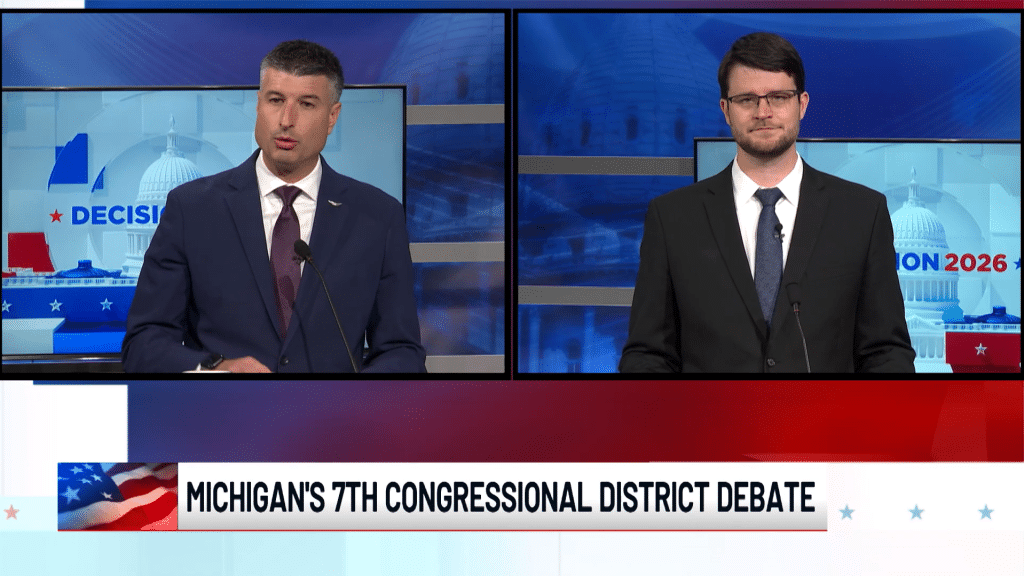
Incumbent U.S. Rep. Tom Barrett (R-MI) and Democrat William Lawrence met in East Lansing on Tuesday to debate who was better suited to represent Michigan’s 7th Congressional District on the Iran War, affordability and data centers.
The district includes Lansing (the state capitol) and East Lansing (home of Michigan State University). The race is hotly contested, with Cook Political Report classifying it as a toss-up. Barrett is conservative and a former helicopter pilot in the Michigan National Guard. Lawrence is a former member of the Democratic Socialists of America and co-founder of the progressive climate nonprofit Sunrise Movement.
The candidates debated many national topics that hit close to home with Michiganders and voters across the country, including tariffs, AI data centers and the Iran War. Barrett stood by his record and asked Lawrence to defend statements he made on X (formerly Twitter) several years ago. Lawrence accused Barrett of changing his mind on important issues during the campaign and failing to curb President Donald Trump’s economic and wartime policies.
The debate, hosted by News 10 Lansing (WILX) and PBS member station WKAR, started with a question about affordability that quickly pivoted to the war in Iran, which has driven gas and diesel prices to historic highs. Barrett, who served in the Army for 22 years, said he was one of the first Republicans to oppose the Iran War.
“I take that responsibility very seriously,” he said. Barrett said he opposed the conflict after it continued for more than 60 days — the time period that a president can wage war without congressional approval.
Lawrence said he was opposed to all “endless wars.”
The candidates also discussed the administration’s trade policy. That includes heavy tariffs on Canada, Michigan’s largest trading partner.
Barrett said he supports tariff policy that brings jobs back to the U.S. after decades of companies “hollowing out” and “offshoring” American manufacturing. Lawrence argued that Barrett’s calls for a stable and predictable economy contradict Trump’s policies.
“What we see from the president is chaos and instability,” Lawrence said. “He wakes up in the morning, throws a dart at the dart board and sets the tariff rate where the dart lands.”
Lawrence tied Barrett to Trump and his policies often, referring to Trump as “your president” throughout the debate. Barrett repeatedly asked Lawrence to defend statements he made on X (formerly Twitter) between 2018-22 about defunding the police and lax border policy.
Data centers are also a contentious issue in Michigan, which has provided tax incentives for developers and encouraged companies to build hyperscale facilities in towns like Mason, southeast of Lansing. Paula Caltrider, a district resident and organizer against the proposed data center, asked the candidates how they would regulate data centers if elected.
Barrett linked the advent of large data centers with the state’s Clean Energy and Job Act, which includes a law that allows state regulators, rather than local governments, to grant permits for large-scale renewable energy installations.
Lawrence accused Barrett of changing his position on regulating data centers as public opinion has shifted against hyperscale projects, like the one proposed in Mason.
“He stuck his finger up into the wind, and he saw which way it was blowing,” Lawrence said, “He did a complete 180 on this issue.” Lawrence argued that he has opposed data center development as long as residents have.
The candidates agreed on one thing: Both would vote for the Save Our Sports legislation that recently passed the U.S. Senate. The bill aims to reverse changes made to college sports in recent years, including reinstating the five-year eligibility period and capping how much student-athletes can make on name, image and likeness deals. Michigan’s 7th District includes Michigan State University (MSU), the largest public university in the state and a Big 10 school. The debate took place in WKAR’s studio on MSU’s campus.
Barrett and Lawrence said college athletics were “degraded” by how “professionalized” the industry has become. Lawrence also expressed concern about the influence of sport betting, which is legal in most states, including Michigan.
The full debate is available to watch on demand on both WILX’s and WKAR’s websites. It will also air on local stations WILX, WKAR and WSYM Wednesday evening at 7 p.m. EST. Candidates for Michigan governor Jocelyn Benson and John James will debate Tuesday evening on WOOD TV8 in Grand Rapids.
Heartland Signal encourages news organizations and content creators to use our content. You're welcome to republish this article for free as long as you follow our republishing guidelines.
Related Articles

Data centers investments, personal finances take center stage at Michigan governor debate
Michigan gubernatorial candidates Jocelyn Benson and John James faced off over rising living costs, government reform and data center developments. While both candidates agreed on a couple issues, they clashed over transparency and who is best equipped to lead the state.
FACT CHECK: Ryan Mackenzie parrots misleading claim denying Iran War is spiking fuel prices
U.S. Rep. Ryan Mackenzie (R-PA) is repeating misleading claims that recent high fuel prices aren’t driven by the war with Iran. Experts say even with sea passages open, risk premiums and lost oil supply from ongoing Middle East conflict continue to keep prices inflated.

Sand, Lahn trade attacks on residency, family at first Iowa gubernatorial debate
Democrat Rob Sand and Republican Zach Lahn accused each other of lying about their residency and family wealth Tuesday while answering questions on the state budget and education during the first 2026 Iowa gubernatorial debate.