
Overturning Roe v. Wade would trigger abortion bans in some Midwest states
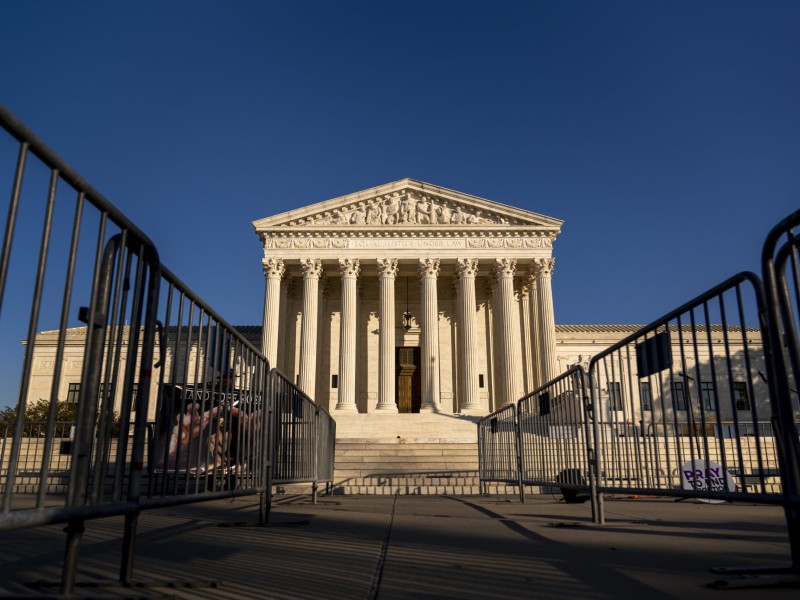
As oral arguments for U.S. Supreme Court case Dobbs v. Jackson Women’s Health Organization take place today, Midwestern abortion rights are the most threatened they’ve been in decades. If the heavily conservative Supreme Court uses the case to overturn Roe v. Wade, three Midwest states have “trigger” laws to immediately outlaw abortion without state legislatures or voters needing to do anything.
Trigger laws are laws that state legislatures pass that only go into effect if the Supreme Court takes a specific action, such as overturning a previous federal law or decision. South Dakota enacted one in 2005, which would immediately ban abortions in the state after a hypothetical Roe appeal, except in medical emergencies.
Missouri lawmakers passed a law like South Dakota’s in 2019. North Dakota’s 2007 trigger law would immediately ban all abortions in the state outside of cases of rape, incest and to “prevent the death of the pregnant female.”
Two other Midwestern states, Michigan and Wisconsin, have pre-Roe abortion bans that have yet to be repealed. Ohio Senate Bill 123, which would create another trigger law, is moving through the state’s Senate Health Committee. And while The 19th reports that Kansas currently acts as a Midwestern “beacon” for abortion access, that title could be in jeopardy should Democratic Gov. Laura Kelly lose her reelection bid in 2022.
Nine other states in the U.S. have trigger laws, and 26 total states would immediately see severe bans and restrictions on abortion, according to data from Guttmacher Institute, a pro-choice research organization. Only two Midwestern states—Illinois and Minnesota—protect the right to an abortion in the state. And Illinois’s guarantee is recent; the state enforced a 1975 abortion trigger law up until 2017.
Roe, the 1973 decision in which the right to abortion in the U.S. without government interference is based on, is facing its biggest threat in the SCOTUS in the Dobbs case. The case involves a 2018 Mississippi law that bars abortions in the state after 15 weeks of pregnancy, far beyond the 24-week fetal viability standard set by the 1992 Planned Parenthood v. Casey SCOTUS decision.
Some legal experts hypothesize that because the current SCOTUS has six conservative justices out of nine, they may go farther than legality of the Mississippi law and rule that the government doesn’t guarantee the right to get an abortion.
Heartland Signal encourages news organizations and content creators to use our content. You're welcome to republish this article for free as long as you follow our republishing guidelines.
Related Articles
Wisconsin’s Belanger pushed Sheboygan Amazon sale ahead of new zoning rules
John Belanger, a former Sheboygan city council alderperson and the Republican nominee, backed Sheboygan’s $2.03 million sale of 58.1 acres to Amazon before finalizing zoning rules and without banning future data center use.
Iowa’s 1st District: Bohannan’s plan for farm runoff and PFAS
As nitrate and PFAS pollution raise cancer concerns statewide, Democratic nominee Christina Bohannan’s approach contrasts with Rep. Mariannette Miller-Meeks, who opposed expanded federal PFAS regulation.

GOP Wisconsin legislator Zimmerman missed 225 votes last session, some to attend AI summit
Reps. Tip McGuire and Shannon Zimmerman were both booked on the same Milwaukee AI panel on June 24, 2025. McGuire withdrew so he could finish voting on the Assembly floor. Zimmerman made the panel, and votes kept being recorded in his name after he left his seat.