
What happened in… Pennsylvania? Historic trifecta has a lot of work to do
Pennsylvania Democrats won an historic trifecta in 2026, and it looks like it’ll be hard to break before 2030. So how did they do it, and what will they be able to do while in charge?
As Heartland Signal’s senior political analyst, I am going in depth on the shifts that happened in every state across the country in the 2026 elections. Today, I’m looking at Pennsylvania. This is the first time Democrats have had a functional trifecta in the state since 1980, which means there are lots of opportunities for them to focus.

Josh Shapiro follows up rout with even bigger rout
In 2022, Josh Shapiro beat far-right conspiracist Doug Mastriano by 15 points en route to winning the state’s governorship. This year, he faced what should have been a tougher opponent in state Treasurer Stacy Garrity, who had already won statewide office. But buoyed by a positive national environment, he won by 22 points, improving his margins pretty much everywhere in the state.
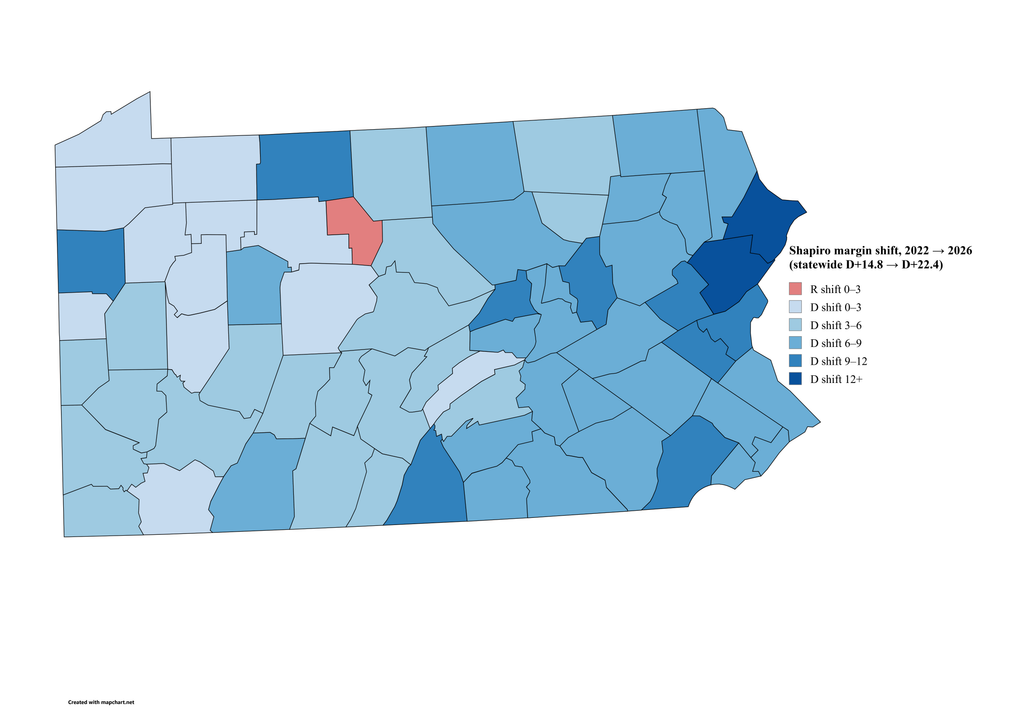
The one red county there is the state’s smallest, and the lighter shades of blue are mostly confined to other rural areas. Meanwhile, the bluest counties on the map are some of the state’s fastest growing ones. So, as was the case in Wisconsin, not only did Democrats increase their margins in Pennsylvania, but they did so in the most populous parts of the state.
Democrats win a narrow but seemingly durable trifecta
The biggest story is that Democrats now control the state Senate, winning four seats in the eastern part of the state. It makes up for losing a Lancaster County seat that they had flipped in a low-turnout 2025 special election.
In Pennsylvania, the lieutenant governor can break ties on a variety of procedural issues but final passage of a bill requires 26 votes. That means Democrats have no room to spare on passing bills, which means the most powerful politician in the state may be state Sen. Lisa Boscola, who has a habit of thumbing her nose at her own party.
Pennsylvania Legislature 2026: Seats That Flipped
Democrats flipped 12 seats Republicans won in 2024, growing their majority from 102 to 114 of 203 seats. Republicans flipped one back: District 12, which Democrat Brandon Dukes won in an August 2026 special election, returned to Republican Scott Timko in November. Hover or tap a district for details.
Only the 25 even-numbered seats were on the ballot. Democrats flipped four seats Republicans won in 2022 and take a 26–24 majority. Republicans flipped one back: District 36, which Democrat James Malone won in a March 2025 special election, went to Republican Tom Jones in November. Republicans held 27 seats going into the election. Hover or tap a district for details.
Philadelphia & suburbs
Pittsburgh & Allegheny County
Seats that changed hands
Democratic flips ranked by margin, closest first, then the seat Republicans took back.
| District | 2026 winner | Runner-up | Previous holder | Margin |
|---|
How this was made
Results are from the Pennsylvania Department of State’s election returns site (electionreturns.pa.gov) for the November 3, 2026 general election, which is still marked active, so counts may change before certification. Margin is the winner’s vote share minus the runner-up’s, as a share of all votes cast in the district; seats with one candidate on the ballot show no margin.
House: a seat counts as flipped when the 2026 winner’s party differs from the party that won it on November 5, 2024. Six House seats had 2026 special elections. In District 12, Democrat Brandon Dukes won the August 18 special 8,470 to 8,372, then lost the seat to Republican Scott Timko in November, so it is shown as flipped back to Republicans. The other five (22, 42, 79, 193, 196) were won by the same party in the special and in November. District 2’s Bob Merski ran on both party lines and is counted as a Democrat.
Senate: senators serve four-year terms, so only even-numbered districts were up in 2026; flips are judged against the November 8, 2022 result for the same seat. Odd-numbered seats, won in November 2024, are shaded lightly by party. In District 36, Democrat James Malone won the March 25, 2025 special 27,034 to 26,508 (after Republican Ryan Aument resigned), then lost to Republican Tom Jones in November, so it is shown as flipped back to Republicans. No other Senate specials have been held since the 2024 election.
District boundaries are the 2022 Legislative Reapportionment Commission House and Senate plans, exported from Dave’s Redistricting and simplified for drawing.
Maybe Senate President Pro Tem Jay Costa can ask his colleague across the Capitol, Speaker Joanna McClinton, for help. For most of the last four years, she’s had to corral a one-seat majority in the state House. No longer. Now, she has a relatively robust majority to work with, and she’s probably just relieved that she doesn’t have to sweat losing her gavel in every single special election.
So what gives?
In 2016, Chuck Schumer said that for every voter Democrats lose in Western Pennsylvania, they’ll win two to three in the suburbs of Philadelphia. He wasn’t wrong, just early.
That’s because now, Republicans hold just three state House seats in the five counties comprising the Philadelphia Metropolitan Area. When Schumer said that, they held almost thirty. That’s the story of this election: The suburban realignment that started during Trump’s first election finally wiped out state-level Republicans 10 years later.
What does a path back for House Republicans look like right now? Well, they could cobble together a majority by flipping back the closest losses from this year, then going after entrenched Democrats in more conservative districts in the Wyoming Valley, Johnstown and outside Pittsburgh. But doing so would likely require a pivot that the party doesn’t seem interested in right now.
And the Senate looks out of the question for Republicans until 2030. That’s because the seats up for election in 2028 were last contested in 2024, and Republicans swept most of the competitive ones, including Dan Laughlin’s. Indeed, in even a neutral year, Democrats could still flip three more Senate seats and require Republicans to flip back five in 2030 to win control back.
What the new trifecta can do
After delivering an historic trifecta to Democrats, what can voters in Pennsylvania expect? More funding for Philadelphia’s beleaguered commuter rail system, SEPTA, for starters. Gov. Shapiro said it’d be one of his top priorities, along with raising the minimum wage and building more housing.
Democrats also seem aligned on raising the minimum wage to $15 per hour, but they still need to hash out how long it’ll take to kick in. As I noted in my newsletter “Radio Free America” a week ago, now’s the time to implement policies that might take a while to have their impact felt!
The same goes with respect to housing. Shapiro was farsighted enough to put out an extensive housing plan earlier this year. And while much of it can be effectuated under existing law, expect him to work with the Legislature to make sure the state can build as much housing as possible over the coming years.
Schadenfreude, Pennsylvania edition
In 2020, future losing Senate candidate Ken Paxton sued to prevent Pennsylvania’s electoral votes from counting. Remarkably, a number of pro-Trump Pennsylvania lawmakers wanted to go along with his scheme. It’s been a long time coming, but voters finally told Sens. Rosemary Brown and Tracy Pennycuick along with Reps. Joe Emrick, Valerie Gaydos, Milou Mackenzie and Brett Miller that actually, no, it’s their votes that won’t count any more, at least when it comes to passing bills.
How we used AI: Aaron Kleinman used Claude to generate the above maps, either natively from official results or by generating .txt files for the Mapchart website.
Heartland Signal encourages news organizations and content creators to use our content. You're welcome to republish this article for free as long as you follow our republishing guidelines.
Related Articles
What happened in… Michigan? Democrats win a trifecta, this time with room to spare
Michigan Republicans got routed in 2026, locking them out of power until 2030. But what can Democrats do with their latest trifecta?

What happened in… Iowa? Rob Sand coasts, Democrats gain, but can it last?
Iowa Democrats are hoping they showed they made the state purple again after they won the governorship, flipped the attorney general’s race and gained seats in the Legislature. But it may be hard to replicate the same conditions in 2028.
Radio Free America: It’s the perfect time to think long term
Democrats have a mandate to lower costs. The good news for them, writes Aaron Kleinman, is that the most obvious policies to pursue will kick in right after the next presidential election