
What happened in… Michigan? Democrats win a trifecta, this time with room to spare
Michigan Republicans got routed in 2026, locking them out of power until 2030. But what can Democrats do with their latest trifecta?
As Heartland Signal’s senior political analyst, I am going in depth on the shifts that happened in every state across the country in the 2026 elections. Today, I’m looking at Michigan. Democrats won back a trifecta after losing it in 2024. But back then, they had one-seat majorities in each chamber. This time, Republicans got wiped out in basically every single swing seat.
Democratic sweep statewide
Secretary of State Jocelyn Benson easily maintained Democrats’ hold on the governorship, winning by eleven points just four years after Gretchen Whitmer won re-election by a near-identical margin. But the similar topline result elides some movement under the surface in the state.
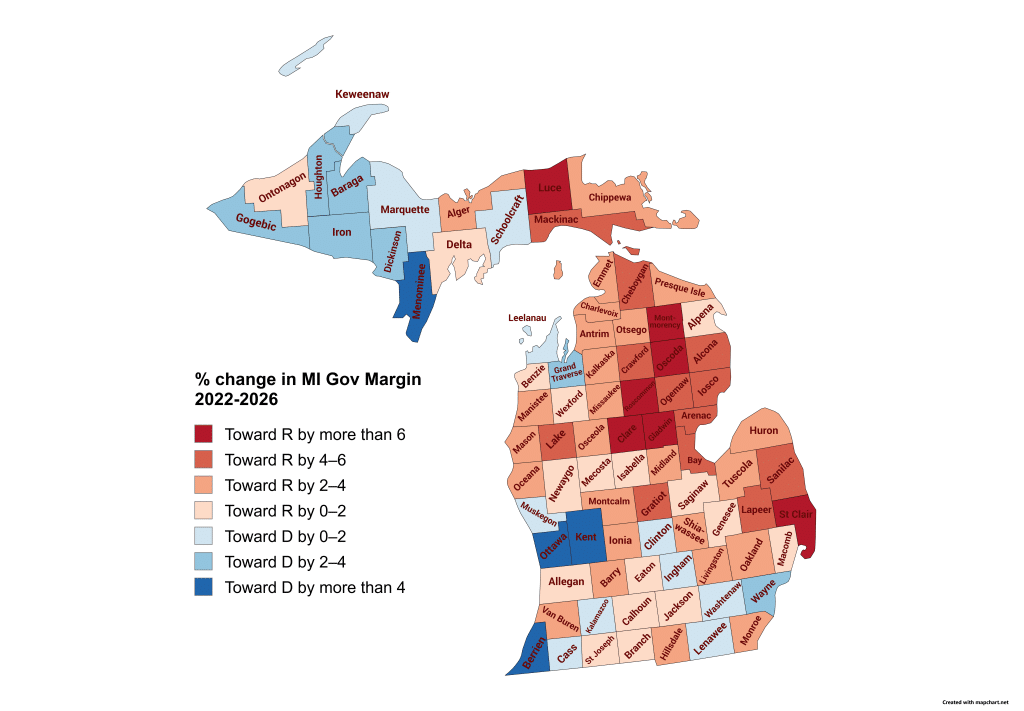
Rural Michigan moved significantly toward Republicans (except for counties in out-of-state TV markets). The greater Detroit area (Wayne, Oakland and Macomb Counties) seemed to stay relatively stable (more on that below), while Benson made huge improvements in the urban and suburban areas around Grand Rapids and Muskegon.
And it didn’t stop with Benson. Republicans were shut out of every statewide office — secretary of state, attorney general, state Supreme Court, even the state’s elected boards of university regents. They got walloped.
Blue wave crashes into Legislature as Democrats win sizeable majorities
Michigan Legislature 2026: what flipped, and what Republicans would need to win back
Democrats won the Senate —–— and the House —–—, flipping — Senate seats and — House seats from Republicans. To take back a majority, Republicans would need to flip the — closest Democratic Senate seats and the — closest Democratic House seats, listed below each map.
State Senate
Flips compared with the 2022 Senate election. 20 seats are needed for a majority.
The — seats Republicans would need
Democratic wins ranked by margin, closest first.
| District | Winner | Margin | Vote gap |
|---|
State House
Flips compared with the 2024 House election. 56 seats are needed for a majority.
Metro Detroit
The — seats Republicans would need
Democratic wins ranked by margin, closest first.
| District | Winner | Margin | Vote gap | Flipped in 2026 |
|---|
How this was made
Results are the Michigan Secretary of State’s county-level results files (MVIC) for November 3, 2026 (unofficial until certified), with flips judged against the November 8, 2022 Senate results and the November 5, 2024 House results. County figures are summed to each district.
Margin is the Democratic share minus the Republican share of all votes cast in the district. Vote gap is the winner’s raw-vote lead over the Republican. A majority is 20 of 38 Senate seats and 56 of 110 House seats; the Republican target list is the closest Democratic wins, as many as Republicans would need to flip to reach those numbers.
Boundaries are the court-ordered remedial maps published by the State of Michigan (House approved 2024, Senate approved 2024 for the 2026 election), simplified for drawing. Several metro Detroit Senate districts were redrawn between 2022 and 2026, so a few 2022 comparisons there cover different ground; all of those seats were held by Democrats both times.
When Democrats flipped the legislature in 2022, it was by the skin of their teeth, with a majority of just one seat in each chamber. But now, they have a four-seat margin in the Senate and an eight-seat margin in the House, allowing them more flexibility in passing their agenda. And as shown on the map, they flipped seats basically everywhere in the state, from the Upper Peninsula to the Detroit River. In the Legislature, there was no real regional realignment, just Republicans losing basically every seat that the parties targeted.
So what gives?
As noted above, Michigan Democrats continued to lose ground in rural Michigan but more than made up for it by improving in Western Michigan strongholds of Dutch Reformed voters. The descendants of Dutch immigrants are a historically Republican group that also tends to be well-educated and as such has trended Democratic over the past decade.
And these recaps are focused on state, not federal politics, but we can’t ignore the impact that Michigan’s high-profile Senate election (and the parties’ shifting stances toward the Middle East) had on the electorate as a whole. So I wanted to take a look at the three largest counties in greater Detroit to see how communities with large Jewish and Muslim populations shifted in the gubernatorial election relative to 2022.
Now before I show the maps, a bit of a caveat: The government does not collect religious practice information in the Census. And if you think about it for a minute, that’s a really great policy, 10/10, keep doing that. But it means we only have non-official estimates of where Jews and Muslims live in the greater Detroit area.
Based on the most recent surveys, the Jewish population is largely centered in Oakland County, with the biggest concentrations around Bloomfield, West Bloomfield and Oak Park, while Muslims are clustered in Dearborn, Dearborn Heights, Melvindale and Hamtramck.
How Oakland, Macomb and Wayne communities shifted in the governor’s race, 2022 to 2026
Across the three counties, the Democratic margin went from — (Whitmer over Dixon) in 2022 to — (Benson over James) in 2026. That near-standstill hides sharp moves in both directions: — of the — communities mapped moved toward the Republican, while a handful of Wayne County cities, led by Dearborn, swung hard toward the Democrat. In raw votes, those cities outweighed everything else: the Democratic vote margin grew by — votes, with Wayne County at — while Oakland (—) and Macomb (—) moved the other way.
By county
| County | 2022 margin | 2026 margin | Shift | Net vote shift | Votes 2026 |
|---|
Shift in margin by city and township2022 margin by city and township2026 margin by city and townshipShift in the vote margin, in votes
Red moved toward the Republican; blue moved toward the Democrat. Dark lines are county borders. Point at or tap a community for its numbers.Whitmer (D) vs. Dixon (R), share of all votes cast for governor.Benson (D) vs. James (R), share of all votes cast for governor.Each circle’s area shows how many votes the Democratic-minus-Republican margin moved from 2022 to 2026: blue toward the Democrat, red toward the Republican.
Biggest moves
Change in the Democratic-minus-Republican margin, in points. Places with fewer than 100 votes are left out of these lists.Change in the Democratic-minus-Republican vote margin, in votes.
Toward the Republican
Toward the Democrat
All results
Show or hide the table
Margin is the Democratic share minus the Republican share of all votes cast for governor. Net vote shift is the change in Democratic votes minus Republican votes. Click a column to sort.
| Community | County | 2022 margin | 2026 margin | Shift | Net vote shift | Votes 2026 |
|---|
How this was made
Oakland: the county’s official precinct results for 2022 and 2026. Wayne: the county’s official 2022 precinct report and its 2026 precinct canvass. Macomb: the county’s official 2022 results by precinct and its 2026 results site. Precincts, including absentee counting boards, are added up by city and township, and each county’s totals match the official county totals.
Margins use all votes cast for governor, minor-party and write-in candidates included. Cities that cross a county line are split at that line, and each portion shows only the votes cast in that county: Northville (Oakland and Wayne parts), Grosse Pointe Shores (Macomb and Wayne parts), and the Macomb parts of Memphis and Richmond and the Oakland part of Fenton. Their parts in St. Clair, Genesee and Livingston counties are outside the map. Portion lines follow the Census Bureau’s county subdivision boundaries.
Boundaries are the State of Michigan’s city and township lines; villages are counted within their townships.
The movement toward Democrats in enclaves with significant Muslim populations far outweighed losses in areas that tend to have higher Jewish populations. The raw votes that Jocelyn Benson gained from Dearborn alone were more than the entire number of votes that she lost off her Oakland County margin combined. And notably, some of her largest declines relative to Whitmer were in a number of areas without high Jewish populations in Northern Oakland or Macomb Counties.
Based on the data from the midterms, Michigan Democrats are benefitting from realignments between Jewish and Muslim populations. There just doesn’t seem to be much evidence that they lost Jewish voters in electorally significant numbers, while they gained truly impressive margins from Muslim voters.
What the new trifecta can do
The last time Democrats had a trifecta, they had to rely on the whims of Karen Whitsett to get anything passed. Now, they have more space to work with, and incoming Senate Majority Leader Darrin Camilleri has said reining in data centers and lowering prescription drug prices are their top priorities. Reforming the Michigan Public Service Commission (MPSC), which could lower utility rates, would also help deliver on their mandate. But with Michigan coming off closing a $1 billion budget gap and the Trump administration hindering state governments by attaching onerous rules to federal funds, it may be hard to effectuate big social welfare expansions. However, Camilleri says he still hopes to lower the cost of childcare, improve transit and pass voting rights protections.
Schadenfreude, Michigan edition
Former House Speaker Matt Hall sent death threats to his college classmates, was reported to the police by his girlfriend after he got agitated about his gambling losses and called an Asian colleague who complained about his behavior a low IQ representative. He still narrowly won his re-election campaign, but Republicans deposed him as the head of their caucus. And it seems like his colleagues are erasing his old videos from their YouTube page like he’s Nikolai Yezhov.
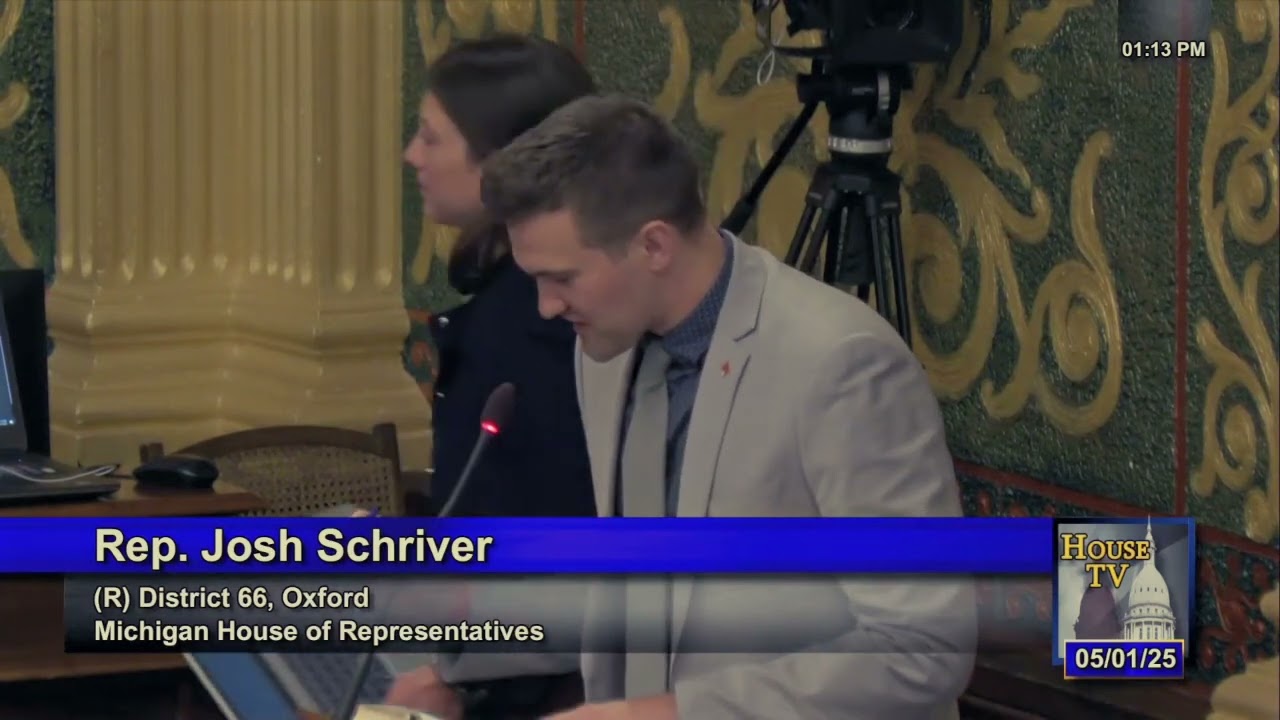
A number of Hall’s old colleagues did lose, including former Turning Point USA leader Rylee Linting and anti-vaxxer/election denier Jamie Thompson. But sadly, Christian nationalist Soundcloud rapper Josh Schriver not only won re-election, but Republicans put him in leadership!
How we used AI: Aaron Kleinman used Claude to generate the above maps, either natively from official results or by generating .txt files for the Mapchart website.
Heartland Signal encourages news organizations and content creators to use our content. You're welcome to republish this article for free as long as you follow our republishing guidelines.
Related Articles

What happened in… Iowa? Rob Sand coasts, Democrats gain, but can it last?
Iowa Democrats are hoping they showed they made the state purple again after they won the governorship, flipped the attorney general’s race and gained seats in the Legislature. But it may be hard to replicate the same conditions in 2028.
Radio Free America: It’s the perfect time to think long term
Democrats have a mandate to lower costs. The good news for them, writes Aaron Kleinman, is that the most obvious policies to pursue will kick in right after the next presidential election
What happened in… Wisconsin? Democrats take full control
For the first time since 2010, Democrats will control the governorship and state legislature in Wisconsin. We look into how they did it and what it means for the Badger State and beyond.