
OPINION: Independents, young men shift right: Breaking down the October Marquette poll
There’s less than four weeks to go until Election Day, and — surprise, surprise! — Wisconsin’s statewide elections are close.
There’s less than four weeks to go until Election Day, and — surprise, surprise! — Wisconsin’s statewide elections are close.
First, let’s take a look at where things stand with the top results in the race for Senate and for governor in Wisconsin.
U.S. Senate:
Ron Johnson: 52%
Mandela Barnes: 46%
Governor:
Tim Michels: 46%
Tony Evers: 47%
(Likely voters, Margin of error of +/- 4.3%. Most interviews were conducted before the Oct. 7 debate.)
Overall, this poll saw improvement for Republicans from the last round in September. Johnson expanded his lead from +1 to +6, and Michels closed the gap from Evers from being down 3% to down just 1%.
So, what’s happening? Where are things changing? What are the top issues emerging at this crucial stage of the race? Let’s get into the crosstabs and recombobulate.
Independents shift to the right
The biggest shift happening in this race is among independent voters. We’ll start with the Senate race, because that’s where the change is most pronounced.
In August, Mandela Barnes — then riding high on a post-primary bounce — led Johnson 55%-40% with independent voters. That evened out to Barnes 48% to Johnson 49% in September, and now, Johnson leads 52% to 46% with independents.
Barnes favorability is also down with independents, now at minus-10, 36% favorable to 46% unfavorable. That’s a greater gap than the minus-7 from the September poll.
In the gubernatorial race, independents have also shifted, essentially pulling even between the two candidates. In September, Evers led by 6% with independents — 45% to 39% — and now, Michels has a 1% lead – 44% to 43%.
With independents, the favorability of the two challengers is heading in opposite directions.
For Barnes, his unfavorable numbers are rising (37% to 46%), and he’s now net minus-10 with independents. For Michels, his favorable numbers rose from September to October, going from net minus-9 (32% favorable) to net minus-2 (38% favorable).
This is Ron Johnson’s best poll in a long time
In August, when Mandela Barnes had a seven-point lead in the Marquette poll, we cautioned not to draw too many conclusions from one great poll. Ron Johnson has been the favorite throughout this race, and one good post-primary poll didn’t change that larger dynamic.
Just as it would’ve been unwise to overreact to one great poll for Barnes in August, we also shouldn’t overreact to a great poll for Johnson. And this is a very good poll for Johnson.
Johnson’s favorability numbers have cratered in recent years. His “favorable” number has been below 40% in every poll dating back to 2019. But this new poll saw that number rise to 41%.
In the head-to-head with Barnes, Johnson saw substantial improvement with older voters, particularly the 45-59 age group, which polled at 63% Johnson – 35% Barnes after being essentially even in September. The senior Senator’s numbers also improved in the Green Bay/Appleton media market, where he’s up 60% (from 51%) to Barnes’ 36% (from 44%).
And while Marquette tends to be a more accurate poll than many others, this is the first major poll to show Johnson with this kind of lead. Other recent polls have shown a much closer race, including the CBS News/YouGov poll, which had Johnson with just a 1% lead.
An internal poll conducted by the Barnes campaign, shared with The Recombobulation Area, showed the lieutenant governor with a 1% lead – 48% to 47%.
Barnes also had a strong first debate, and another debate between the two candidates will be held Thursday, Oct. 13 at Marquette University, providing an opportunity for that momentum to continue.
Even so, Ron Johnson is the frontrunner in this race, just as he has been throughout the campaign. This is a midterm election where Republicans have the historical advantage, Johnson has incumbency on his side, and the top issue in the poll (inflation) is one where Johnson is polling better.
But this is still Wisconsin, and this race is still close. Barnes has work to do to close the gap, but until we see more evidence to suggest otherwise, Johnson’s lead might not be as wide as this poll indicates. There have been 12 polls taken of this race since the beginning of September, according to FiveThirtyEight’s poll tracking, and this is the first one showing Johnson with a lead of more than 5%. This race is still winnable for Mandela Barnes. But time is getting tight.
Ron Johnson is leading with younger voters
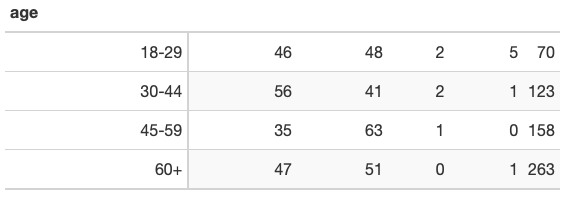
We can’t call this an outlier anymore. Ron Johnson is leading Mandela Barnes with young voters in Wisconsin.
This is not happening in the other statewide race in Wisconsin, where Tony Evers had a 10-point lead over Republican Tim Michels (49%-39%). It is just happening in the Senate race.
We picked up on this months ago, when in the June pre-primary poll, Johnson was leading all Democratic challengers by a healthy margin among voters age 18-29. We filed it away as something to watch, and in the last two polls where Johnson has led, he’s also been ahead of Barnes with the youngest group of voters.
This, of course, flies against conventional wisdom about these types of races, where Democratic candidates typically have an advantage with younger voters. These results seem especially surprising, considering the fact that Mandela Barnes is 35 years old and has lived experiences that would be relatable to younger voters.
But in averaging the last three polls (including the one where Barnes had an overall lead), you can see that Johnson has a slight lead over Barnes with the 18-29 age group.
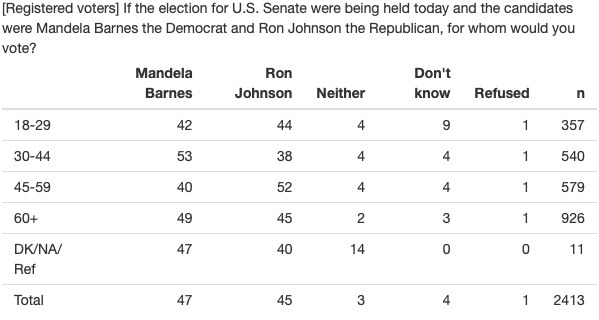
So, what’s happening here?
For one, there is a huge gender gap between the two candidates generally, and that is especially pronounced in this age group. The chart below, shared with The Recombobulation Area, is with Likely Voters, combining the results of the last three Marquette University Law School polls:
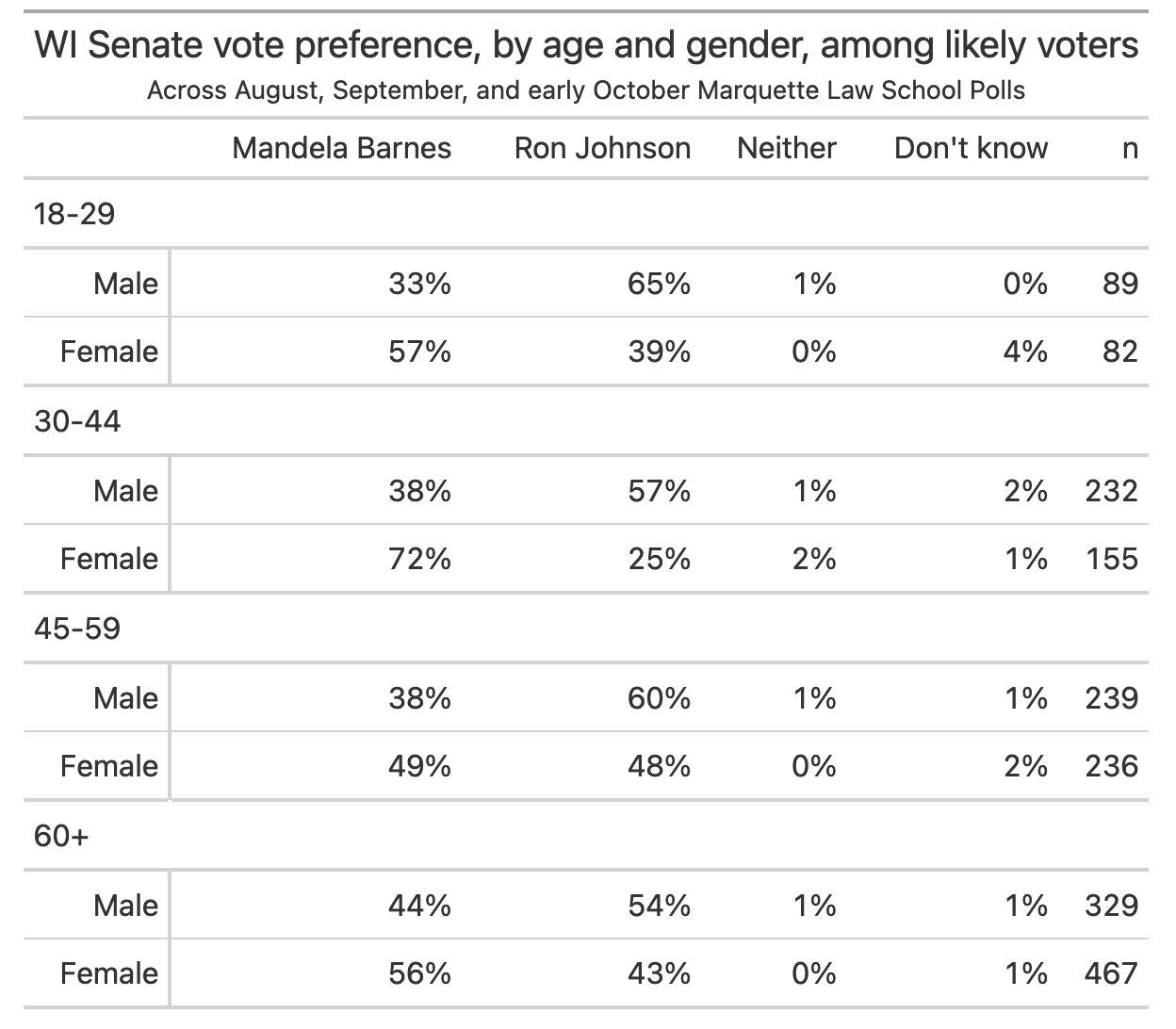
This shows Johnson with a massive lead over Barnes with young men – 65% to 33%, a staggering margin. At the same time, young women favor Barnes, 57% to 39%.
Here’s the same dataset with registered voters:
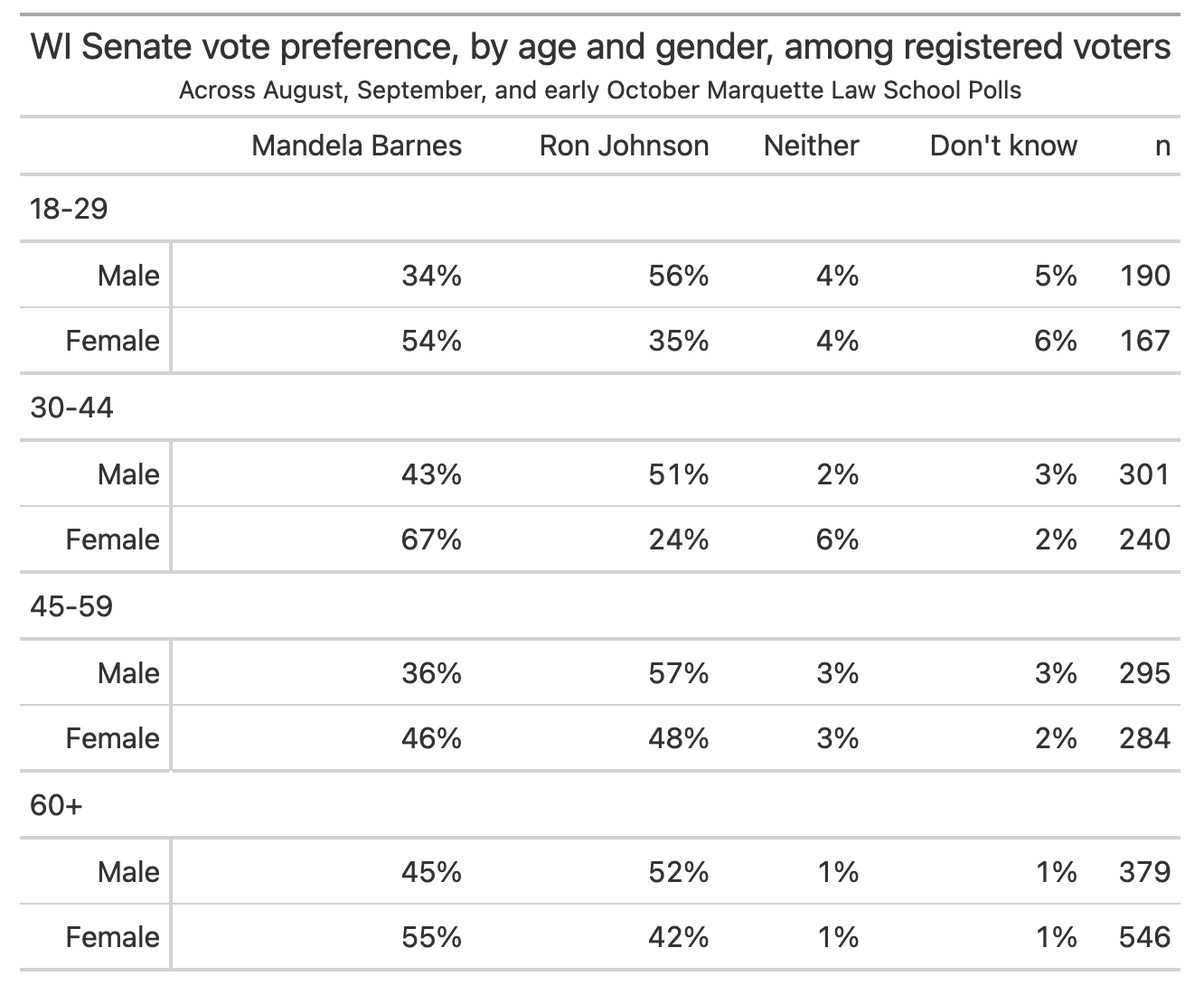
Here’s my theory about what’s happening: Johnson has been aggressively advertising online for much of this year, particularly on YouTube. We’ve seen in the months since the primary how impactful a well-funded advertising blitz can be in a race like this one. I think Johnson has been targeting young men to support his campaign in ways we’re not seeing from other candidates.
As recently as September, nearly 50% of voters aged 18-29 did not yet have an opinion of Mandela Barnes. His favorability rating with the group was net plus-16 in that poll (34%-18%). Now, in the October poll, the number of voters in that age group who don’t have an opinion of him is down to 30%, and essentially all of those voters who made up their mind about him went to the “unfavorable” category, shifting things to a slight net-negative — 34% favorable, 35% unfavorable.
Barnes needs to win with young voters, period. This may be a lower-turnout constituency, but if Johnson has the support of young men to the degree he has, that’s a real problem for the lieutenant governor in this race.
Evers vs. Michels
The race between Evers and Michels is tight. Reports have suggested this is the most expensive gubernatorial race in the country, and anyone who has turned on a TV lately can attest to that. This race has been ultra-negative and fairly ugly.
But Evers still maintains a slight edge in this race, and looking into the crosstabs shows why he’s still the favorite to win re-election.
Evers leads in almost every age group, except for the 45-59 age range that’s been proving to be ultra conservative. His dip with independents is slightly worrisome, but he has a huge lead with “moderate” voters — 63% to 31%, increasing his advantage from the September poll. Moderate voters in Wisconsin do tend to vote for Democrats, though, which is a factor to keep in mind. Evers also has a clear lead in the “rest of state” region, outside the three major media markets — 49% to 41% — a reversal from the September poll where Michels had a slight lead with the group.
Michels has made it a priority to run a working-class style of campaign, but that doesn’t appear to be connecting with voters at lower incomes. Among those making less than $40,000, Evers leads 53% to 32%, and among those in the $40,000 to $70,000 range, Evers leads 51% to 42%. Evers increased his lead with both groups from September to October. Michels only leads with those making over $75,000 (52%-45%). It seems as if working class voters connect more to the longtime science teacher and school administrator than to the inherited-wealth business owner who has been living in Connecticut.
But this is a close race. Michels improved with independents and has double-digit leads over Evers in the suburban Milwaukee and Green Bay/Appleton media markets.
It’s Wisconsin. This was always going to be a toss-up.
The top issues of “concern” to voters
Inflation continues to rank as the top issue concerning voters in this election, with 68% saying they’re “very concerned” and 25% saying they’re “somewhat concerned.” That’s down a bit from peak concern in June, but still ranks as the top issue going into this election.
Abortion policy — the issue that has in many ways upended these midterm elections — now ranks fourth, behind inflation, public schools and gun violence, and tied with crime.
While abortion rights are an issue where polling is clearly on the side of Democrats — 57% of voters oppose the overturn of Roe v. Wade and 83% of voters say the state should allow exceptions for rape and incest — to focus singularly on this issue in the final weeks of the campaign could be a mistake. While it ranks as the No. 1 issue among Democrats, it is not a top five issue for independents — and that’s where Evers and Barnes have been losing ground.
Republican election deniers, two years later
Despite all evidence endlessly showing Wisconsin’s election in 2020 to be free, fair and secure, 65% of Republican voters still say they are not confident in the election results.
As an issue poll, Marquette included “accurate vote count” alongside things like taxes, abortion policy, inflation, illegal immigration, etc. That issue ranked as the No. 4 concern among Republicans.
What perhaps should be included in the next poll is the issue of protecting American democracy. It would be very interesting to see where Democrats and independents would rank that crucially important concern in a state where small-d democracy is backsliding more acutely than perhaps any other state, and where top of the ticket Republicans have not said whether or not they would accept the election results, and where our senior Senator has participated in the plot to overturn the election and has been arguably the biggest election denier and insurrection apologist in the Senate. Just a thought. Democracy is kind of important.
Dan Shafer is a journalist from Milwaukee who writes and publishes The Recombobulation Area. He previously worked at Seattle Magazine, Seattle Business Magazine, the Milwaukee Business Journal, Milwaukee Magazine, and BizTimes Milwaukee. He’s also written for The Daily Beast, WisPolitics, and Milwaukee Record. He’s won 13 Milwaukee Press Club Excellence in Journalism Awards. He’s on Twitter at @DanRShafer.
Heartland Signal encourages news organizations and content creators to use our content. You're welcome to republish this article for free as long as you follow our republishing guidelines.
Related Articles

Former elections official accuses Missouri secretary of state of altering results, misleading judge
Nick La Strada, fired in May as director of election integrity, alleges Denny Hoskins also illegally used public funds to influence a St. Louis County election.
Husted political committee got nearly $500K from a bank he worked for while in office
Ohio U.S. Sen. Jon Husted said joining a regional bank’s board as lieutenant governor was just a learning opportunity. State disclosures reveal Heartland Bank went on to pour nearly $492,000 into his political committee.