
Right to Life leader in Ohio says 10-year-old rape victims should carry babies to term
During a hearing by the Ohio House’s Constitutional Resolutions Committee on Tuesday, Laura Strietmann, the executive director of Cincinnati Right to Life organization, argued that raped 10-year-olds are capable and should carry their attacker’s children to term.
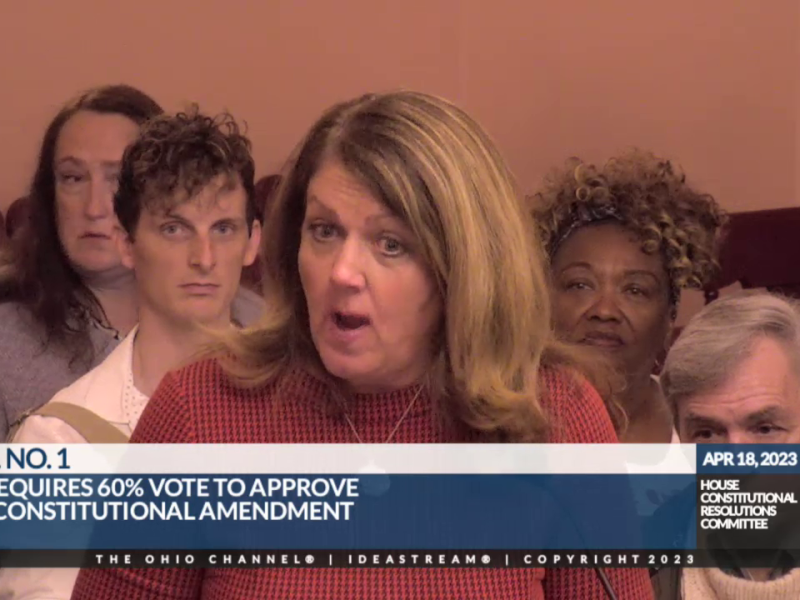
During a hearing by the Ohio House’s Constitutional Resolutions Committee on Tuesday, Laura Strietmann, the executive director of Cincinnati Right to Life organization, argued that raped 10-year-olds are capable and should carry their attacker’s children to term.
“I know that a 10-year-old might not understand pregnancy, but I also know that a 10-year-old understands life and playing with dolls,” Strietmann contended. “I know when my daughter was ten years old, she cried and begged for a little sister or a baby. And while a pregnancy might have been difficult on a 10-year-old body, a woman’s body is designed to carry life. That is a biological fact.”
Both the World Health Organization and the National Institute of Health published research finding that globally, adolescents giving birth are at higher risk of severe childbirth complications, including severe bleeding and systemic infections. And the children delivered from adolescent and teenage birth are more likely to be underweight, which may lead to future illnesses and physical and mental disabilities.
The 10-year-old used as an example refers to a highly publicized rape last summer, where the young victim could not receive abortion care in Ohio because of a ban on all abortions after a fetal heartbeat is detected (usually at six weeks of pregnancy), which was put in place after Roe v. Wade fell. She was forced to travel across state lines to Indiana to get an abortion. The Ohio abortion ban has been blocked indefinitely since last October by a lower county court judge, while Indiana has since banned abortion with limited exceptions.
Strietmann submitted proponent testimony for House Joint Resolution 1 as a means to block the reproductive rights amendment. Because of pro-abortion groups advocating for a constitutional amendment to protect the reproductive rights of women in Ohio, the Resolutions Committee is hearing testimony on HJR 1 to increase the percentage of votes required to pass such amendments from 50% to 60%. This is one of the ways Republican-controlled legislatures like Ohio’s have been combating the ballot initiative process, which has been successfully used to preserve reproductive rights even in traditionally conservative states like Kansas and Kentucky.
Strietmann went on to contend that the doctor who performed the abortion did not report the rape to authorities, a talking point consistently used by right-wing leaders to make the incident look like a hoax. She also blamed the mother for supposedly allowing the rape to happen. State Rep. Jessica E. Miranda (D-Forest Park), who earlier in the hearing shared her personal experiences of child sexual assault, thoroughly pointed out Streitmann’s falsehoods and chastised her on behalf of the girl and her family.
“Let us not continue to spread disinformation about [a] certain family’s personal issues that they have dealt with in terms of a ten-year-old rape victim being raped and child sexual abuse,” Miranda said. “I take extreme offense to that on behalf of the family and the poor ten-year old who was subjected in that way to being raped at such a young, tender age.”
Throughout the rest of her testimony, Strietmann also argued that over 90% of abortions in Ohio are performed for “convenience” and simply to “kill children for profit,” effectively denying that many abortions are needed to save the life of the mother for a variety of medical reasons. She advocated for a near-total ban on abortion in the state with no exceptions for rape, incest and the mother’s health — without evidence, Streitmann doubted the medical severity of most cases where doctors determined the abortion was necessary to protect the mother’s life.
“Abortion is never necessary for the life of the mother,” Streitmann falsely claimed. In fact, the American College of Obstetricians and Gynecologists and Physicians for Reproductive Health put out a statement in 2019 stating that abortion may be necessary to save the mother’s life in certain cases.
Last November, National Public Radio reported that a Northeast Ohio emergency room denied proper care for a 33-year-old pregnant woman despite her “profusely” bleeding for seven straight hours, in part because of the strictness of Ohio’s current abortion law.
Heartland Signal encourages news organizations and content creators to use our content. You're welcome to republish this article for free as long as you follow our republishing guidelines.
Related Articles

GOP Wisconsin legislator Zimmerman missed 225 votes last session, some to attend AI summit
Reps. Tip McGuire and Shannon Zimmerman were both booked on the same Milwaukee AI panel on June 24, 2025. McGuire withdrew so he could finish voting on the Assembly floor. Zimmerman made the panel, and votes kept being recorded in his name after he left his seat.

Ohio’s Ramaswamy and McColley have long backed near-total abortion bans
Even after Ohio voters overwhelmingly passed a 2023 constitutional amendment protecting abortion rights, GOP gubernatorial nominee Vivek Ramaswamy and state Senate President Rob McColley remain committed anti-abortion advocates. Audio from a recent rally shows McColley framing the constitutional defeat not as a setback, but as a shift in strategy.

Ryan Mackenzie’s stance on data centers collides with his policy record
Rep. Ryan Mackenzie says data centers should pay their fair share. His record includes a 2021 tax exemption vote and support for limits on local oversight.