Michigan budget moves Rx Kids funding, but $18M remains in play
The Legislature shifted the money out of a dedicated appropriation, but the budget leaves room for competing interpretations.
This post has been republished from the Michigan Advance under Creative Commons license CC BY-NC-ND 4.0.
The Fiscal Year 2027 budget, approved by the Legislature on July 3, redistributed $20 million within the Michigan Department of Health and Human Services budget for Temporary Aid for Needy Families, or TANF. Exactly how that money can and will be used remains an open question.
The money had previously been appropriated to the Rx Kids program, a prenatal and infant cash support program that has come under fire from Republican leadership, including House Speaker Matt Hall (R-Richland) in the last year.
A budget analysis from the nonpartisan House Fiscal Agency shows the split between chambers, and the negotiated agreement — the Republican-led House sought to strike that $20 million from the budget entirely, while the Democrat-led Senate would have left the money alone to be allocated to Rx Kids. The final version of the budget keeps the money in the budget, but reallocates it to five different line items under the TANF, or Temporary Aid for Needy Families, budget.
SUBSCRIBE: GET THE MORNING HEADLINES DELIVERED TO YOUR INBOX.
That is $4.5 million apiece for “Coordinated children’s healthcare policy and supports,” “Family, maternal, and child health administration,” “Prenatal care outreach and services delivery supports,” and “Special projects,” as well as $2 million for child supplemental payments under the state’s Family Independence Program, or FIP.
The FIP payments are more strictly conditional on what they will go towards. But for the remaining $18 million, Rx Kids could still be eligible to receive some or all of that money. It will be up to the Department of Health and Human Services to determine how exactly the funds are spent.
Spokespeople for the department did not respond to multiple requests for comment.
Program leaders believe that the money initially appropriated to them will continue to fund Rx Kids. Dr. Mona Hanna told Bridge Michigan in the days following the budget’s passage that she was “happy to share with confidence that Rx Kids will continue to be funded and operational.”
The $20 million TANF authorization “is still in the omnibus budget,” she said. “The fact that our program survived this difficult budget process is indicative of its success and the faith Michigan communities have in our work.”
Hall, however, believes that Rx Kids would not be eligible to receive any funding under the specific line items under TANF that the money was reallocated to, adding that he “hand selected” those funds.
“My view is that they will not be eligible for those pots, and that’s why I picked them,” he said in a July 7 press conference. “I picked specific pots that they wouldn’t be able to get, because the other pots were the ones that I would describe as much easier for them to get. So I specifically put them into the pots that should be going to these other programs.”
Those “other programs” that Hall describes include funding for programs like the Women, Infants and Children, or WIC, program, as well as certain Child Protective Services programs.
Hall and his fellow Republicans have long argued that Rx Kids, which does not have any income-based eligibility requirements and does not limit what the money can be spent on, differs from other welfare programs that only cover very specific expenses.
Data collected from program participants show that the vast majority of money received by families is spent on baby supplies, food, rent or housing expenses, and utilities. The freedom to choose how to spend the money is key to the nature of the program, according to program leaders, which is based on trusting mothers and families to know the needs of their children.
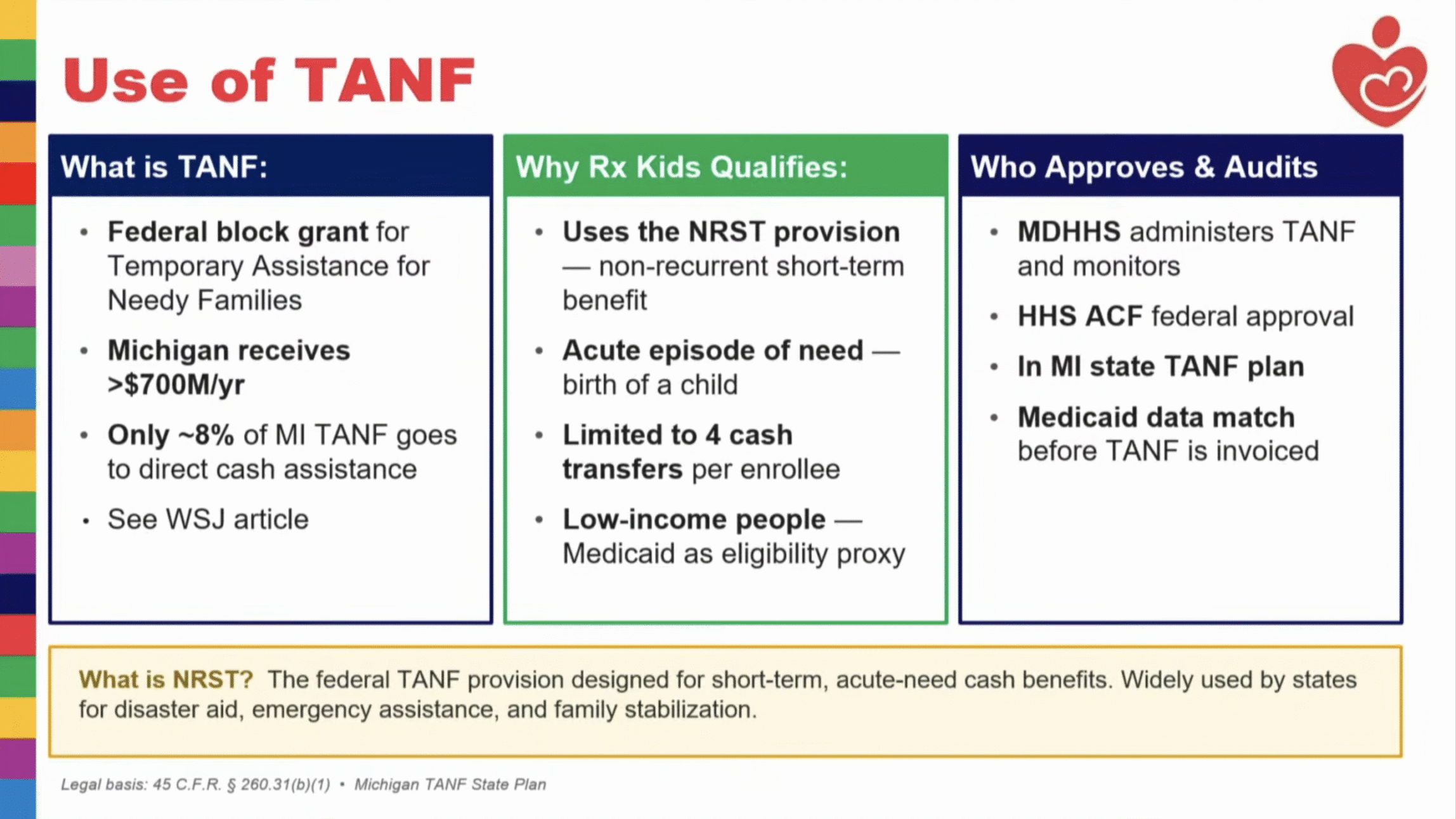
As of July 16, information published by Rx Kids showed that 14,240 families had been enrolled in the program, and nearly $50 million had been disbursed. The program, a public-private partnership, is funded through a mix of government dollars and private philanthropy. The source of the money each family receives depends on the applicant’s Medicaid eligibility and ability to verify citizenship or legal status.
Any applicant who is not able to submit that kind of identification does not receive any state funding, just funds from private donors. And only applicants who can demonstrate their eligibility for Medicaid receive TANF-funded benefits.
As for the future of Rx Kids, program leaders have indicated that future expansions may be dependent on continued state funding.
“We already have raised so much money from other sources, we’ve raised $86 million from other sources, we’ve kind of tapped out philanthropy and other sources, so we’ll see how take-up goes in the communities that we’re in,” Hanna told the Michigan Advance following a House Oversight Committee hearing on the program in June. “We’ll see how this next budget goes, and if take-up is a little less expected, because all of our numbers are projected on 100% take up, so if it’s a little less than that, maybe we’ll have some leftover funds, and we’ll be able to expand to places that really want this, that are just waiting for that opportunity.”
An April press release announcing the expansion of Rx Kids into 20 additional Michigan communities similarly stated, “Future application cycles and expansions will depend on sustained state investment, including restoration of previously cancelled funds, continued annual TANF support, and strong enrollment across communities.”
The program announced on July 7 that in the fall it will expand to its first community outside of Michigan, into certain ZIP codes in Cleveland, Ohio in partnership with First Year Cleveland. In that announcement, program leaders urged that “Additional public and philanthropic investment will help accelerate the program’s expansion to more Cleveland families.”
Heartland Signal encourages news organizations and content creators to use our content. You're welcome to republish this article for free as long as you follow our republishing guidelines.
Related Articles
WisEye streaming service gets $250k to operate for the rest of 2026
A bipartisan committee of Wisconsin legislators has signed off on a $250,000 funding deal for WisconsinEye, the livestream service that covers the state Legislature.
Pillen memo calling for 5% cut across Nebraska agencies raises questions about governor’s authority
For the University of Nebraska, a 5% cut could subtract $36 million from its newly approved operating budget
PA legislature wrestles with how to handle data center developments
State legislators in Harrisburg have largely resisted any comprehensive regulation, on data centers, instead focusing on piecemeal, largely bipartisan efforts.