
What happened in… Minnesota? DFL sweeps but trails the national swing
The DFL won Minnesota’s governorship and both legislative chambers on Nov. 3, but the state swung less than the nation. Here’s where it gained and lagged, and why.
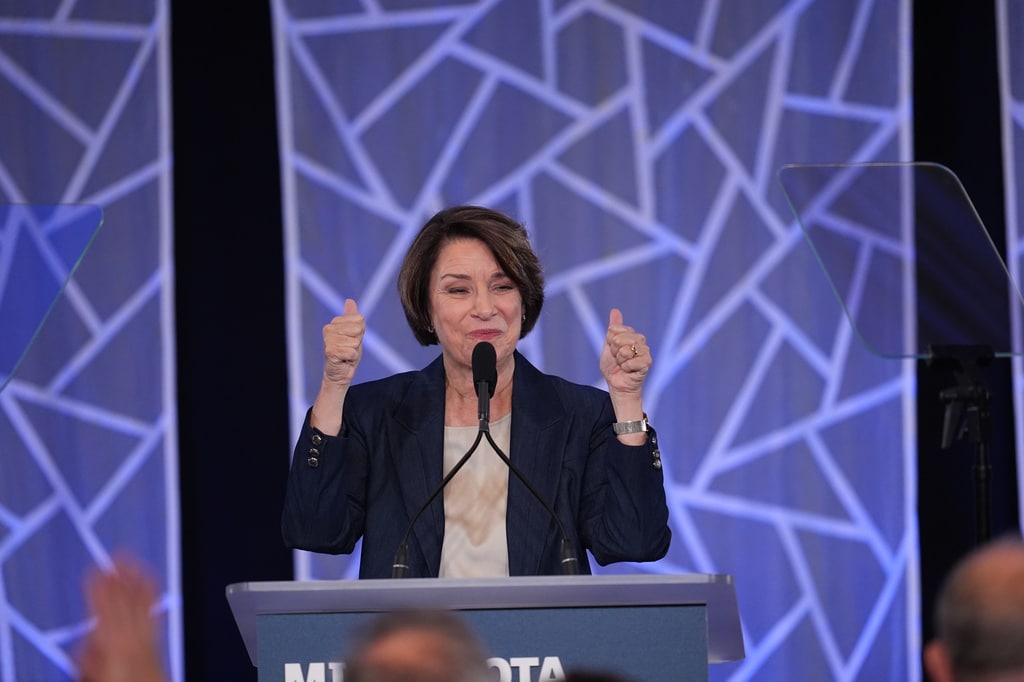
As Heartland Signal’s senior political analyst, I am going in depth on the shifts that happened in every state across the country in the 2026 elections. I’m starting in Minnesota, where Democrats retained the governorship and every statewide elected position while maintaining control of the state Senate and flipping the state House. Notably Minnesota’s results haven’t been certified, but the state counts votes quickly, and any recounts will not change topline results.
Klobuchar runs up the score
In the Minnesota gubernatorial election, Democratic-Farmer-Labor (DFL) U.S. Sen. Amy Klobuchar beat Republican House Speaker Lisa Demuth by an almost 13-point margin. This was a five-point improvement over Tim Walz’s showing in 2022. However, the electoral environment was much friendlier in 2026, and Klobuchar has a strong record of overperformance. You can see below which parts of the state shifted most strongly toward Democrats in the gubernatorial election:
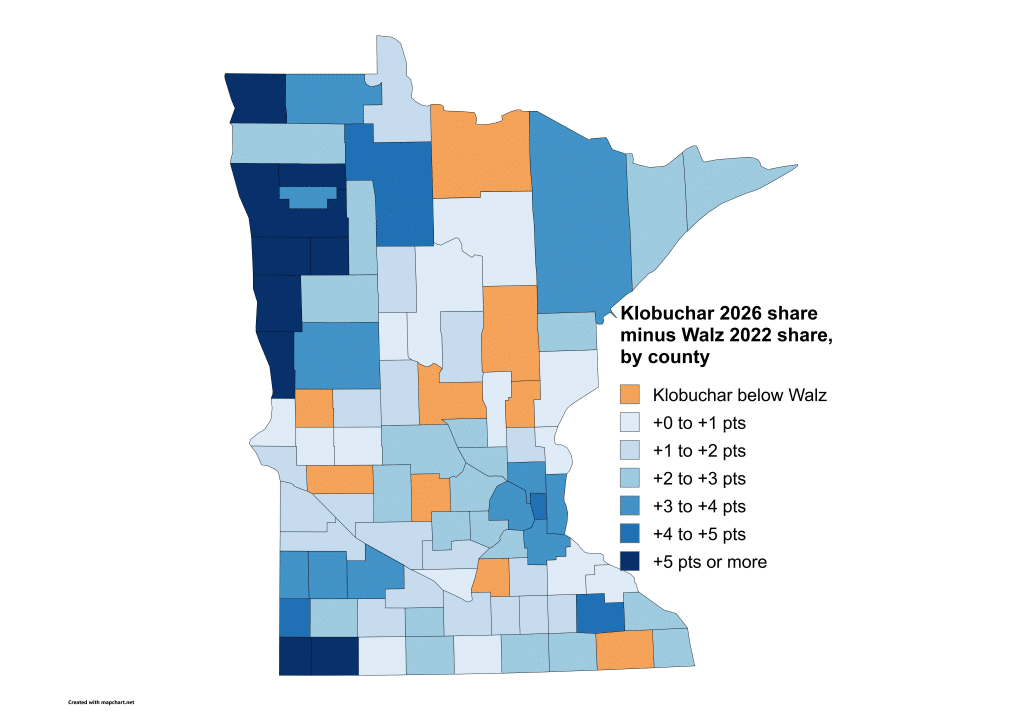
She mostly padded her margin by doing much better in the Twin Cities area and its suburbs (also in the parts of the state that are in non-Minnesota media markets, as Republicans likely didn’t spend resources in those while they did in 2022).
Minnesota also elects its secretary of state, attorney general and state auditor. The DFL won all of those elections by between nine and 13 points, keeping every office in its hands.
A trifecta, with the size of the majority pending a few recounts
The biggest change in the state came in the Legislature. Heading into the election, Democrats held a one-seat lead in the state Senate while the state House was tied. Now, Democrats have a clear majority in both.
Which legislative seats changed parties
Flipped seats
Party before the election is the winner of the last regular election: 2024 for the House, 2022 for the Senate. Special elections held since then (House 40B, 34B, 47A and 64A; Senate 6, 29, 47 and 60) were all won by the same party, so no seat changed hands between regular elections. Margins are unofficial results before the state canvass, from Secretary of State files updated Nov. 9, 2026. Senate District 4 was decided by 4 votes, House 32A by 22 and Senate 33 by 42. Sources: Minnesota Secretary of State results files (2026 LegislativeByDistrict.txt and stsenate.txt, 2024 House, 2022 Senate); district boundaries from U.S. Census Bureau 2024 cartographic boundary files.
The DFL netted between five and seven seats in the Senate. They picked up five seats in the Twin Cities suburbs and one in Rochester, the traditionally Republican home of the Mayo Clinic that has turned sharply Democratic in recent years. There are also two recounts looming: state Sen. Rob Kupec (DFL-Moorhead) trails in his re-election campaign by just four votes, while Sen. Karin Housley (R-Stillwater), wife of Hockey Hall of Famer Phil, is ahead by just 42 votes.
Meanwhile in the House, only half of the seats that the DFL netted were in the Twin Cities metro area, as they also flipped seats in the Iron Range, St. Cloud, Mankato and Winona. Not only did all of their incumbents win re-election, but they came within 22 votes of flipping another seat (32A in the Blaine area), pending a likely recount.
So what gives?
While the outcome for the DFL in Minnesota was positive overall, it shifted less toward Democrats than most other states. Nationwide, the popular vote was about 14 points in favor of Democrats. In Minnesota, it was 13 points in favor of the Democrats. But that’s despite the state being six points more Democratic than the rest of the country in 2024, so you’d have expected Democrats to do even better there. And it’s not like ICE’s occupation of the Twin Cities in Operation Metro Surge improved Republicans’ image in the Land of 10,000 Lakes.
It’s likely because of a burgeoning fraud scandal that uncovered what seems to be lax oversight of government contractors by the state. Republicans used it as a cudgel against all state-level Democrats, insisting many were complicit in it — often on flimsy grounds. Considering that Kupec is trailing in a district far outside the area affected by Operation Metro Surge, it seems likely the scandal may cost him his seat, even though he has little to do with it. His opponent was able to motivate just enough people (three voters switching sides would have flipped the result) to vote out someone they supported just four years ago.
So it stands to reason that Minnesota Republicans managed to avoid losing as many votes as their colleagues in other states by focusing on the scandal. Oddly, I think this is positive news for Democrats at the national level. It’s proof that there are voters who are motivated by fighting corruption. Obviously, you don’t want an outcome like the one Minnesota Republicans just experienced. But if there is a mass of people who won’t vote for a party they think is too lax on government fraud, then investigating the Trump administration will help you win votes in 2028.
What a trifecta means
Gov.-elect Klobuchar and DFL leaders want to focus on lowering housing and healthcare costs when the Legislature reconvenes in January, so expect those issues to be tackled early. She also campaigned on a pledge to not levy new taxes, so she will likely try to root out the remaining waste within the government as she seeks to free up public funds for worthy projects.
The DFL accomplished a lot during its last trifecta in 2023 and2024, so there’s less low-hanging fruit in Minnesota than elsewhere. But with larger margins, it seems like they may be able to shepherd through bills addressing ICE’s culpability in terrorizing the Twin Cities region during Operation Metro Surge. Also, Demuth allegedly broke a promise to the parents of a school shooting victim by refusing to bring a gun safety package to the House floor, so expect that to be addressed early in 2027.
Oh, and if Republicans want to continue blocking fair districts nationwide, Minnesota can easily draw a map that would assure the state sends six Democrats to the U.S. House instead of the four that currently represent the state in Washington.
Schadenfreude, Minnesota edition
The most deserving Republican loser was Jeff Dotseth, an anti-vaxxer who, according to affidavits, once kicked a dog and called his stepson “Kunta Kinte.” He lost by 11 points, doing worse than all of the Republican statewide nominees in his seat. That said, Demuth lied to the family of a school shooting victim, so seeing her humiliated at a statewide level was pretty righteous, too.
How we used AI: Aaron Kleinman used Claude to create the maps in this article from the vote counts on the Minnesota Secretary of State site. Aaron reviewed the output against the source data, and Heartland Signal editors reviewed the article before publication. All reporting, analysis and conclusions are the author’s.
Heartland Signal encourages news organizations and content creators to use our content. You're welcome to republish this article for free as long as you follow our republishing guidelines.
Related Articles

Radio Free America: Voters rebelled against impunity
Was the mandate from the midterm to lower costs? Yes, kinda. But a wave that large is about something bigger, writes Aaron Kleinman. It’s about the American people seeing how destroying the constitutional order leads to chaos in their own lives. Democrats really have a mandate to crack down on right-wing impunity.
Radio Free America: How to follow election results like an expert
Election Night is a chaotic time that’s difficult to make sense of. Aaron Kleinman breaks down what to look for as results come in (assuming you’re not listening to his stream or WCPT, of course).
Donate or volunteer? How to help a campaign before Election Day
As the midterm elections approach people are wondering how to get involved. As our Aaron Kleinman points out in his Radio Free America newsletter, candidates need your money far more than they need you to cold call strangers.