
Expert says new Kansas news anti-trans law will also suppress voting rights
Last month, the Republican-controlled Kansas state legislature pushed through a new anti-transgender law that is expected to threaten the voting rights of the state’s trans population.
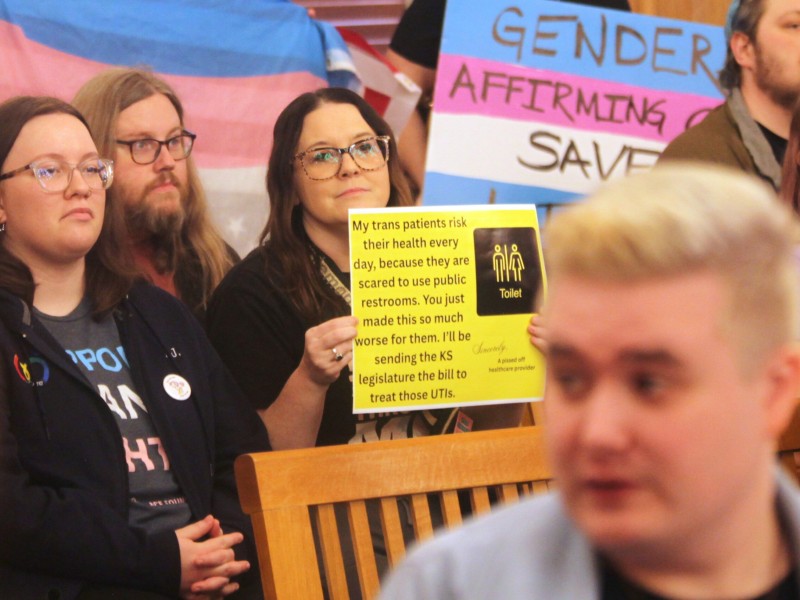
Last month, the Republican-controlled Kansas state legislature pushed through a new anti-transgender law that is expected to threaten the voting rights of the state’s trans population.
One of the provisions in the new law, known as House Substitute for Senate Bill 244, requires birth certificates and driver’s licenses to reflect a person’s sex when they were born, regardless of the gender they currently identify as. While this alone will increase the risk of harassment and discrimination to Kansas’ LGBTQ+ population, policy expert Logan Casey argues that this law will also hinder the ability for transgender individuals to vote in Kansas.
Casey, who is the director of policy research at the Movement Advanced Project, made the case in an opinion piece published by the Kansas Reflector last week. SB 244 will invalidate the IDs of many transgender people, and the law offers no information or timeline on when they will be invalidated or if the state will provide them a new one. A recent AP News report from 8 News Now suggests that the state has already begun notifying transgender citizens that their driver’s licenses are no longer valid and they would be illegally driving without a license.
Since Kansas already has strict laws requiring photo identification to vote, Casey thinks many transgender individuals will be disenfranchised during this year’s elections. (Kansas’ primaries are scheduled for Aug. 4, with the general election on Nov. 3.)
“These two policies together mean that many transgender Kansans may have their IDs invalidated this year yet still be required to produce a valid ID to be allowed to vote,” Casey said in his opinion piece. “This combination means that at least some of an estimated 22,000 adult transgender Kansans will face serious obstacles to voting this fall and beyond.”
SB 244 also forces anyone using a bathroom in a government building to use the facility that matches their biological sex at birth. Any individual who violates this provision will receive a written notice after the first offense, a $1,000 fine after the second offense and be guilty of a misdemeanor after the third offense.
Opposition to the bill
Melissa Stiehler, advocacy director for Loud Light Civic Action, spoke against the original version of the bill during a committee hearing in January, saying it will exacerbate the already increased rate of violence against transgender individuals.
“This has become so much of an issue that, because state legislatures such as this one are passing laws based on propaganda, based on misinformation, based on Twitter conspiracy theories – this national trend of legislating based on this is alarming enough that globally renowned scholars have issued a warning this week that the United States is in early stages of genocide against trans Americans,” Stiehler said.
SB 244 took effect on Feb. 27, the same day two transgender men filed a lawsuit seeking to block its enforcement.
Kansas Republicans forced the new law
Even though the original version of the bill received more than 300 written comments and testimony from opponents, Republicans later passed it through a Senate committee without a public hearing.
In the hearing for the original bill, proponents included Wichita physician Michelle Baalmann, who argued gender identification matters for medical responders.
“There are differences in medical emergencies and differential diagnosis of pathologies. Gender does matter,” Baalmann said. “It is like a vital sign when treating a patient, especially in a life-threatening emergency. If we were to remove this from the driver’s license and change it to a subjective choice that the person is making, you’re essentially blinding emergency responders and emergency physicians.”
Bob Stuart, the executive officer for the Kansas Bureau of Investigation, told the committee that the bill will make it easier for law enforcement officers to do their jobs.
“Not having the right sex on a driver’s license is one of those things that makes it more difficult for law enforcement to do their job correctly and to do it safely, not only for law enforcement, but for the subjects that we’re trying to either arrest or clear and let go on their way,” Stuart said.
Gov. Laura Kelly (D) vetoed the bill on Feb. 16, but the Republicans in the state legislature overrode Kelly’s veto to pass SB 244 into law. Kansas lawmakers can override a Governor veto with a two-thirds vote in both chambers, and Republicans currently hold veto-proof supermajorities in the State House (88-37) and Senate (31-9).
Heartland Signal encourages news organizations and content creators to use our content. You're welcome to republish this article for free as long as you follow our republishing guidelines.
Related Articles

Minnesota Senate District 54: Bakeberg, Olson on fraud, taxes and ICE
Republicans handily won this race four years ago. But the current seat holder is retiring and now it’s seen as a tossup.
Zach Nunn sticks to phone sessions as Trone Garriott holds open town halls
Iowa Rep. Zach Nunn swatted at a reporter’s phone when asked about rural hospital closures — after calling warnings about the issue a “myth” last year. Meanwhile, his Democratic opponent Sarah Trone Garriott is holding open town halls across all 21 counties, while Nunn opts for telephone sessions.

With Coleman absent, Kessler presses affordability and health card at Minnesota forum
Minnesota Senate District 48 DFL candidate Dan Kessler says health care is the one cost Minnesota can actually bring down. He made his case at a forum his opponent, Sen. Julia Coleman, didn’t attend.