
Kansas has invalidated some transgender Kansans’ driver’s licenses — but not all
The Kansas Department of Revenue — the state agency that oversees driver’s licenses — sent out letters invalidating some, but not all, transgender Kansans’ licenses following the passage of Senate Bill 244.
This post has been republished from the Kansas Reflector under Creative Commons license CC BY-NC-ND 4.0.
LAWRENCE — After Jamie Miller underwent irreversible gender-affirming surgery and obtained a court order in 2014 recognizing her female gender, her driver’s license was invalidated under a new Kansas law.
But not all transgender Kansans’ driver’s licenses have been invalidated.
The Kansas Department of Revenue — the state agency that oversees driver’s licenses — sent out letters invalidating some, but not all, transgender Kansans’ licenses following the passage of Senate Bill 244.
Multiple transgender residents told Kansas Reflector the notion of being “caught” — the question of if, or when, their letter is coming — hangs over them.
But for Miller, a transgender woman from Lawrence, the letter arrived in April. She filed a lawsuit against the state, arguing that invalidating her license goes against her constitutional rights — privacy, compelled speech, due process — and that changing her license to “male” would be fraud.
Miller is the primary caregiver for her disabled daughter. Miller’s attorney, David Brown, said her invalidated license affects Miller’s daughter, too, by limiting Miller’s ability to parent.
“The child needs medication. The child needs doctor’s visits. The child needs transportation,” Brown said. “(The daughter) does not drive, so many of her life activities require my client to transport her. Her ability to parent her child is limited in unfortunate ways.”
Since her license was invalidated, Brown said Miller has been using an electric bike to get around.
Colin McAdam, a transgender man from Augusta, uses his car — but with a license that shows “female.” He changed his gender marker shortly after receiving the letter.
“I was the only person that I knew that received that letter, so I kind of felt singled out, even though I know that wasn’t the case,” McAdam said.
Rep. Abi Boatman, a Wichita Democrat, opposed the new law while it moved through the chambers.
“There seems to be a disconnect between the law that was passed and the way it’s being enforced,” Boatman said. “I think part of it may be that it was just so quick and so ill-informed and unplanned that they have run into more difficulties than they expected invalidating people’s licenses.
“My other theory is that it was a really unpopular bill to begin with, and part of me does wonder how much giddyup and go there is at the Department of Revenue to cancel everybody’s licenses.”
The first wave of about 300 letters from KDOR went out in February, and a spokesperson told KCUR there were more on the way. Miller received hers in April.
Jessie Lawson, a transgender woman from Wichita, got her letter in February. But then her renewed concealed carry license was approved using her invalidated license, which Lawson said was “ridiculous.”
Because of the lawsuits KDOR is facing over the new law, KDOR’s general counsel — who handles the implementation of the law — declined to comment.
Miller’s lawsuit is part of a storied history between legislation and litigation regarding how transgender people are identified in government documents.
In 2023, the state passed a law that defined women by reproductive ability, prompting Attorney General Kris Kobach to sue KDOR for allowing transgender Kansans to change their gender markers. A district judge temporarily blocked the changes, but the court of appeals overturned the block.
After the Kansas Supreme Court declined to hear Kobach’s appeal, GOP leaders set forth on their goal to create a new law barring transgender people from changing their gender markers. That goal was actualized with SB 244, which passed in February.
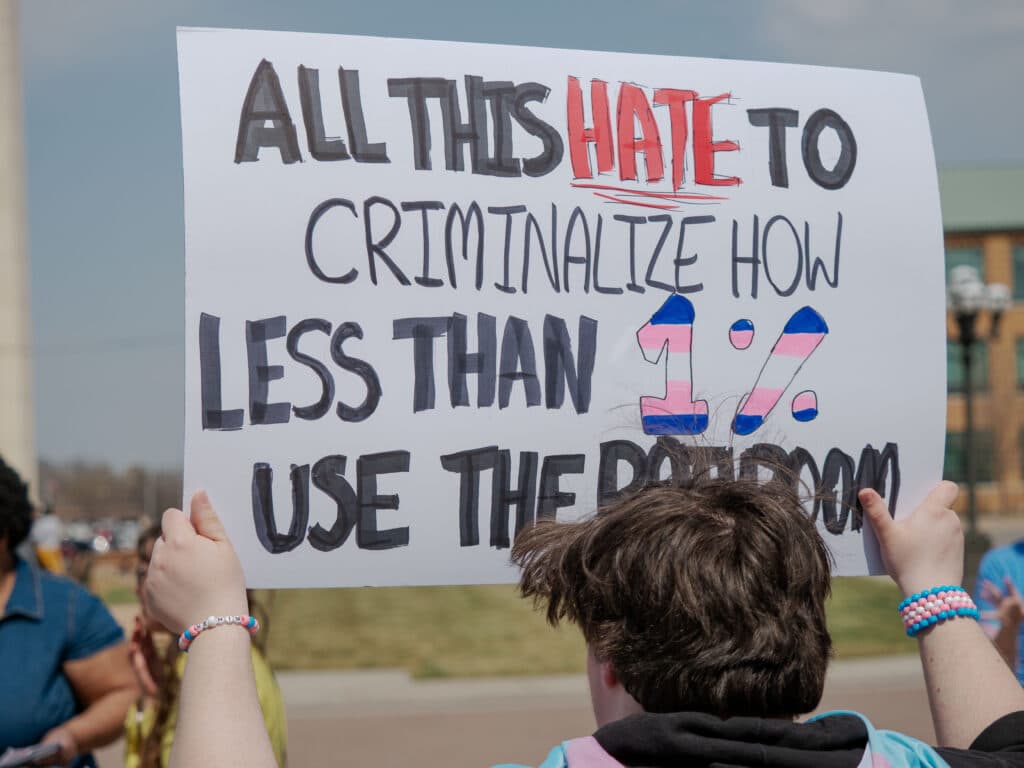
With the ACLU, two Lawrence transgender men filed a lawsuit challenging both provisions of the new law, including the requirement for transgender people to use the bathroom of their sex assigned at birth in government buildings. Miller’s lawsuit only focuses on the part that invalidated driver’s licenses.
The attorney general’s office moved to consolidate the two cases. A spokeswoman did not comment on Miller’s lawsuit or the inconsistent letters.
Brown said Miller’s facts — including her court order recognizing her gender — are different from the Lawrence men’s.
“When people who are trans are forced to produce a driver’s license that indicates a gender that is not the gender they present as, it puts them in all sorts of awkward positions,” Brown said.
May Earle, a transgender woman from Wichita, never changed her gender marker.
“I will never forget an encounter with a police officer years ago, who though initially very friendly, quickly changed his attitude after seeing my ID,” Earle said. “He proceeded to call me ‘sir,’ and was generally disrespectful.”
Heartland Signal encourages news organizations and content creators to use our content. You're welcome to republish this article for free as long as you follow our republishing guidelines.
Related Articles
Illinois legislature wraps 2026 with $55.9 billion budget, new corporate taxes and rideshare union rights
The Illinois state legislature sent a record-setting $55.9 billion budget to Gov. J.B. Pritzker at the conclusion of the 2026 legislative session.

‘We are standing with you’: Lansing raises Pride flag over City Hall to recognize LGBTQ+ community
Lansing Mayor Andy Schor was joined by elected officials to raise an LGBTQ+ Pride flag over Lansing City Hall on Monday afternoon, marking the first day of Pride Month in 2026.

More than 10,000 Kansas children lose food assistance in wake of One Big Beautiful Bill Act
The advocacy organization Kansas Appleseed sounded an alarm about a report indicating 10,300 children in low-income families across the state stopped receiving food aid since President Donald Trump signed sweeping federal legislation nearly one year ago.