
Kansas attorney general asks three cities to undo conversion therapy bans
The Kansas attorney general demanded three cities repeal their bans on conversion therapy for minors following a U.S. Supreme Court decision that found such bans violate the First Amendment.
This post has been republished from the Kansas Reflector under Creative Commons license CC BY-NC-ND 4.0.
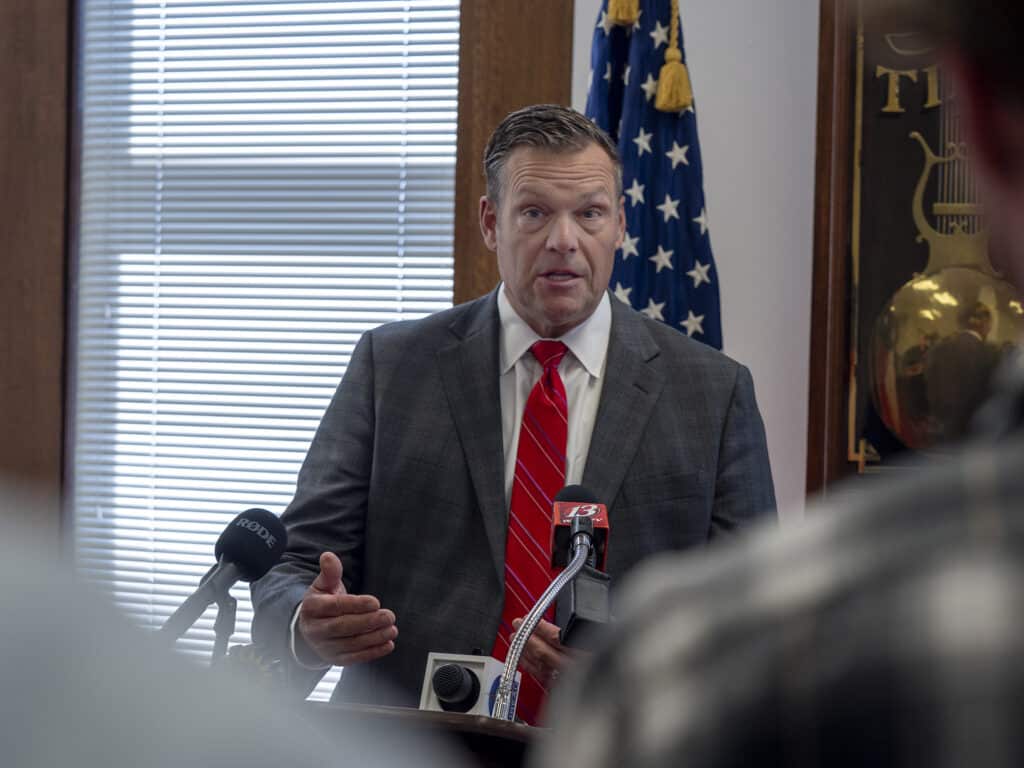
TOPEKA — The Kansas attorney general demanded three cities repeal their bans on conversion therapy for minors following a U.S. Supreme Court decision that found such bans violate the First Amendment.
Attorney General Kris Kobach sent letters Thursday to city officials in Lawrence, Prairie Village and Roeland Park, requesting they respond within 60 days to indicate whether they nullified their bans on conversion therapy.
The collection of practices known as conversion therapy were designed to attempt to change a person’s sexual orientation or gender identity. It is banned in 27 states and more than a dozen other countries, and it has been discredited by major American medical and psychological associations.
An estimated 698,000 LGBTQ+ adults have received conversion therapy in the United States, and more than half of them received it as a minor, according to the Williams Institute at the University of California Los Angeles School of Law.
The U.S. Supreme Court ruled in Chiles v. Salazar in March that a conversion therapy ban in Colorado violated therapists’ constitutionally protected free speech.
“The First Amendment applies to everyone — therapists, patients and everyone else,” Kobach said last week. “A city violates the Constitution when it attempts to forbid a therapist from providing the counseling that the therapist believes is in the best interest of the patient.”
The Lawrence City Commission and the Prairie Village City Council passed bans in 2021. Roeland Park was the first city in Kansas to pass a ban in 2020. Legislation to codify a conversion therapy ban statewide has repeatedly failed to progress in the Kansas Legislature. The latest attempt came in 2025 from Democratic Rep. Susan Ruiz, an openly gay legislator from Shawnee, but the bill never received a hearing.
Keith Moody, city administrator for Roeland Park, told Kansas Reflector its city council passed the attorney general’s letter to the city attorney, who is completing a legal review. It will be shared with elected officials once it is finished, he said.
Cori Wallace, a spokesperson for the city of Lawrence, declined to answer questions about whether the city will repeal the ban.
“We are in receipt of the letter from the Attorney General’s Office and have noted the 60-day timeline,” she said in an emailed statement.
A spokesperson for the city of Prairie Village did not return Kansas Reflector’s request for comment.
The U.S. Supreme Court held that the Colorado law violated the First Amendment, the conversion therapy practices at the heart of the case were protected speech, and the state law censored therapists’ speech based on viewpoint.
“Lawrence’s ordinance seeks to control speech in a nearly identical way,” Kobach wrote in a letter to Lawrence Mayor Brad Finkeldei.
Lawrence’s law bans “any practice, counseling or purported treatment that seeks to change an individual’s sexual orientation or gender identity, including efforts to change behaviors or gender expressions or to eliminate or reduce sexual or romantic attractions or feelings toward individuals of the same gender.” It also bars professionals from advertising or using the terms “conversion therapy, ex-gay therapy, sexual orientation and gender identity change efforts, or any substantially similar wording.”
“The government may not declare that some words and ideas are forbidden,” Kobach wrote. “And now the Supreme Court of the United States has squarely ruled on the subject.”
Kobach called both pieces of the law “equally disturbing.”
Violations of Lawrence’s law are punishable by a maximum $500 fine, and penalties in Prairie Village can include an up to $1,000 fine.
Heartland Signal encourages news organizations and content creators to use our content. You're welcome to republish this article for free as long as you follow our republishing guidelines.
Related Articles
Michigan state Rep. Jamie Thompson touts endorsement from anti-vaccine mandate group
Thompson is a nurse, but she is touting an endorsement from Stand for Health Freedom — an advocacy group lobbying to roll back public school vaccine requirements.
Michigan utility donation ban clears corporate-funded signature challenge
Board of State Canvassers meets July 24 to decide whether the measure, which would bar utilities from donating to state candidates, reaches November’s ballot.
‘Stabbed in the back’: Unions, House Democrats call Whitmer’s veto of 9 bills a betrayal
Allies question Whitmer’s reasoning in vetoing long-sought worker protections and retirement reforms, saying technical issues could have been addressed later