
Hinson asks Iowans for ‘gas money’ as fuel costs climb amid Iran war
Ashley Hinson asked Iowans for gas money for her $92,000 bus tour. Iowa diesel is up 81% in a year, and farmers are paying for it in the middle of harvest.
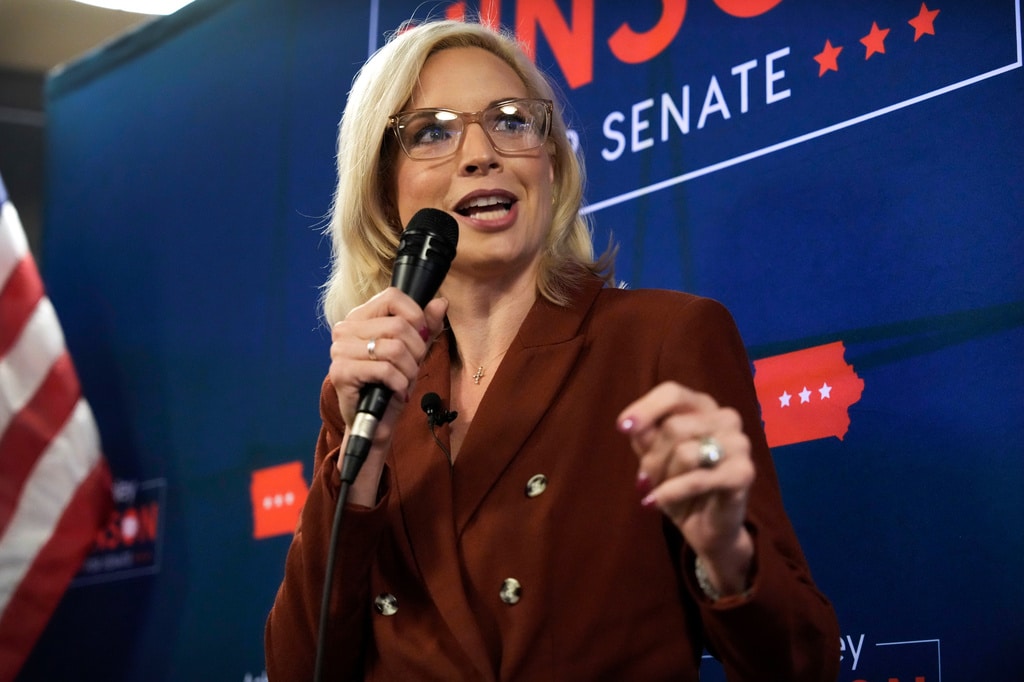
Republican U.S. Senate candidate Ashley Hinson is asking Iowans to chip in “a little gas money” for her statewide campaign bus tour as fuel prices climb, household budgets tighten and the Iran War adds pressure to energy costs across the state.
Hinson made the request during a bus tour stop in Fort Dodge earlier this month, asking for donors to “help give us a little gas money for our bus.”
Federal Election Commission campaign finance records show her campaign spent a combined $92,000 on bus charter and logistics expenses: $87,000 for charter services and $5,000 for logistics.
The charter company, Premiere Transportation, advertises luxury coach rentals featuring “modern comfort” and “VIP executive coaches.”
Hinson’s “Fighting for Iowa” tour began Oct. 14, with stops announced in Mason City, Fort Dodge, Sioux City, Council Bluffs, Ankeny, Davenport and Marion. Later events included Mount Ayr and Glenwood, with Jefferson scheduled for Oct. 24 and Manchester for Oct. 25. The campaign says the tour promotes affordability and rallies Republicans ahead of Election Day.
The “gas money” request comes as Hinson faces criticism over her votes against congressional efforts to end U.S. military involvement in the conflict. The Iran War has contributed to higher energy prices by disrupting oil shipments through the Strait of Hormuz, a critical global shipping route. Reuters reported that renewed U.S.-Iran fighting and attacks on tankers intensified concerns about energy supply disruptions. Hinson voted seven times seven times against war powers resolutions, six of them on Iran.
The appeal is particularly pointed in a state where rising fuel costs affect not only household budgets but also one of Iowa’s most important industries. As of Oct. 23, Iowa’s average price for regular gasoline was $4.18 per gallon, up about 46% from $2.86 a year earlier, according to AAA. Diesel averaged $6.17 per gallon, compared with $3.41 a year earlier, an increase of about 81%.
For Iowa farmers, the consequences reach beyond filling a vehicle. Diesel powers tractors, combines and trucks used to plant, harvest and transport crops. Fertilizer costs have also risen amid disruptions to global energy and fertilizer supplies.
Dan Pedersen, a Republican, runs a 10,000-acre farm in Underwood, Iowa, where he grows corn and soybeans. He also sells about 20,000 cattle a year. His operation employs eight full-time workers and four part-time employees. During harvest, his farm burns through about 800 gallons of diesel a day.
A year ago, when diesel cost a little more than $3 a gallon, that fuel bill ran about $2,400 a day. Now, at $6 a gallon, it has doubled to $4,800.
“That’s $2,400 more per day times 30 days is $75,000 more,” Pedersen said. “That’s a lot of money.”
And he is paying those costs at the busiest time of the year, when his combines run from 7 a.m. until 9 p.m. and crops must be hauled from the fields. The additional roughly $72,000 a month does not include the cost of trucking his cattle and other goods, he said.
“You can’t do nothing,” Pedersen said. “We can’t change nothing.”
The financial strain is beginning to change what he expects to be able to afford. Pedersen typically trades in one of his combines each year, rotating older equipment out of his operation. This year, he said, the additional fuel expenses and surcharges could prevent him from buying a new one at the end of the season.
Pedersen is accustomed to farming’s financial uncertainty, but rising costs are eating into what he expected to be a profitable year. He said his operation could absorb the added expenses for a month or two, but a prolonged war could make them harder to manage. He is also reluctant to rely on government relief, saying he would rather see prices return to normal.
“We thought we were going to have a great year, and it’s just taken so much of our money,” he said. Still, the prospect of diesel reaching $7 a gallon frightens him “to death,” he said.
An Iowa State University agricultural economics study found oil and fertilizer prices rose nearly 50% in the weeks after the war began Feb. 28. Its economic model projected that U.S. corn growers could face roughly $4 billion in additional costs and a $6 billion decline in profits. Iowa could absorb an estimated 15% to 20% of the losses because of its share of the national corn market. Those figures are projections, not a tally of losses already realized.
The Iowa Corn Growers Association has also warned that diesel is a major input cost for farmers operating with tight margins. On Oct. 6, the organization welcomed temporary federal and state fuel-tax relief allowing expanded use of untaxed off-road diesel for agricultural and trucking equipment during harvest.
Agriculture and related industries account for an estimated 23.4% of Iowa’s gross domestic product, or about $63 billion, according to Iowa State University’s Center for Agricultural and Rural Development. Higher costs for fuel, fertilizer and transporting crops can squeeze farm profits and ripple through food processing, transportation and other businesses.
Hinson has voted against six House resolutions seeking to end U.S. hostilities with Iran (March 5, 2026 (Roll Call 85), April 16, 2026 (Roll Call 114), May 14, 2026 (Roll Call 170), June 3, 2026 (Roll Call 199), July 23, 2026 (Roll Call 282) and September 15, 2026 (Roll Call 307) and against a separate resolution concerning U.S. military involvement in Lebanon. PolitiFact rated Hinson’s opponent’s, lowa state Rep. Josh Turek (D), claim that Hinson supported the war seven times “mostly accurate,” noting one vote concerned Lebanon, not Iran. Hinson said she wanted an “immediate and successful end” to the conflict but opposed limiting Trump’s military authority, PolitiFact reported.
Polling suggests a competitive race. A Marist poll conducted Oct. 8-11 found Turek leading Hinson 48% to 45% among likely voters. A separate co/efficient poll conducted Oct. 15-19 showed Hinson ahead by the same margin, 48% to 45%.
Hinson’s campaign has framed the tour as a way to promote lower costs. But asking Iowans to help pay for a $92,000 campaign transportation effort, while farmers face sharply higher diesel and fertilizer costs linked in part to a war she has declined to help end, raises a question about who is being asked to bear the costs and who is accountable for them.
Hinson’s campaign did not respond to Heartland Signal’s request for comment.
Heartland Signal encourages news organizations and content creators to use our content. You're welcome to republish this article for free as long as you follow our republishing guidelines.
Related Articles
MI-04 incumbent Huizenga continues to skip in-person town halls, both as candidate and congressman
U.S. Rep. Bill Huizenga (R-MI) hasn’t faced his constituents in an in-person town hall in over a year. Facing a tight reelection fight in Michigan’s 4th Congressional District, Huizenga has restricted live access, added a Ring camera to his district office door and moved public Q&As entirely to screened phone calls.
Iowa’s 1st District: Where Christina Bohannan stands on gun policy
Iowa Democrat Christina Bohannan shoots at the range and backs gun rights. So why has gun safety group Everytown spent nearly $1.5 million boosting her campaign? A look at her voting record and where she stands on assault-style weapons.
Minnesota Senate District 3: Hauschild, Zupancich on fraud and tariffs
Northern Minnesota provides 80% of the iron ore used in automotive steel, leaving the Iron Range directly exposed to Canada’s retaliatory tariffs. In a tight rematch for Minnesota Senate District 3, Grant Hauschild and Andrea Zupancich clashed over state fraud, data centers and the cross-border trade war.