
For civil rights veteran Robert L. Green, the election is only the beginning
Drawing on his activism with Martin Luther King Jr., at 93, civil rights veteran Dr. Robert L. Green reflects on Democrats’ historic 2025 election wins, including Mississippi’s first Black senator since Reconstruction.
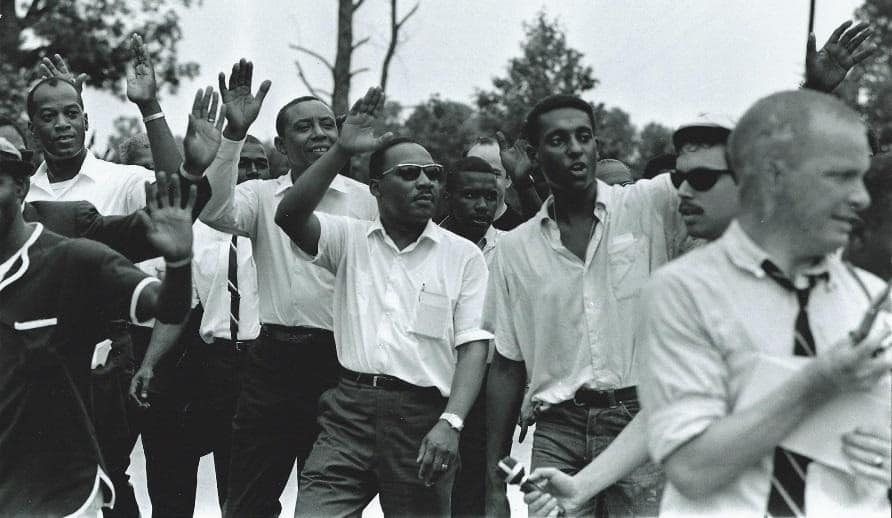
Civil rights veteran Dr. Robert L. Green has spent much of his life watching doors open. He has spent even more time making sure they do not close behind him.
In Mississippi, he marched with the Rev. Dr. Martin Luther King Jr. through towns where Black residents were threatened for trying to register to vote. In Michigan, he challenged real estate agents who refused to sell him a home in a white neighborhood. At Michigan State University, where he taught, he worked to keep students from turning their grief and anger after King’s assassination into violence. And throughout it all, he returned to a conviction his father had instilled in him: Education could change the course of a life.
Now, at 93, Green is watching another moment of political possibility unfold across states where he lived and marched. Democrats’ sweeping victories in November brought historic representation to places where Black people had long been shut out of political power. In Mississippi, Scott Colom’s election to the U.S. Senate made him the state’s first Black senator since Reconstruction. For Green, who remembers a Mississippi where Black residents could not walk freely on certain sides of the street, the result is extraordinary.
But extraordinary is not the same as enough.
“Sometimes this country confuses representation with progress,” Green said. “A little progress is all right. I’m not against it. You push for it.”
The question, he said, is what happens after the celebration. “Today’s progress is not necessarily tomorrow’s opportunity.”
That distinction is the unfinished business of the civil rights movement, and the measure by which Green believes this political moment should be judged.
Lessons in creating change
Green’s understanding of that work began long before he stood beside King. Born and raised in Detroit, he grew up in a family where education was understood as something that had been taken from his father, and something his children would not be denied.
His father grew up in Georgia and wanted to continue his schooling. Instead, Green recalled, his grandfather sent him to work in the fields. He had only made it to about the fourth grade. After serving in the Army, his father returned home and could not find a job. He spoke to his children about the racism he had experienced in the South, including the threats Black people faced when they tried to educate themselves.
Green and his siblings all went to college. He earned degrees in psychology and educational psychology, eventually completing his doctorate at Michigan State University.
The education Green received became part of the work he carried into the South. In 1965, he took a leave from Michigan State to become national education director for the Southern Christian Leadership Conference (SCLC). He worked closely with King, organizing voter education and literacy efforts as the movement confronted segregation and the systematic denial of Black political rights. He traveled with King, Andrew Young and other movement leaders, including during James Meredith’s 1966 “March Against Fear” across Mississippi.
Green recalled Black residents warning him about a sheriff in Mississippi who had killed Black men. When Green confronted the sheriff, he told him he knew his history and was not afraid. On another occasion, he recalled leading thousands of marchers past a storefront as demonstrators threw bricks. He used the threat of broken windows to keep the sheriff from striking him, knowing that a confrontation could quickly turn deadly.
He was learning what his father had tried to explain from Georgia, that racism was more than a collection of individual cruelties. It is a system upheld by people and institutions with the power to decide who could move freely, earn a living, own property or exercise a right.
Prioritizing Black students
Green wants Michigan’s elected leaders to make quality elementary education a priority, invest in teachers and support parents. The numbers show why he remains concerned. In 2024, only 25% of Michigan fourth-graders scored at or above the National Assessment of Educational Progress’ (NAEP) “Proficient” level in reading, compared with 32% in Mississippi and 31% nationally. In Michigan, just 8% of Black fourth-graders reached that benchmark, compared with 30% of white students. Mississippi, which has made notable gains in reading over the past two decades, still had a 19% proficiency rate among Black fourth-graders, compared with 45% among white students. NAEP’s Proficient benchmark is not the same as a state’s grade-level standard, but the disparities underscore the work ahead.
“Reading is the gateway to opening up the world,” he said. “Things that I began to think about and wonder about came from books.”
W.E.B. Du Bois made a similar argument, viewing education as a tool for oppressed people to challenge those who hold power, arguing that recognition alone would not deliver equality.
Green also knows how important fair access to housing is for families. Green and his wife, Lettie, repeatedly found houses in East Lansing they wanted to purchase, only to be denied when they tried to make an offer. In 1964, real estate agents blocked him from buying a home, suggesting he would be happier in Lansing among his own kind. One particular realtor, whom Green identified as Walter Neller, illustrated the hostility he faced. Green recalled, “He came to my house one evening about 8 o’clock. Didn’t knock on the door. Just opened the door and walked in. He said, ‘I want to see who you are.’” Green also said that the realtor called him “pup,” a term he understood as a racial epithet.
The Michigan Civil Rights Commission ordered a local company to sell to him, but Green refused a private arrangement that would have let the discriminatory realtor avoid accountability. His case galvanized local organizing for fair housing, and his children were among the first Black students to integrate Pinecrest Elementary School, later renamed in his honor. The East Lansing City Council passed its fair housing ordinance four days after King’s assassination in April 1968.
Demanding action after the midterms
Carrington Scott, a political activist and labor organizer, sees a similar danger in the celebration surrounding the Democratic victories. “Representation can matter,” he said, “particularly when people are fighting for survival and the alternatives threaten to make their lives worse. But a blue wave is not, by itself, a redistribution of power.” It can crest, recede and leave the same people exposed.
Scott said Democrats have too often romanticized the struggle without addressing the conditions that shape life. He argued that party leaders know what those conditions are, but allow commissions, studies and incremental reforms to stand in for action. By the time a proposal is studied and watered down, he said, the political energy that could have forced change has dissipated.
His test is material. He wants to see Black women’s unemployment fall, people convicted of nonviolent offenses released and given opportunities to vote and find work, and communities affected by mass incarceration receive more than symbolic gestures. He also argues that Democrats should be fighting much harder to expand unions, which give workers collective power over wages and working conditions. A 2025 analysis by the Center for Economic and Policy Research found that Black workers with union representation earn an average hourly wage premium of 13.2% over comparable nonunion workers.
Green is not dismissive of the election. He believes the country is becoming more equitable because people are no longer willing to accept what previous generations endured. He wants young people to demand quality education, jobs and accountability, and to hold elected officials to their promises. He wants politicians to understand that the people who helped elect them are not there simply to provide a historic photograph or a moment of celebration.
“When we push young Blacks or whites we need to make sure we hold them accountable in some kind of way. Accountable in terms of jobs. Accountable in terms of education. Keep them accountable to making sure opportunities are made available for others.”
Heartland Signal encourages news organizations and content creators to use our content. You're welcome to republish this article for free as long as you follow our republishing guidelines.
Related Articles

Comer announces candidacy for Kentucky governor in 2027
Republican U.S. Rep. James Comer has made his long-rumored campaign for Kentucky governor official.

DesJarlais concedes Tennessee 4th Congressional District to Democrat Victoria Broderick
Almost two weeks after polls closed in the Nov. 3 midterm elections, Democrat Victoria Broderick has won Tennessee’s 4th Congressional District.

Gov.-elect Cindy Holscher pledges to advocate for all Kansans: ‘I will work for you’
Counting and recounting of votes didn’t alter the outcome of the Kansas gubernatorial race, enabling Gov.-elect Cindy Holscher to personally offer thanks at the close of a campaign entwined with economic forces aggravating the cost of living.