
What happened in… Wisconsin? Democrats take full control
For the first time since 2010, Democrats will control the governorship and state legislature in Wisconsin. We look into how they did it and what it means for the Badger State and beyond.
As Heartland Signal’s senior political analyst, I am going in depth on the shifts that happened in every state across the country in the 2026 elections. Today, we’re looking at Wisconsin, where Democrats kept control of the governor’s office and flipped the state legislature. Notably, Wisconsin’s results haven’t been certified, but the state counts votes quickly, and any recounts are not expected to change topline results.
Democrats sweep statewide races
Democratic Gov.-elect David Crowley won statewide by eight percentage points over Republican nominee Tom Tiffany to become the state’s first Black governor. While that margin was only a five-point swing in Democrats’ favor since 2022, it was the biggest win in a Wisconsin gubernatorial election this century.
It was also unexpected because Crowley had actually dropped out of the race, only to reenter weeks before the August primary, after his main rival had to quit because of a campaign finance scandal. In spite of his shambolic campaign, he narrowly beat democratic socialist state Assemblywoman Francesca Hong (D-Madison) in the primary. Then, he defeated Tiffany this month despite being outspent by Republicans by nearly $70 million. It’s easy to imagine Crowley winning in a blowout if spending had been closer to parity.
Wisconsin also elects its attorney general, secretary of state and treasurer. And Democrats not only swept all of the offices, but all three of their nominees for those positions were of Asian or Latino descent, giving Wisconsin one of the most diverse groups of statewide elected officials in the country.
Fair maps mean the legislature flips
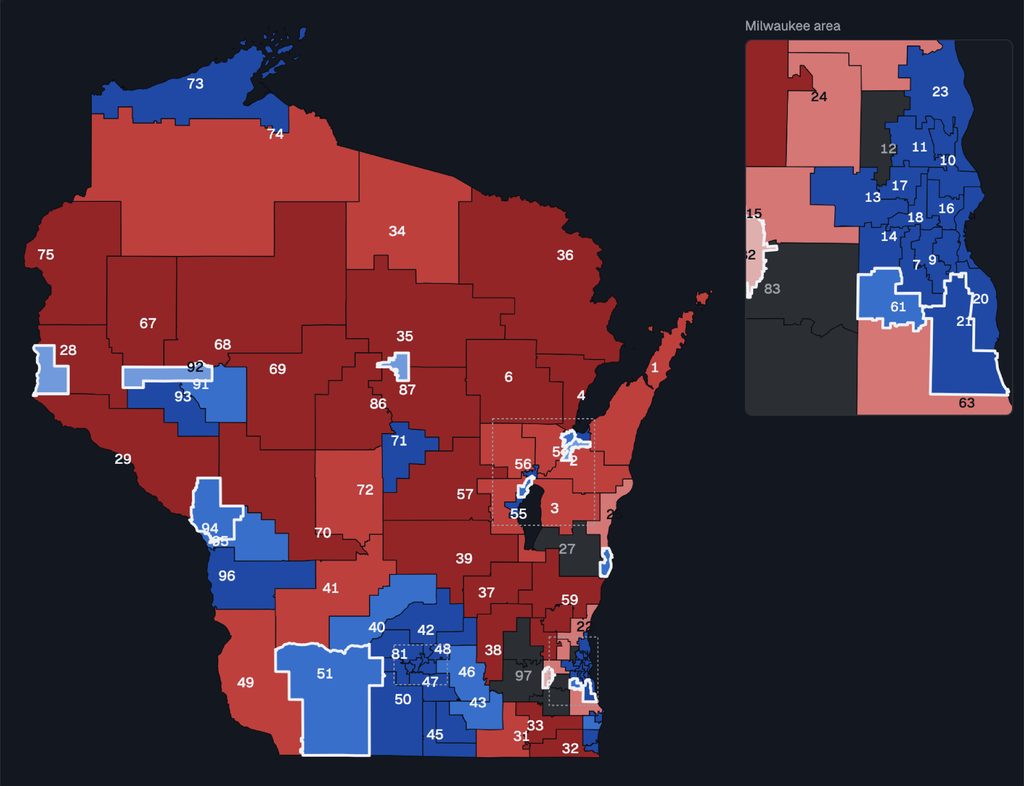
In 2023, Wisconsin was forced to draw new state legislative maps after the state Supreme Court ruled the then-existing lines violated state law. With fair districts in place, Democrats gained 10 seats in the Assembly and four in the Senate in 2024, even though Donald Trump carried the state in the presidential election. And this year, they won majorities in both chambers, flipping eight more seats in the Assembly and three in the Senate. And they flipped districts almost everywhere — the Milwaukee area, the Fox River Valley, Wausau, the Twin Cities suburbs, outside Madison and the Chippewa Valley.
So what gives?
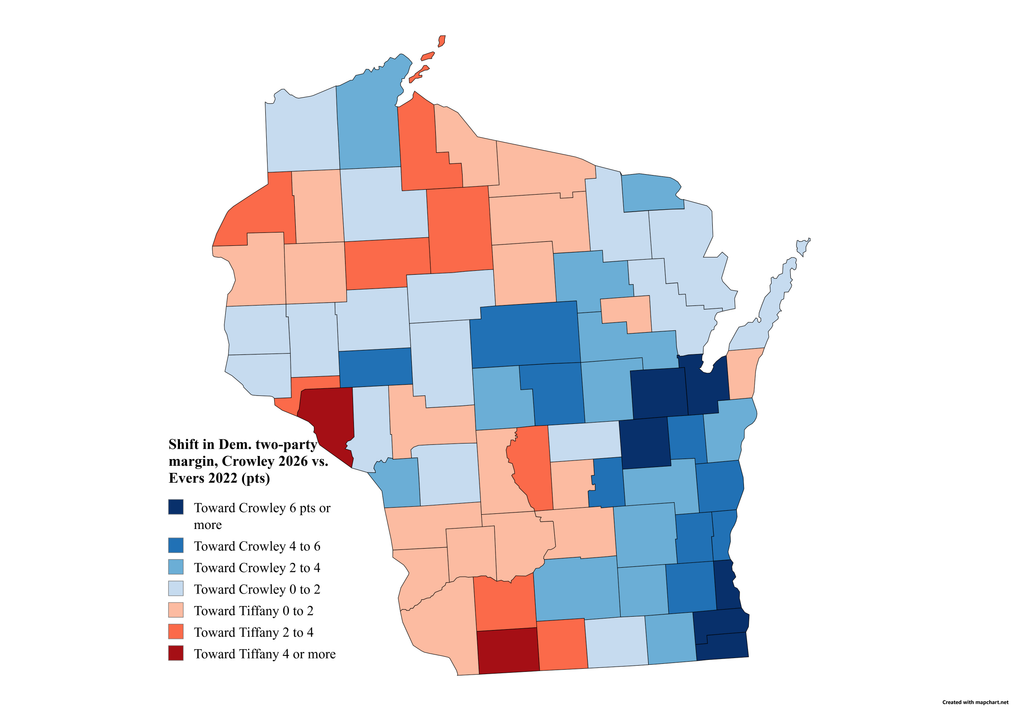
Tom Tiffany represented rural Wisconsin in the state legislature and Congress for 16 years before running for governor. In his campaign, he improved on Republican margins in 28 counties that cast more than 325,000 votes between them. But those 28 counties still combined to cast fewer votes than Milwaukee County alone, where Crowley ran up record margins.
And it wasn’t just Milwaukee; Crowley won by picking up votes in the largest counties. The six counties shown above where he improved by more than 6% contain almost a third of all the voters in the state.
For example, in the northeast portion of the state, he improved most in the BOW counties (Brown, Outagamie and Winnebago), a Republican-leaning mid-sized urban area best known as the home of the Green Bay Packers. Even though Trump carried them by 8%, Crowley ended up winning by 2%. To put that in perspective, if Kamala Harris had won the BOW counties by 2% in 2024, then she would have narrowly carried the state even if no other votes had changed.
Democrats see an opening in that there are a lot of mid-sized urban areas across the Midwest where they can eat into Republican margins. The BOW counties are not much different from Scranton-Wilkes-Barre in Pennsylvania or the Tri-Cities in Michigan. These places swung hard to Trump in 2016, but if Democrats are competitive in them again, they can make up for further erosion among rural voters.
And while Crowley didn’t win the conservative suburban WOW counties (Waukesha, Ozaukee and Washington) around Milwaukee, he nevertheless improved significantly over outgoing Gov. Tony Evers’ performance in them. (Evers did not seek a third term.) When Trump carried Wisconsin in 2024, he got a 90,000-vote margin out of those three counties; he only won the state by around 30,000 votes. Eating into Republican margins there could help offset potential losses in rural portions of the state as well. And Democrats can look there if they also want to flip more seats in the legislature; some of Republicans’ slimmest wins came in those three counties.
What a trifecta means
As in other states, Democrats in Wisconsin ran on making the cost of living go down, and that’s likely where they’ll start out. Free school lunches, prescription drugs and paid family leave all seem like they’ll be on the agenda in January to help get Wisconsinites more money in their pockets.
But after eight brutal Scott Walker years that gutted state government and another eight years of Evers having to work with a hostile legislature, there are plenty of other issues for Democrats to tackle. It’s one of just ten states that hasn’t taken advantage of the Affordable Care Act (ACA) Medicaid expansion. They might try to roll back Walker’s controversial Act 10 at some point, though the courts may address that before they do. And legislative leaders have indicated an openness to drawing a fairer congressional map.
Schadenfreude, Wisconsin edition
Tiffany was an election denier, and we should all be grateful to the voters of Wisconsin for ending his political career. But perhaps the sweetest victory came against Assembly candidate Dylan Pfaffenbach, who founded Carroll University’s Turning Point USA chapter and an antivaxxer who considered investigating Jan. 6 a betrayal. He lost by 25 points in a seat Republicans carried just two years earlier.
How we used AI: Aaron Kleinman used Claude to take a spreadsheet of county-level results and turn it into a text file that MapChart could use to generate a map.
Heartland Signal encourages news organizations and content creators to use our content. You're welcome to republish this article for free as long as you follow our republishing guidelines.
Related Articles
Radio Free America: Project REDMAP is dead
The 2026 elections resulted in a wipeout for Republicans at the state level, and with it their power over redistricting. Aaron Kleinman argues that this is proof that it’s time for them to come together with Democrats and pass a national gerrymandering ban.
What happened in… Minnesota? DFL sweeps but trails the national swing
The DFL won Minnesota’s governorship and both legislative chambers on Nov. 3, but the state swung less than the nation. Here’s where it gained and lagged, and why.

Radio Free America: Voters rebelled against impunity
Was the mandate from the midterm to lower costs? Yes, kinda. But a wave that large is about something bigger, writes Aaron Kleinman. It’s about the American people seeing how destroying the constitutional order leads to chaos in their own lives. Democrats really have a mandate to crack down on right-wing impunity.