
How did trans rights fare in the blue tsunami?
Anti-transgender rhetoric found some success on Nov. 3, but advocates are hopeful that they can win the messaging battle and protect trans rights.
Organizers with PROMO, Missouri’s statewide LGBTQ+ nonprofit, believed they could beat Amendment 3 in the midterm elections. But Shira Berkowitz, the senior public policy director at PROMO, never dreamed the margin of victory would be this high.
“We had some confidence in the last couple months that we really could win this, that it would be narrow, and I’m still blown away that we won by 11 points,” they said. “Like it’s shocking to think through.”
Missouri’s Amendment 3 would have amended the state constitution to ban abortion except for medical emergencies and fetal anomalies, and for rape or incest only in the first 12 weeks of pregnancy. It also included a constitutional ban on gender-affirming care for minors that would replace the current law, which is set to expire in 2027. Missouri voters rejected Amendment 3 by 55.4% to 44.6% — almost four points higher than the 2024 constitutional amendment that made abortion legal in the state.
While anti-transgender rhetoric found some success on Nov. 3, advocates are hopeful that they can win the messaging battle. Republicans — especially President Donald Trump — have added transgender rights to their arsenal of culture war battering rams, and Democrats have struggled with how to respond to these attacks.
Support decreased across the political spectrum
Data show support for transgender rights has declined since the last midterm election.
A 2025 survey by Pew Research Center shows this shift is happening across the political spectrum, not just within the Republican Party. Pew’s data found that support for non-discrimination laws that would protect trans people has dropped several points among Republicans, Democrats and Independents.
Issues affecting minors — sports bans in K-12 sports and gender-affirming care for patients under 18 — have become lightning rod issues. The Pew survey also found that 45% of Democrats (88% of Republicans) support requiring trans athletes to play with teams that match their sex assigned at birth. That’s up from 37% of Democrats in 2022.
About 35% of Democrats support restrictions on gender-affirming care for minors, up nine points from 2022.
Berkowitz attributed this shift to relentless — and mostly incorrect — messaging from the right that targets transgender people.
“A very small microcosm of the very far right created this issue and has globalized it in a way that seemingly like everyone has to talk about,” they said. “And their tactics have been wildly successful.”
Republicans spent millions on trans-specific ads
The GOP has spent big on messaging targeting trans rights in the last few national elections. It’s proven to be a huge challenge for advocates who don’t have those kinds of funds, said Shelby Chestnut, the executive director of the Transgender Law Center.
“[They] are spending millions of dollars to target communities that they know literally nothing about, but they think that they can scapegoat their voters into being against us and manipulating even Democrats to distance themselves,” they said.
For the 2024 presidential election, Republicans spent $151 million on ads just about transgender issues. The GOP spent even more for the 2026 midterms, according to analysis of campaign spending reports through Oct. 25 by the Associated Press.
Across a few competitive races, the GOP spent $183 million on over 217,000 ads claiming Democratic candidates supported allowing men to play women’s sports and performing gender-reassignment surgical procedures on minors.
Democrats responded with $11 million in ads — but they weren’t all supportive.
Several red state Democrats sided with Republicans
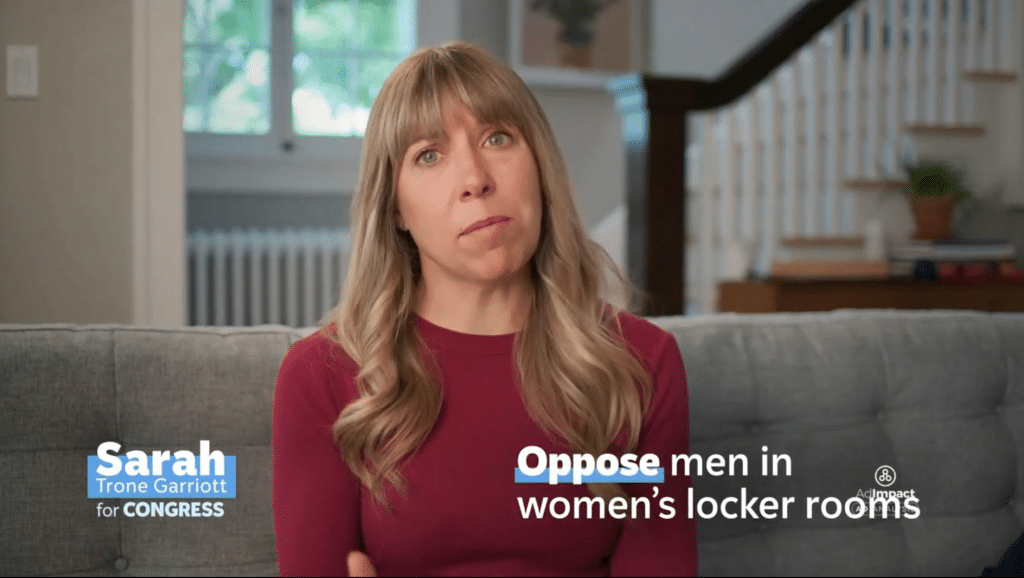
Several Democratic candidates facing tight races in traditionally red states sided with Republicans on the issue of trans athletes in sports.
That includes Ohio Gov.-elect Dr. Amy Acton, Iowa Gov.-elect Rob Sand, Sen.-elect Josh Turek, and incoming U.S. House Reps. Sarah Trone Garriott, Christina Bohanon, and Lindsay James. Ohio Rep. Marcie Kaptur responded to GOP attack ads by pointing to her voting record, which already reflected her commitment to keeping “transgender ideology” out of schools, one ad said.
Since the election, Turek has also doubled down on his belief that Medicaid shouldn’t cover gender-affirming care.
All of those candidates won their elections. Chestnut said they didn’t need to abandon trans people to win.
“I think they signaled to the electorate that it was acceptable to walk away from our communities,” they said. “And we just know that not to be true.”
Chestnut pointed to candidates like Michigan Sen.-elect Abdul El-Sayed, who defended trans rights when he appeared on “60 Minutes” despite running in a tight race with some of the highest spending in the election cycle.
Berkowitz said Democrats in Missouri didn’t “take the bait” from Republican attacks — a big change from previous elections.
“This was the first election that we’ve seen in Missouri where Democrats were really standing up to the claims [attacking transgender people],” they said.
Stop the Ban, a coalition of Missouri organizations opposed to Amendment 3, mostly focused on the provision in Amendment 3 that banned abortion. Opponents of Amendment 3 argued that Missouri’s GOP-led legislature added gender-affirming care to the initiative to trick voters into repealing rights they had already approved in 2024.
But supporters focused on the gender-affirming care ban, and PROMO spent months knocking doors to counter it. Berkowitz said that effort was “foundational and crucial” to defeating Amendment 3.
Countering anti-trans messaging is an uphill battle
But Missouri was the only state that rejected a ballot measure restricting trans people’s access to sports and medical care in the midterms.
Ballot measures banning trans athletes from playing on teams that match their gender identity passed in Arizona, Washington, and Colorado. Washington and Colorado also elected several Democrats for state and federal offices. That concerns Chestnut and other trans advocates.
“It speaks to how negatively these anti-trans ads impact our ability to communicate on issues to people,” they said.
Berkowitz said responding to GOP attacks on trans people requires nuance that some Democrats aren’t always able to articulate.
“Democrats can’t figure out how to pivot away from it fast enough, while also acknowledging that it’s an invented issue that is not an issue,” they said.
Building relationships is key
Berkowitz said advocates can address this challenge with grassroots public education campaigns similar to what PROMO did this summer.
“There’s a lot of misunderstanding on trans truth, as we call it, or like the idea that trans people know exactly who they are,” they said.
Chestnut said politicians need to reach out, too.
“Lawmakers need to be making concerted efforts to build ongoing relationships with trans people, with trans-led organizations, with trans elected officials across the country,” they said.
Chestnut said it’s evident from the midterm results that voters, regardless of gender identity, are expecting change.
“It really showed that people are coming out in higher numbers than they ever have to hold lawmakers accountable and to say, ‘we want a different world,’” they said.
Heartland Signal encourages news organizations and content creators to use our content. You're welcome to republish this article for free as long as you follow our republishing guidelines.
Related Articles
Ohio secretary of state wants to oversee voter rolls in new office as state auditor
Frank LaRose, Ohio’s incoming state auditor, wants to retain authority to audit voter rolls after leaving the secretary of state’s office, alarming Democratic successor Allison Russo.
For civil rights veteran Robert L. Green, the election is only the beginning
Drawing on his activism with Martin Luther King Jr., civil rights veteran Dr. Robert L. Green reflects on Democrats’ historic 2026 election wins, including Mississippi’s first Black senator since Reconstruction.
Pro-voucher group spent big on Blackburn, but not in the state House, throwing expansion into doubt
Tennessee
Gov.-elect Marsha Blackburn received millions in support from a pro-private-school-voucher group during the 2026 election cycle, but won’t say whether she’ll push for expanding the program next year.