
What happened in… Iowa? Rob Sand coasts, Democrats gain, but can it last?
Iowa Democrats are hoping they showed they made the state purple again after they won the governorship, flipped the attorney general’s race and gained seats in the Legislature. But it may be hard to replicate the same conditions in 2028.
As Heartland Signal’s senior political analyst, I am going in depth on the shifts that happened in every state across the country in the 2026 elections. Today, we’re looking at Iowa, where Rob Sand won the governorship and Democrats flipped the attorney general’s office and gained seats in the legislature. But can they build a durable winning coalition in the state? Time to dig deep.

Democrats flip the governorship, win two other statewide races
State Auditor Rob Sand easily became the first Democrat elected governor of Iowa in two decades, winning by 11 percentage points and improving over 2022 Democratic gubernatorial nominee Deidre DeJear everywhere in the state. The Democratic ticket was strong enough that former state Rep. Nate Willems was elected attorney general. And Taylor Wettach, an Iowa native who worked at a law firm targeted by Donald Trump, held the state auditor’s office for the party.
Democrats break legislative supermajority with gains in suburbs and small cities
Which Iowa legislative seats flipped in 2026
Each district is compared with the party that held it going into the election, including changes from special elections since the House and Senate were last on the ballot. Strong colors mark seats that changed parties.
Flipped seats
| District | Change | Winner | Margin |
|---|
| District | Republican winner | Margin |
|---|
Results: Iowa Secretary of State, electionresults.iowa.gov, unofficial results as of November 16, 2026. Margins are between the top two candidates and leave out write-ins. Only odd-numbered Senate districts were on the ballot this year; even-numbered districts are shown in gray with their current holder. District boundaries: U.S. Census Bureau TIGERweb, 2026 state legislative districts, simplified for display.
In the state legislature, Democrats only netted one seat in the Senate. But only half of the chamber was up for election, and they lost a heavily Republican district that they had flipped in a low turnout special election. But in the House, they flipped 11 seats, going well above the supermajority threshold and making it so Sand does not have to worry about his vetoes being overridden.
The map above shows that Democrats made a lot of gains in suburban Des Moines. But they also won in smaller cities like Dubuque, Marshalltown, Muscatine, Burlington and Mason City, all of which had voted for them in the past. This hopefully means that they weren’t fluke wins and the party will be competitive in them post-Trump. But they still have work to do with Iowans if they want to get a legislative majority.
So what gives?
Iowa is proof that television matters. Just look at the map comparing the 2022 auditor race to the 2026 one, both times narrowly won by a Democrat:
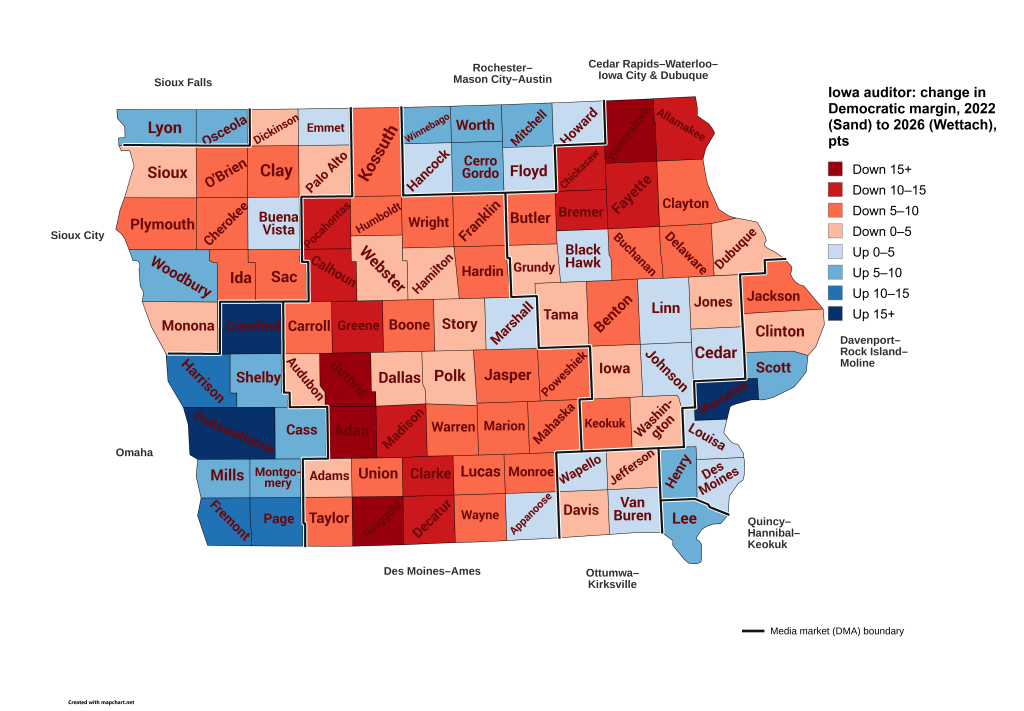
It can’t be a coincidence that Wettach massively overachieved within the borders of the Omaha and Rochester designated market areas (DMAs, the geographic boundaries of local television affiliates) while doing worse in every county bordering them. He outraised his opponent, and it’s possible that she just wasn’t able to advertise as much outside of Des Moines, Sioux City and Cedar Rapids — three markets that are either mostly or wholly contained in Iowa.
It’s also possible that Democrats overachieved in the Omaha market because it’s Senator-elect Josh Turek’s base, and in the Rochester market because it’s familiar with Rob Sand (who’s from that blood red county just outside its border). So it’s possible that Democratic overperformance is due to earned and not-paid-media advantages for top-ticket candidates. But even if the change isn’t due to a disparity between advertising strategies, it shows that linear TV still matters.
I also highlighted the seven state House districts that Democrats would have needed to flip in order to get a majority — they were around 1,000 votes changing away from getting the speaker’s gavel. You can see that a lot of these fringe districts take in significant rural turf outside major cities, or around college towns. So a House majority might hinge on whether the war in Iran is dragging into its third year at that point, continuing to spike diesel and fertilizer prices.
In sum, Iowa Democrats seem to have a winning statewide formula in their grasp with an emerging coalition of formerly Republican suburbs and small, blue collar cities that used to be Democratic. But winning a trifecta might have to wait until after the next Census, when new legislative maps might further empower those suburbs where they made most of their improvements.
What divided government means
Rob Sand knew going into the election that he likely wouldn’t have a Democratic legislature to work with, so he prepared a number of proposals that could win over Republican support. That includes putting limits on data centers, restricting school vouchers and legalizing marijuana.
Sand’s victory could also reverberate to the United States Capitol. Iowa’s senior senator, Republican Chuck Grassley, is 93 years old. And under Iowa law, the governor would appoint his replacement if he dies before his term ends in January 2029, with no restrictions on their party or input from the legislature. Republicans have balked at changing the state law around the appointment before Sand takes office, so keep an eye on that developing situation.
Schadenfreude, Iowa edition
Heartland Signal has already covered the exploits of Republican gubernatorial nominee Zach Lahn, but did you know his running mate, Derek Wulf, was credibly accused of being a pig thief? Or that Attorney General Brenna Bird flew to New York to provide moral support to Donald Trump during his hush money trial? Or that state Sen. Caitlin Drey won re-election over a J6 truther? Good news, you don’t have to know those things any more, because they all lost.
How we used AI: Aaron Kleinman used Claude to generate the above maps, either natively from .csv files of official results or by generating .txt files for the Mapchart website. Then he used Claude to overlay a DMA map on it.
Heartland Signal encourages news organizations and content creators to use our content. You're welcome to republish this article for free as long as you follow our republishing guidelines.
Related Articles
Radio Free America: It’s the perfect time to think long term
Democrats have a mandate to lower costs. The good news for them, writes Aaron Kleinman, is that the most obvious policies to pursue will kick in right after the next presidential election
What happened in… Wisconsin? Democrats take full control
For the first time since 2010, Democrats will control the governorship and state legislature in Wisconsin. We look into how they did it and what it means for the Badger State and beyond.
Radio Free America: Project REDMAP is dead
The 2026 elections resulted in a wipeout for Republicans at the state level, and with it their power over redistricting. Aaron Kleinman argues that this is proof that it’s time for them to come together with Democrats and pass a national gerrymandering ban.