
Whitmer’s final State of the State speech to include pitches on medical debt, housing reforms
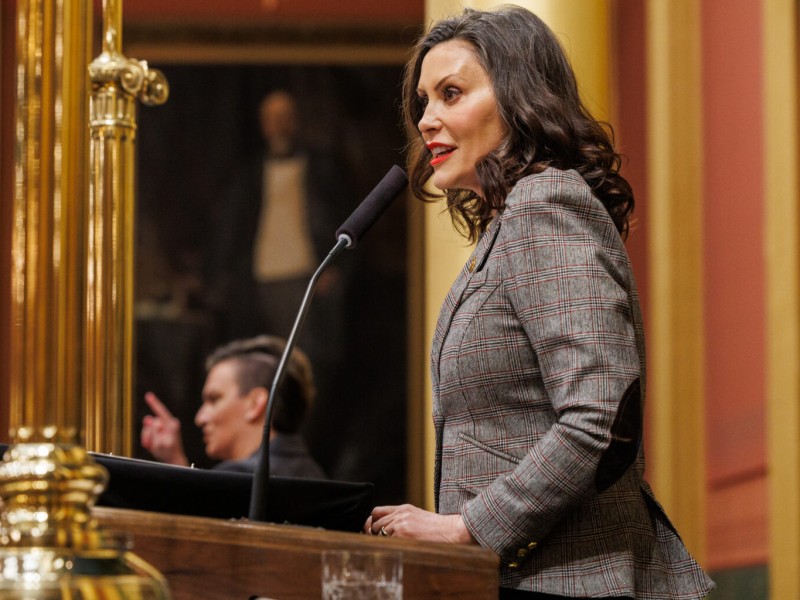
Gov. Gretchen Whitmer will highlight her record after nearly a decade in office as Michigan’s chief executive Wednesday evening, but don’t expect the governor’s eighth and final State of the State address to be just another greatest hits compilation.
The governor’s office has said that her address at 7 p.m. on Wednesday will lay out plans to build on past accomplishments, with proposals on creating jobs, lowering costs and continuing record-level investments in education and literacy.
Multiple sources told Michigan Advance on Tuesday and Wednesday that the governor’s speech might include a few bold policy pitches for her last year in office, including a plan to ease the burden on residents’ medical debt, support for a set of bipartisan housing reforms that were recently introduced, and education policies in line with what Whitmer proposed in her 2026-27 fiscal year budget plan.
On the health care front, an excerpt of Whitmer’s speech obtained by the Advance shows that she plans to attack medical debt by capping interest rates on that debt, while also preventing medical debt from showing up on residents’ credit reports. Whitmer also plans to pitch a requirement for hospitals to set up financial assistance programs for patients, and banning liens or foreclosures on homes due to that medical debt.
Whitmer is also expected to call on Congress to extend the now-expired Affordable Care and Patient Protection Act subsidies that the Republican majority let lapse at the turn of the year. Whitmer has long said that doing so would lower costs and protect coverage for thousands of Michiganders.
On the housing front, Whitmer has been meeting with the bipartisan and bicameral group of lawmakers behind a push to reform the state’s zoning laws as a way to spur affordable new single-family home developments and make housing more attainable for more Michiganders.
One of the key lawmakers behind that push is state Rep. Joseph Aragona (R-Clinton Township). He told the Advance in an interview that he met with Whitmer on Tuesday to discuss that proposal and that they had her support.
“In a divided government, that obviously helps, right? I know we disagree on a lot of stuff, but I appreciate the fact that she’s willing to reach across the aisle on this,” Aragona said. “Honestly, the conversations that I’ve had with her, she seems appreciative that there’s a group of us that are willing to reach across the aisle, as well, and just kind of pull politics aside and just try and get this job done.”
Aragona said housing is already a complex enough issue and that petty politics won’t help either side get to the real meat of the matter: making housing accessible for as many residents as possible.
“This isn’t a niche issue anymore.” Aragona added. “When housing prices go up a little bit, some people get priced out of the market. I think some, around 80% of Michiganders, think that we should have some type of smaller home being built that’s available and less expensive, and a lot of these, especially younger people, are feeling the pinch on trying to get their first home or even renting. It’s driving up all the other costs and all the other prices, just because of what the markets are doing. It’s a tough situation.”
At present, the bills have Whitmer’s support and a glowing nod from House Speaker Matt Hall (R-Richland Township), who told reporters last week that the bills fit into his overall plans to reduce tax burdens on residents, which includes some focus on real estate taxes.
The housing reform bills, however, have met some opposition from the Southeast Michigan Council of Governments. The group held a press conference on Tuesday and said the solution was too “one-size-fits-all” to work effectively.
Aragona said he gets it, that local governments want to have as much control as possible, but at the same time, there has to be room for personal property rights.
State Sens. Kevin Hertel (D-St. Clair Shores) and Darrin Camilleri (D-Trenton) told the Advance on Wednesday that spectators should expect Whitmer to continue to focus on early childhood education and improving literacy.
Camilleri said that Whitmer may refocus her efforts on securing free breakfast and lunch programs this year in the budget process again, setting an early stage for that issue as a major battle while the Republican-controlled House and the Democratic-led Senate prepare to duke it out once again over how money flows across the state.
In that regard, Camilleri said he doesn’t expect Whitmer to deviate from that agenda.
“We’ve been very consistent on changing a lot of things during her time in office, and we do know that literacy is still a hot topic, in particular for her, but we’ve also done a lot of work on the literacy front the last couple of years,” he said.
Hertel also said that he expects the housing piece to get some of the spotlight this evening, because housing costs are affecting people from all walks of life across the state.
“We need to build more homes. The governor talked about that in previous State of the States, that we need to focus on reducing some of that red tape and make sure that we are building more affordable housing across the state of Michigan,” Hertel said. “And that’s something that the seven Democrats have focused on over the last few years as well, both from a budgetary standpoint, and working on legislation like my bill that changed the land division act so that lots became available to build on here in the state of Michigan.”
Despite some of the battle lines on the budget being pretty firmed up before the House and Senate have even made their formal 2026-27 fiscal year proposals, Hertel said he expects Whitmer to potentially play toward the middle and reissue her proclamation that she’s willing to work with anyone — whether that’s Hall, Senate Majority Leader Winnie Brinks (D-Grand Rapids, or even President Donald Trump — to ensure Michigan has a bright future.
“Whether that’s here in the state of Michigan, or making sure we pass the bipartisan budget that has delivered for communities across the state, but also in Washington, D.C.,” Hertel said. “What I want to see the governor point to, and really, as we get down through this budget process, is encouraging people to put the rhetoric aside. There’s no doubt it’s an election year, and so there’s always a lot of politics involved, but we’ve got to put that stuff aside and actually get it done and deliver for the residents that we serve. And the governor has done a really good job of that in the past.”
Michigan Advance is part of States Newsroom, a nonprofit news network supported by grants and a coalition of donors as a 501c(3) public charity. Michigan Advance maintains editorial independence. Contact Editor Jon King for questions: info@michiganadvance.com.
This article, “Whitmer’s final State of the State speech to include pitches on medical debt, housing reforms,” has been republished from the Michigan Advance under Creative Commons license CC BY-NC-ND 4.0.
Heartland Signal encourages news organizations and content creators to use our content. You're welcome to republish this article for free as long as you follow our republishing guidelines.
Related Articles
Michigan budget moves Rx Kids funding, but $18M remains in play
The Legislature shifted the money out of a dedicated appropriation, but the budget leaves room for competing interpretations.
Pillen memo calling for 5% cut across Nebraska agencies raises questions about governor’s authority
For the University of Nebraska, a 5% cut could subtract $36 million from its newly approved operating budget

PA legislature wrestles with how to handle data center developments
State legislators in Harrisburg have largely resisted any comprehensive regulation, on data centers, instead focusing on piecemeal, largely bipartisan efforts.